A spring cleaning checklist is a room-by-room plan for the deep clean you put off all year — the one that empties cabinets, degreases the range hood, and defrosts the fridge, not the counters you already wipe on a Tuesday. It is not a weekly schedule with more items on it. It is a different list entirely: fewer tasks per room, but every task reaches somewhere a normal clean never goes.
This guide shows how to build one, then walks through the three shapes it takes — a whole home, an office, and a move-out pass. You can adapt the spring cleaning checklist template, edit the rooms and tasks in the browser, or print it and tape it to the fridge.
What a spring cleaning checklist should achieve
A spring cleaning checklist is not the same as your regular chore list. The chore list keeps the house livable; the spring list makes it feel new. The difference is depth. Where the weekly pass wipes the visible counters and vacuums the middle of the floor, the spring pass opens the cabinets, moves the fridge, and washes the curtains.
A useful checklist should produce five outcomes:
- every room has its own row of deep tasks, not a single catch-all "deep clean" line;
- each task names its tool and a rough time, so the day stays realistic;
- the hidden surfaces are written down explicitly — cabinet tops, behind appliances, grout, baseboards;
- each room has an owner, so the whole thing is a team effort rather than one person's marathon;
- the order works top to bottom and room by room, so dust from an early room doesn't settle on a later one.
The moment your spring list starts to look like your weekly list is the moment it stops being a spring list. If you can finish the whole thing with your usual Tuesday supplies, you are re-cleaning, not cleaning deeper.
How to build a room-by-room spring cleaning checklist
The clean that works is the one you can hand to another person. Build the list around that test: could someone else walk in with this grid and do the rooms correctly without asking you twenty questions? If not, add the tool and the order.
1. List the rooms, then the once-a-year tasks
Start with the rooms, not the tasks. For most homes that is kitchen, bathroom, living room, and bedroom. Under each room, write the tasks you have been putting off all year — the ones that never make the weekly list. Emptying the cabinets, not wiping them. Defrosting the fridge, not just tossing expired food.
2. Put a tool and a time on every task
A task without a tool stalls the moment you start it. "Degrease the range hood" needs a degreaser and a cloth; "descale the shower head" needs vinegar and a zipper bag. Writing the tool next to the task means you can gather everything in one trip instead of ten. The rough time keeps the day honest — forty-five minutes for the cabinets, twenty for the shower head.
3. Order the rooms so you clean in one pass
Work top to bottom within each room — shelves before floors — and order the rooms so dust from one doesn't settle on the last. Most people clean kitchen first, then bathroom, then living room, then bedroom, but the real rule is just: go high before low, and keep moving in one direction.
4. Assign each room to a person
A whole-home deep clean done alone is how the last two rooms get skipped. Give each row an owner, and give each owner a time slot. The grid makes this obvious — a row is a hand-off. When four people each take a row, the weekend stays short.
5. Write the hidden surfaces explicitly
The visible surfaces clean themselves out of habit. The hidden ones — cabinet tops, the top of the fridge, behind the washing machine, the grout, the baseboards — are what actually define a spring clean. List them on the grid or they will be quietly skipped again.
6. Check off only when the surface is empty
The honest checkmark comes when the cabinet is empty, the appliance is pulled out, and the surface is wipeable. Checking "kitchen" because you wiped the counters is how the list fills up while the fridge stays frosted. One cell, one finished surface.
Whole-home deep clean example
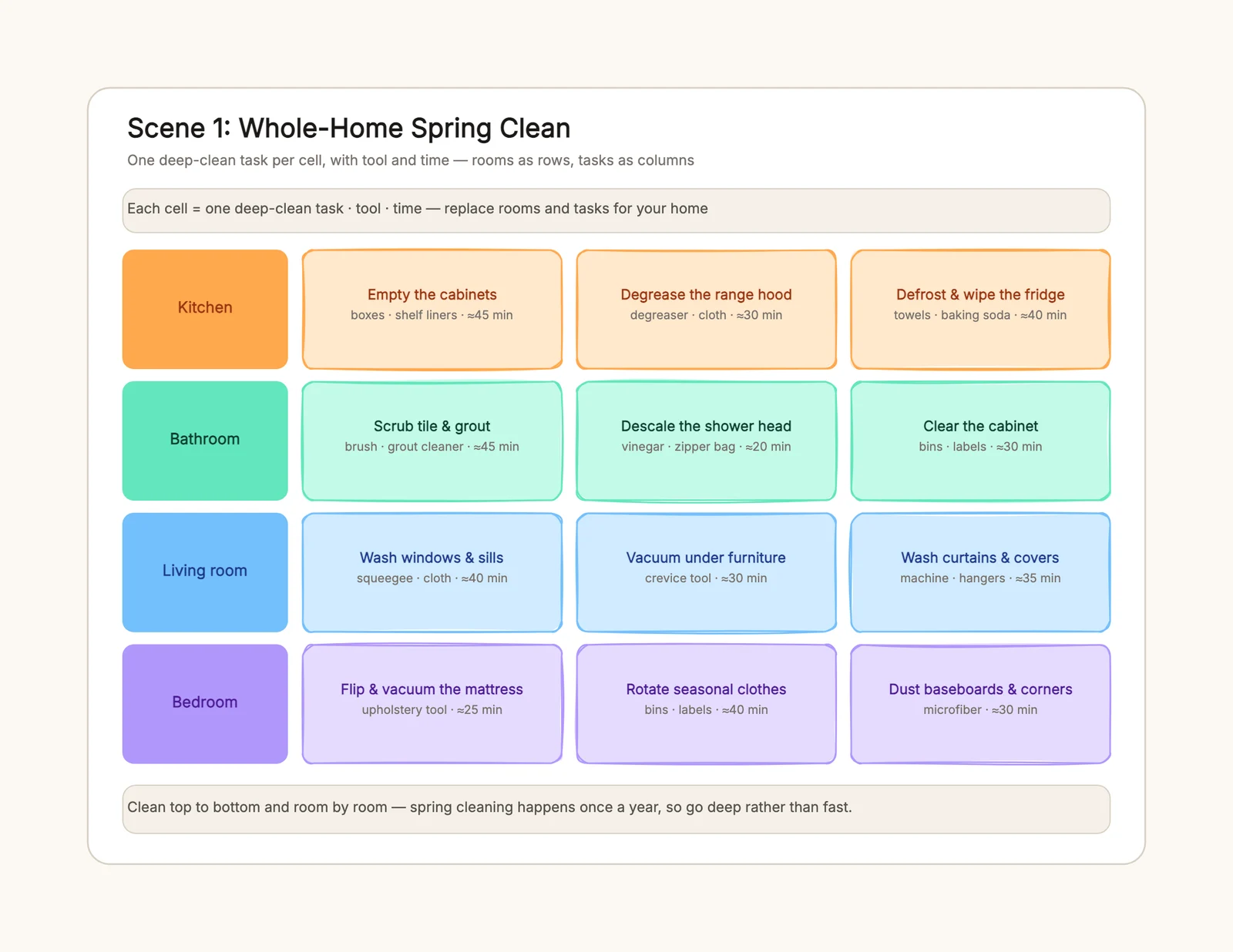
A whole-home spring clean usually covers four rooms, three deep tasks each. The kitchen row is the one that defines the day: empty the cabinets and wipe the shelves, degrease the range hood, then defrost and wipe the fridge. That single row is worth more than an hour of wiping counters, because it resets the room rather than touching it up.
The bathroom row is grout and limescale — scrubbing tile and grout with a brush, descaling the shower head by soaking it in vinegar, and clearing out the cabinet of half-empty bottles. The living room row is everything you can't reach with a normal vacuum: washing the windows and sills, vacuuming under the furniture with a crevice tool, and washing the curtains and cushion covers. The bedroom row is the mattress flip, the seasonal clothes rotation, and the baseboards.
The mistake that eats a whole-home day is starting with the room you look at most. Start with the kitchen and get the worst row done while the energy is there; the living room curtains can wait until the afternoon.
Office spring clean: what changes
An office clean changes the rows from rooms to work zones. The four zones that matter are desks and IT, the kitchenette, the meeting room, and reception. The dust is the same; the objects are different.
Desks and IT means wiping monitors and keyboards with compressed air, tidying the cable runs with ties and labels, and clearing drawers. The kitchenette is usually the worst part of any office — the shared fridge nobody claims, the microwave, and the counters. The meeting room is the screen and whiteboard, the table and chairs, and the floor. Reception is the front desk, the glass doors, and the welcome area.
The office mistake that costs the most is the shared fridge. Someone has to own it: empty it, wipe the shelves, and label anything left with a name and a date. A fridge nobody owns is a fridge that stays dirty until someone quits.
Move-out deep clean: what changes again
A move-out clean is the same grid with one more column. Where the whole-home version uses three tasks per room, the move-out version uses four, because this is the pass a landlord or the next tenant actually inspects. Every surface has to be empty and wipeable — from inside the cabinets to behind the fridge.
The kitchen grows a fourth task: after emptying the cabinets, degreasing the oven and range hood, and cleaning behind the fridge, you mop the floors and baseboards. The bathroom adds the mirror and the toilet as its own tasks. The bedrooms add the walls and the hook holes — remove every hook and patch the holes so the walls look new. The living room and hallway add the doors and handles, then the edges and corners, then a final mop.
For more on what comes after the keys are handed over, the new home checklist template covers the move-in checks on the other side.
Common spring cleaning mistakes
Cleaning only what you can see
The counters get wiped and the top of the cabinets stays dirty for another year. A deep clean is defined by the hidden surfaces. If they are not on the list, they will not get cleaned.
No tool or time per task
Without a tool and a rough time, the day balloons and half the tasks stall waiting for supplies. Put both on every cell before you start, and gather everything in one trip.
Treating it like the weekly routine
If your spring list looks like your weekly schedule, you are re-cleaning instead of cleaning deeper. The test is simple: if your usual Tuesday supplies can finish the task, it belongs on the weekly list, not the spring one.
Doing it alone in one day
A whole-home deep clean is a team job. Assign rooms to people and split it over a weekend, or the last rooms will be skipped when you run out of steam.
No order to the rooms
Cleaning out of order means dust from the first room settles on the last. Work top to bottom within a room and room by room across the house, in one pass.
Keep the checklist useful over time
After the clean, note what you missed and what took longer than the grid said, so next year's list starts more accurate. Keep the grid somewhere reachable — printed on the fridge or saved in a doc — and reuse it next spring, swapping tasks for whatever the year actually dirtied.
Start with the spring cleaning checklist template, replace the rooms and tasks with your own, and print it before you start. The upkeep between deep cleans belongs on the weekly cleaning schedule template, and once the house is spotless, the moving checklist template helps you pack the rooms you just emptied.