If you work in software, you've heard both words so many times they've blurred together: "We're Agile." "We do Scrum." "We're an Agile Scrum team." The Agile vs Scrum question comes up in every team that's trying to get better at building software — and people toss them around as if they're synonyms. They're not. Confusing the two leads to teams running Scrum ceremonies without an Agile mindset, wondering why nothing actually improved.
This article untangles what Agile and Scrum actually mean, how they relate, and — more importantly — which one your team actually needs right now.
Agile Is a Mindset, Not a Process
In 2001, seventeen software developers met at a ski resort and wrote four sentences that changed how the industry builds software. The Agile Manifesto says:
- Individuals and interactions over processes and tools
- Working software over comprehensive documentation
- Customer collaboration over contract negotiation
- Responding to change over following a plan
That's it. No standups. No sprints. No story points. Agile is a value system — a belief that software projects work better when you ship early, talk to users, and adapt as you learn.
You can be Agile without ever touching a Scrum board. A solo developer who ships a feature every Friday, shows it to three users, and rewrites the worst parts based on their feedback is practicing Agile. No framework required.
Scrum Is a Specific Recipe
Scrum takes Agile principles and turns them into a concrete structure. It was formalized by Ken Schwaber and Jeff Sutherland in the 1990s, refined through real projects, and documented in the Scrum Guide.
Scrum prescribes three roles, five events, and three artifacts:
Roles:
- Product Owner — decides what to build and in what order
- Scrum Master — coaches the team on Scrum practices and removes blockers
- Developers — the people building the product (not just coders; anyone contributing to the increment)
Events (the "ceremonies"):
- Sprint — a fixed timebox (usually 1-4 weeks) to deliver a working increment
- Sprint Planning — the team decides what to build this sprint
- Daily Scrum — a 15-minute sync, not a status report
- Sprint Review — show stakeholders what was built, get feedback
- Sprint Retrospective — the team inspects how they worked and picks one improvement
Artifacts:
- Product Backlog — the ordered list of everything the product might need
- Sprint Backlog — what the team committed to this sprint, plus a plan
- Increment — the working, usable result of the sprint
Scrum is explicit. Agile is abstract. That's the core difference.
Where People Get Confused
The confusion happens because Scrum is by far the most popular Agile framework. The 2024 State of Agile Report shows that 87% of organizations practicing Agile use Scrum or a Scrum hybrid. When "Agile" comes up in a job description or a meeting, nine times out of ten they're talking about Scrum.
This creates a false equivalence: "We do standups and sprints, so we're Agile." Not necessarily. A team can run perfect two-week sprints with story points, burndown charts, and retrospectives — and still deliver features nobody asked for, ignore user feedback, and resist changing direction. That team is doing Scrum. It is not being Agile.
The opposite is also true. A team with no ceremonies, no Product Owner, and no backlog can be deeply Agile — shipping every few days, talking to customers daily, pivoting when data says to pivot.
Agile Without Scrum: Kanban, XP, and "Just Ship It"
Scrum is not the only way to practice Agile. Here are three common alternatives:
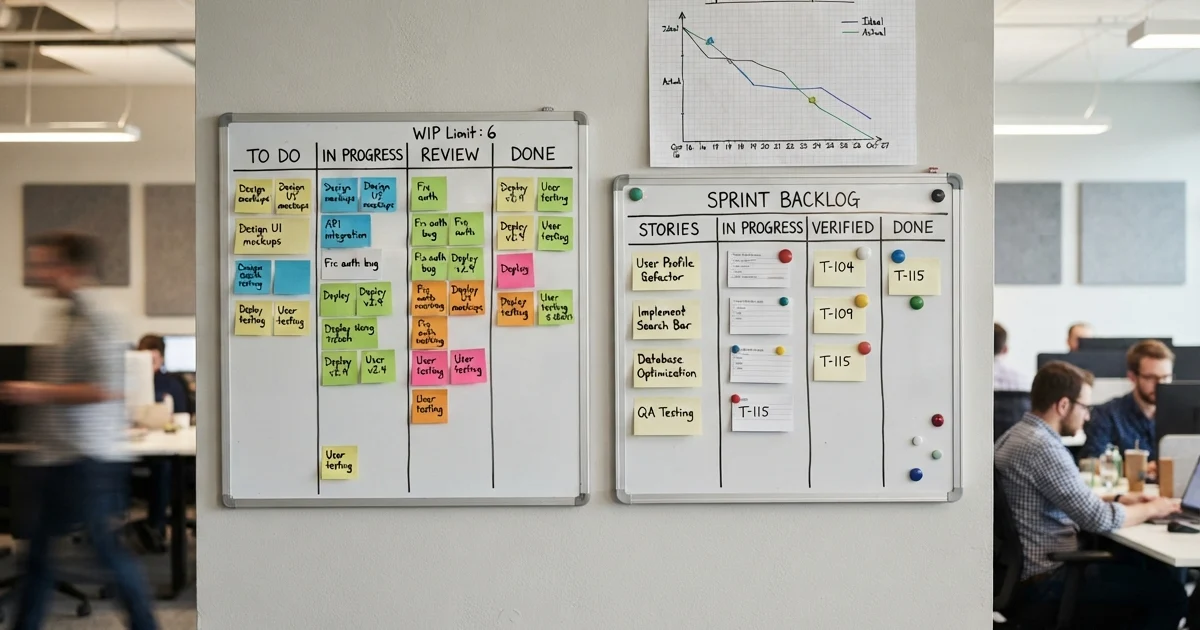
Kanban. Instead of time-boxed sprints, Kanban uses a continuous flow model. Work items move across a board (To Do → In Progress → Done) with a limit on how many items can be in each column. Kanban works well for teams whose work arrives unpredictably — support teams, ops teams, or any team where "planning two weeks ahead" is a fantasy. CodePic has a Kanban template if you want to set one up in 30 seconds.
Extreme Programming (XP). XP focuses on engineering practices: pair programming, test-driven development, continuous integration, and frequent small releases. XP and Scrum are often combined — Scrum provides the management structure, XP provides the technical practices.
"We don't use a framework." A surprising number of effective teams practice Agile without naming it. They ship small, talk to users, reflect periodically, and skip the ceremony. For teams under 5 people, this is often the highest-performance approach — less overhead, more building.
Specific Scenarios: What Would I Use?
A 6-person startup building an MVP. Agile principles, no named framework. Two-week check-ins to decide what to build next. No Scrum Master, no story points, no sprint review deck. Just a shared board, a backlog of ideas, and frequent user conversations.
A 25-person product team in a scaling company. Scrum. The structure that feels heavy for a startup becomes necessary when you have multiple squads, dependencies, and stakeholders who need visibility. A good Scrum Master here pays for themselves by keeping ceremonies useful instead of ceremonial — fifteen-minute standups that actually take fifteen minutes, retrospectives that produce one real change instead of a list of wishes.
An ops team handling incoming requests. Kanban. Work doesn't come in two-week batches — tickets land continuously. A Kanban board with WIP limits prevents the team from being overloaded. Sprint planning makes no sense when you don't know what Tuesday afternoon looks like.
A remote team of 12, spread across six time zones. Agile principles with lightweight async ceremonies. Replace the daily standup with a Slack thread. Replace the sprint review with a Loom video and a shared doc. The values are the same; the practices adapt to the constraints.
The Board Matters More Than the Framework
Here is something most methodology debates miss: the physical act of making work visible — on a whiteboard, a wall, or a digital canvas — does more for team alignment than any framework choice.
A sprint backlog scribbled on a whiteboard is seen. A Kanban board in the team's line of sight gets updated. A retrospective template with columns for "Start / Stop / Continue" turns vague frustration into concrete action items.
CodePic's whiteboard templates give teams a place to do this — Sprint Planning, Retrospective, and Kanban boards that open in one click. No Jira account, no Confluence space, no setup overhead. Just a canvas.
Bottom Line
Agile is the "why" — ship early, listen to users, adapt.
Scrum is one "how" — sprints, standups, retrospectives, defined roles.
A team that internalizes the "why" will figure out the "how." A team that copies the "how" without the "why" will fill two weeks with ceremonies and deliver nothing users want.
Start with the principles. Add structure when the team asks for it — not before. The best Agile implementations do not start with a framework purchase or a certified Scrum Master. They start with a team that cares about shipping better software and gradually adopts practices that make their specific problems visible and solvable. The framework is the result of the process, not the starting point. Start with principles, add practices when you feel the pain of not having them.