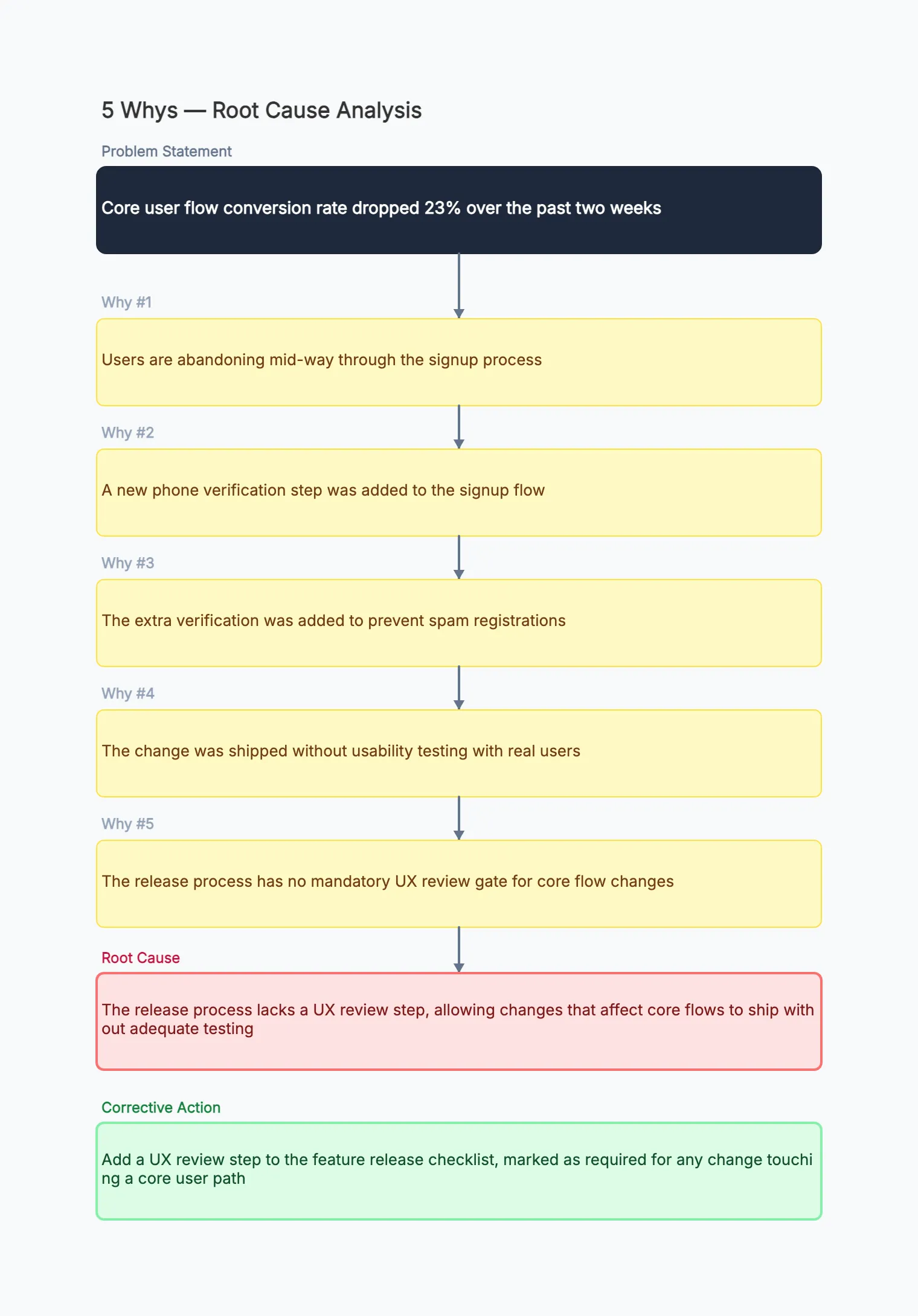
A 5 Whys template gives you a simple, repeatable structure for root cause analysis. Instead of treating symptoms — fixing the same problem every week — you trace the causal chain backward until you find the real source. The format is deceptively simple: start with the problem, ask "why?" five times, and the answer to the fifth why is usually the root cause.
The technique was developed by Sakichi Toyoda, founder of Toyota Industries, and became a core tool in the Toyota Production System. Its genius is that it requires no data, no statistics, and no training — just the willingness to keep asking why instead of accepting the first answer.
If you want to start with a ready layout, open the free 5 Whys template. It comes pre-filled with a business example showing a complete chain from problem to root cause to action. This guide explains how to run a 5 Whys session that produces real results, not just a filled-in template.
When to Use the 5 Whys
The 5 Whys works best for problems that are specific, recurring, and have a human or process component. It is less useful for complex problems with multiple interacting causes — those need a fishbone diagram or a more structured root cause analysis method.
Use the 5 Whys for:
- Recurring incidents: a deployment fails every other week, a customer reports the same bug, a machine jams at the same step
- Process breakdowns: approvals get stuck, handoffs fail, deadlines slip for the same reason
- Team friction: communication breakdowns, missed expectations, recurring conflicts
- Quality issues: defects that keep appearing despite fixes
- Customer complaints: the same complaint from different customers, suggesting a systemic issue rather than a one-off
Do not use the 5 Whys for one-time accidents (investigate, but the root cause framework may be overkill), purely technical failures with a known cause (a server crashed because the disk was full), or problems where blame is the real agenda (5 Whys requires psychological safety).
How to Run a 5 Whys Session
Step 1: Write the problem statement
Be specific. "The project is behind schedule" is too vague. "The Q3 release missed the September 30 deadline by 12 days" is specific. A good problem statement describes what happened, when, and the measurable impact.
Step 2: Ask the first why
Ask: "Why did this happen?" Write the answer directly below the problem. The answer should be a factual cause, not a blame statement. "Because the engineering team was slow" is blame. "Because the database migration step took 8 days instead of the estimated 3" is a cause.
Step 3: Ask why again
Take the answer from step 2 and ask "Why did that happen?" Write the next answer below. Continue this chain. Do not jump to conclusions — let each answer suggest the next question.
Step 4: Stop when you reach an actionable root cause
You have reached the root cause when the answer is something you can fix with a concrete action. "Because our hiring process is slow" is not actionable enough. "Because we have no automated test for migration rollback, so every migration is done manually by one person who was on leave" is actionable.
Step 5: Define the countermeasure
For the root cause, write a concrete action that will prevent the problem from recurring. Assign an owner and a deadline. The template has a dedicated Action field for this.
A Complete 5 Whys Example
Here is the example pre-filled in the free 5 Whys template:
Problem: Customer support response time increased from 4 hours to 18 hours in Q3.
Why 1: Why did response time increase? → Because the support queue grew 3x while the team size stayed the same.
Why 2: Why did the queue grow? → Because a new product launch generated 200+ tickets per day that should have been handled by the self-service knowledge base.
Why 3: Why didn't the knowledge base handle those tickets? → Because the KB articles for the new product were not published until two weeks after launch.
Why 4: Why were the KB articles delayed? → Because the product team did not provide final feature documentation until the day before launch.
Why 5: Why didn't the product team provide documentation earlier? → Because the launch checklist did not include "deliver KB-ready documentation to support team" as a step.
Root Cause: The product launch checklist lacks a support-readiness step.
Action: Add "Deliver KB documentation to support team 1 week before launch" to the product launch checklist. Owner: Product Ops. Deadline: Before next launch cycle.
This example shows why the 5 Whys is valuable: the surface problem was "support is slow," but the root cause had nothing to do with the support team. Without the 5 Whys, the company might have hired more support agents — expensive, and it would not prevent the same problem from happening at the next launch.
Common 5 Whys Mistakes
Stopping too early. Teams often stop at Why 2 or Why 3 because the answer feels actionable. But if the answer is still a symptom of something deeper, you have not reached the root cause. Ask: "If we fix this, will the problem stay fixed?"
Asking why about people instead of processes. "Why did Bob make a mistake?" leads to blame, not improvement. "Why was it possible for one person's mistake to cause a production outage?" leads to process fixes.
Getting different answers from different people. If team members give conflicting answers at the same why level, you may have multiple contributing causes. That is fine — note each branch and investigate separately. A 5 Whys can branch into multiple chains.
No follow-up action. A 5 Whys without a countermeasure is just an intellectual exercise. The Action field in the template is not optional.
5 Whys Template vs. Fishbone Diagram
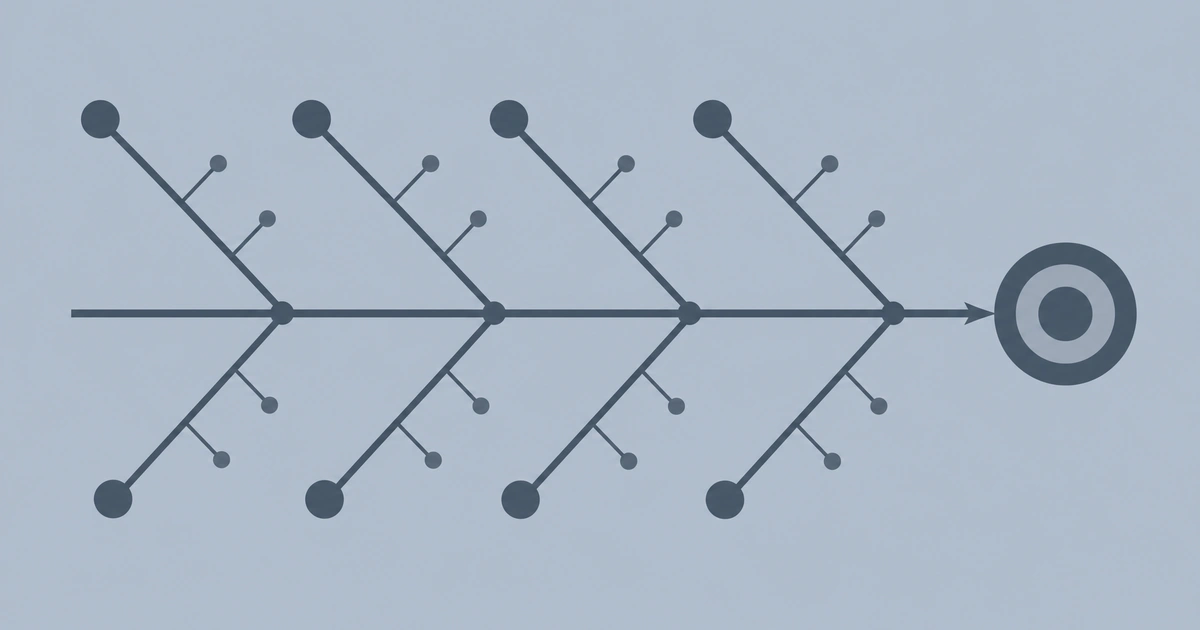
The 5 Whys and fishbone diagram are both root cause analysis tools, but they work at different depths. A fishbone diagram is useful when you do not yet know which category of cause matters. It spreads the investigation across people, process, equipment, materials, environment, measurement, or your own custom categories. The 5 Whys is useful after you pick one likely cause and need to drill deeper.
For example, if customer complaints increased, a fishbone diagram might reveal possible causes in support staffing, product documentation, CRM performance, and satisfaction survey timing. After discussion, the team might decide that delayed product documentation is the most likely cause. That is where the 5 Whys begins:
- Why did complaints increase? Because users could not find answers for new features.
- Why could they not find answers? Because knowledge base articles were missing.
- Why were articles missing? Because support received docs too late.
- Why did support receive docs too late? Because the launch process did not include a documentation handoff.
- Why was the handoff missing? Because support readiness was never part of the launch checklist.
The fishbone gives you breadth. The 5 Whys gives you depth. If you skip breadth, you may drill into the wrong cause. If you skip depth, you may list many causes but never reach an action.
What Makes a Good 5 Whys Countermeasure
The countermeasure is the part teams most often underwrite. "Improve communication" is not a countermeasure. It is a wish. A good countermeasure changes the system so the same problem is less likely to recur.
Good countermeasures are:
- Specific: "Add support-readiness checklist item to launch template" is better than "coordinate earlier."
- Owned: one person or team is responsible.
- Dated: the action has a deadline.
- Preventive: it stops recurrence rather than only cleaning up the current incident.
- Verifiable: you can check whether it happened.
For the support response example, "hire more agents" might reduce the queue temporarily, but it does not prevent future launches from missing documentation. "Add KB-ready documentation handoff one week before launch" directly addresses the root cause. When you use the template, treat the Action box as the most important part of the diagram, not an afterthought.
One practical way to improve the action is to write it as a small experiment rather than a permanent policy. For example: "For the next two product launches, require the product manager to attach a documentation checklist before release approval." That makes the fix concrete, reversible, and easy to inspect. If the checklist prevents repeated support tickets, you can standardize it. If it adds friction without reducing tickets, you can adjust the handoff instead of pretending the problem is solved.
The template should also capture evidence. Add the ticket count, defect rate, delay time, or customer quote that proved the problem existed. Root cause analysis is much stronger when the team can revisit the diagram later and see why a cause was chosen. Without evidence, 5 Whys sessions often drift toward the loudest opinion in the room.
Start with the Free 5 Whys Template
The 5 Whys template takes 15 minutes to fill and often saves hours of treating the wrong problem. Open the free 5 Whys template, replace the pre-filled example with your own problem, and trace the chain to its real root.