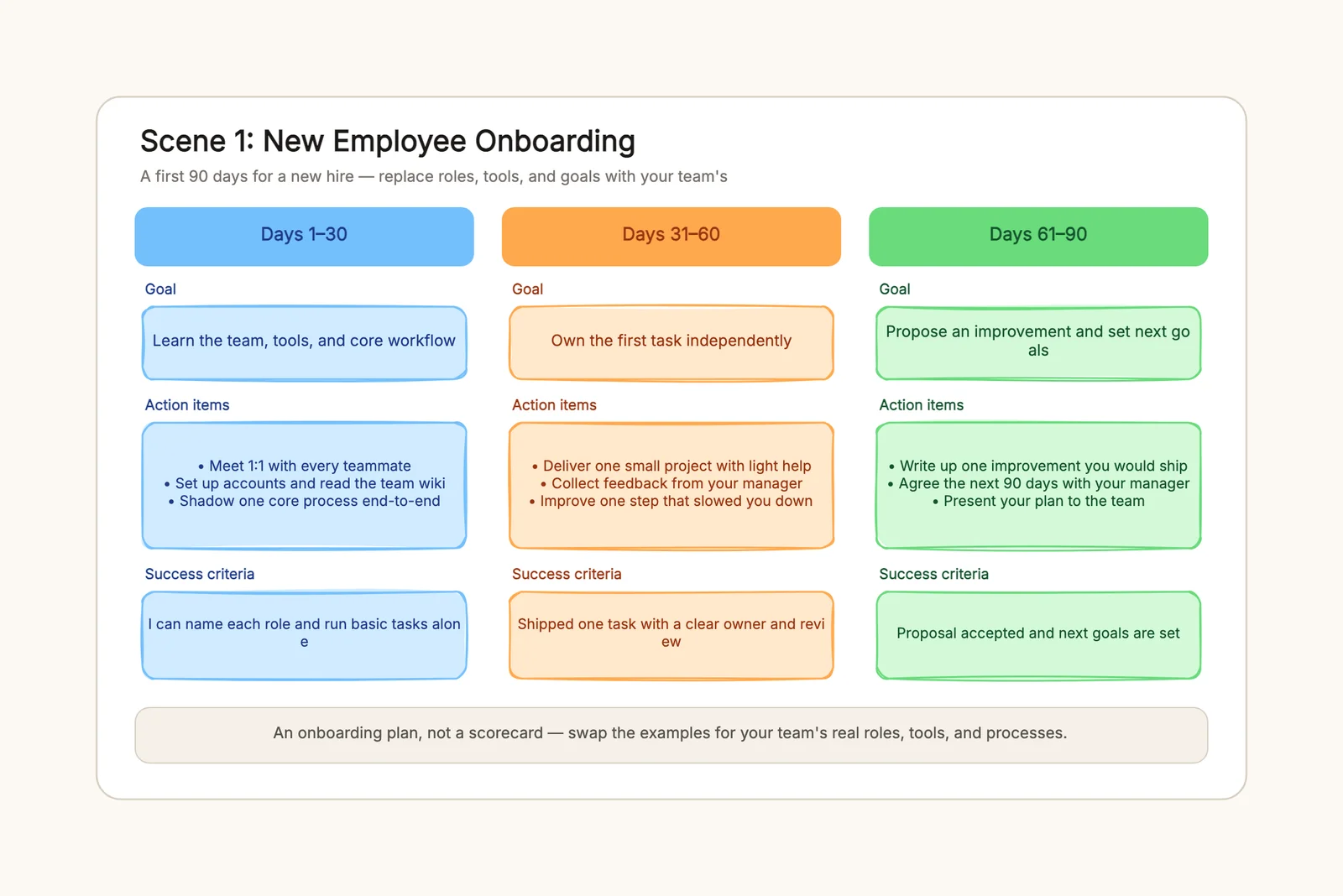
A 30-60-90 day plan is a three-phase ramp that breaks a new hire's first quarter into learn, contribute, and improve. Instead of one long list titled "onboarding," it gives the employee and their manager a shared answer to the question both of them are quietly asking: what does good look like by day 30, day 60, and day 90?
This guide walks through how to build one in six steps, then shows what the plan looks like for a new hire, a promotion, and a sales role. You can adapt the 30-60-90 day plan template and edit the goals, actions, and success criteria directly in the browser.
What a 30-60-90 day plan should achieve
A 30-60-90 day plan is not a to-do list with ninety boxes. It is a ramp organized around time, where each phase has a different job. The first 30 days are for learning — the team, the tools, the vocabulary, and the unwritten rules of how work actually gets done. The middle 30 days are for contributing — taking a real task from start to finish with only light help. The last 30 days are for improving — stepping back to propose a change and agree on what comes next.
A useful plan should produce five outcomes:
- the employee knows exactly what to learn in the first 30 days, and where to find it;
- the manager knows which first task the employee will own, and by when;
- each phase has a success criterion that a third party could verify;
- the plan names real tools, people, and tasks instead of generic placeholders;
- there is an agreed review point at the end of each 30-day phase.
The reason the 30-60-90 split works where a flat checklist fails is that it forces progression. A checklist tells you what to complete; a 30-60-90 plan tells you what to complete and what that completion proves. "Finish the product training" is a checkbox. "Run a discovery call alone by day 30" is a milestone.
How to build a 30-60-90 day plan
The most useful plan is built for one specific person and one specific role, not pulled whole from a library. The six steps below get you from a blank canvas to a plan both sides can actually use.
1. Start with the role, not the template
Write down the role and what "fully ramped" means for it, in plain sentences. For a developer that might be "ships a feature independently." For a seller it might be "runs a full sales cycle solo." This sentence is the destination; the three phases are just the route to it. If you skip this step, the plan becomes a generic onboarding checklist with the employee's name on it.
2. Split 90 days into three phases
Divide the quarter into days 1–30, days 31–60, and days 61–90. Give each phase a verb: learn, contribute, improve. The verbs matter more than the day numbers, because they set the tone of each phase. Days 1–30 are deliberately low-stakes; days 31–60 are where ownership begins; days 61–90 are where the employee starts shaping the job instead of just doing it.
3. Write one goal per phase
Each phase gets exactly one goal, written as an outcome rather than an activity. "Learn the team, tools, and core workflow" is a goal; "read the wiki" is an activity that serves it. One goal keeps the phase focused. When a phase tries to carry three goals, the employee cannot tell which one matters when time runs short.
4. Add the action items
Under each goal, list three action items — the concrete moves that get there. For the learning phase, those might be meeting every teammate one-on-one, setting up accounts and reading the team wiki, and shadowing one core process end to end. Keep the list to three; more than that and the actions become a second checklist competing with the goal.
5. Add success criteria
This is the step most plans skip, and the one that makes the rest of it real. A success criterion says how both sides will know a phase is finished: "I can name each person's role and run basic tasks alone," or "a qualified pipeline and the first closed deal." Write it so a third party could check it off without asking for an opinion.
6. Agree a review rhythm
Fix a check-in at the end of each 30-day phase. Draft days 1–30 in full detail, keep days 31–60 and 61–90 lighter, and update them at each check-in based on what actually happened. A plan that is never revisited drifts from reality within the first two weeks.
New employee onboarding example
For a new employee, the arc is the classic one: learn, then own, then improve. Days 1–30 are about the team and its workflow — meeting every teammate one-on-one, setting up accounts, reading the team wiki, and shadowing one core process from start to finish. The success criterion is simple: the person can name each role and run basic tasks without help.
Days 31–60 shift to ownership. The employee delivers one small project with light help, collects feedback from their manager, and fixes one step in the process that slowed them down. The point is not the size of the project; it is that the employee experiences the full loop — start, finish, review — for the first time.
Days 61–90 turn outward. The employee writes up one improvement they would ship, agrees the next 90 days with their manager, and presents the plan to the team. A plan that ends at "did the onboarding" stops one step short of its real payoff; the third phase is where the new hire starts contributing to the team instead of just absorbing it.
Promotion or new role example
A promotion plan looks different because the person already knows the company. The risk in a promotion is not "learning the tools"; it is carrying old habits into a bigger scope. So the plan starts from scope, not tasks.
The first 30 days are spent mapping stakeholders and their expectations, listing the quick wins that can ship early, and setting up a weekly check-in rhythm. The success criterion is that scope, owners, and early wins are written down — because a promotion without a written scope is just a title.
The middle 30 days are about delivering one visible result. The person ships the highest-leverage quick win, delegates one task to free up time, and asks for upward feedback once. Delegating matters more than the win itself: it is the first sign the person is thinking at the new level instead of doing their old job with a new name.
The final 30 days set the rhythm for the quarter ahead — drafting the quarter plan with clear owners, aligning it with the manager and team, and defining how success will be measured. For a deeper structure on the goals that follow, the goal setting template picks up where the 90 days end.
Sales role example
A sales 30-60-90 day plan runs on activity and pipeline, because that is what the job runs on. The phases are still learn, contribute, improve — but the measures change.
Days 1–30 are about the pitch. The rep memorizes the product and pricing, shadows five discovery calls, and builds a 100-account prospect list. The success criterion is being able to run a discovery call with notes — not to close anything, just to hold the conversation without help.
Days 31–60 are where the pipeline opens. The rep books meetings from the prospect list, runs discovery and demos solo, and moves deals through each stage. The success criterion is a qualified pipeline and the first closed deal; a rep who can book meetings but never advance a deal is only half-ramped.
Days 61–90 are about repeatability. The rep standardizes their outreach and demo, hits the weekly activity target, and logs what wins and what does not. A repeatable cadence is what separates a rep who got lucky in month two from one who can hit the number every month after. For the quarterly goals this ramp feeds, the OKR planning template is the natural next step.
Common 30-60-90 day plan mistakes
Phases without success criteria
"Learn the product" has no finish line. Without a success criterion, the phase ends when time runs out rather than when the goal is met. Write every phase so a third party could verify it is done.
Filling all three phases at once
Days 61–90 depend on what happened in days 1–60. Drafting every detail up front means rewriting most of it. Keep the first phase detailed and the later phases light, and update them at each review.
Copying a template without editing
A 30-60-90 day plan only works when it names the real tools, people, and first task of the job. A template that still says "set up accounts" when the team has none is a signal the plan was copied, not written.
Turning the ramp into a scorecard
The plan is a ramp, not an evaluation. Using it to judge performance in the first weeks makes new hires hide problems instead of surfacing them, which defeats the purpose of a ramp.
No review rhythm
A plan written once and never revisited drifts from reality within two weeks. Fix a check-in at the end of each phase and treat the later phases as drafts, not commitments.
Keep the plan alive
The plan is a living document for ninety days, not a certificate. At each check-in, ask what the employee learned that changes the next phase, then rewrite it. When the 90 days are over, the last phase should have already pointed at what comes next — a real goal, a real OKR, or a real project — so the ramp lands in something durable.
Start with the 30-60-90 day plan template, replace the examples with your team's real roles and tasks, and agree a review point at the end of each phase. For the longer-term goals the plan feeds into, see the goal setting template, and for the quarter after the ramp, the OKR planning template.