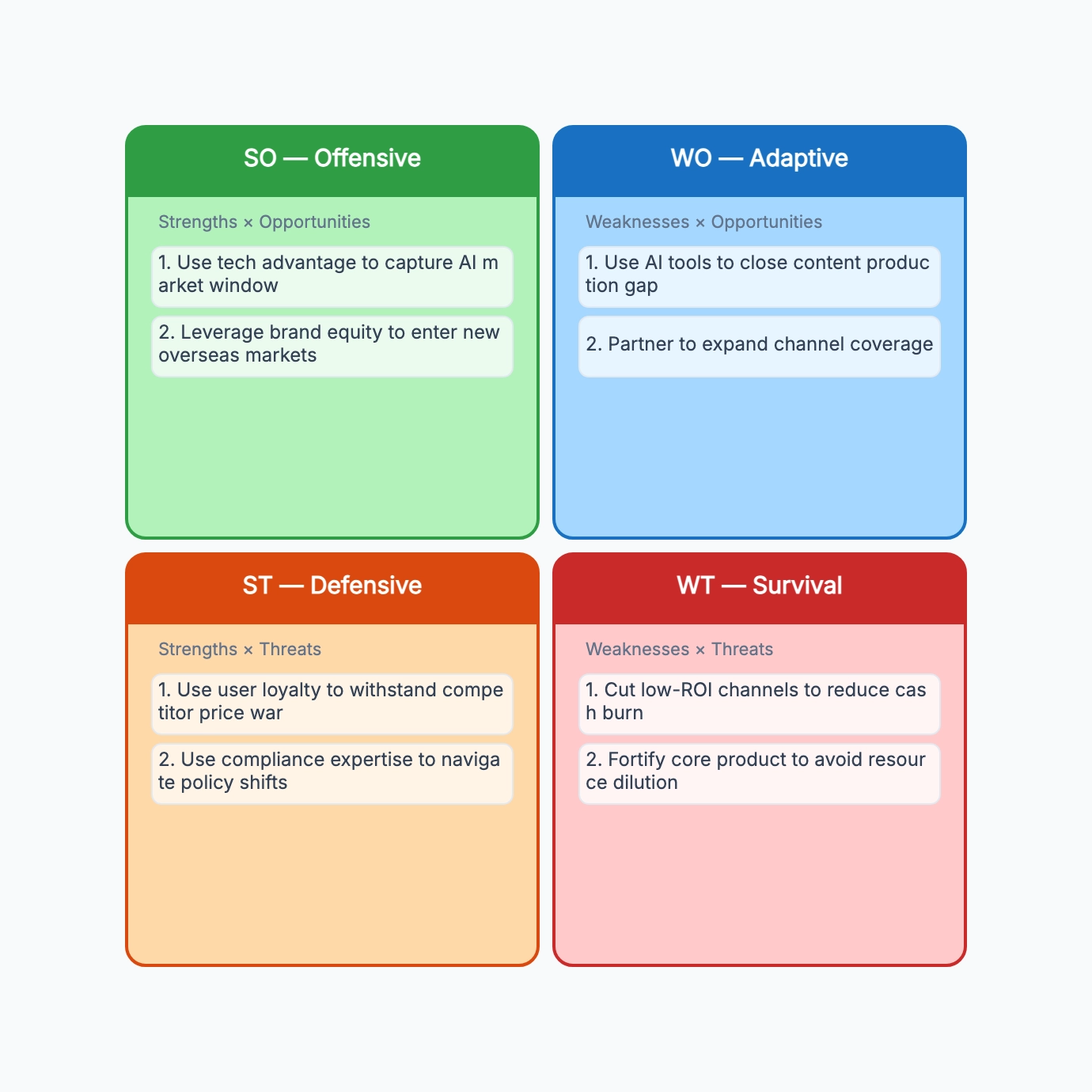
SaaS growth strategy
Who uses it: Leadership team after quarterly SWOT
SO: package integrations around the fastest-growing automation use case
WO: use partner webinars to compensate for weak content production
ST: highlight switching-cost benefits against competitor discounting
WT: pause low-conversion ad channels while CPC rises
Why this works: The TOWS matrix converts a broad growth conversation into four strategy lanes with different risk profiles.
Marketing campaign reset
Who uses it: Marketing team reviewing underperforming channels
SO: use strong customer stories to capture comparison-search demand
WO: use new creator partnerships to solve weak video production
ST: use email loyalty to reduce algorithm dependency
WT: stop low-ROI paid tests during budget pressure
Why this works: This makes budget cuts and new experiments part of the same strategic conversation.
Operations improvement
Who uses it: Ops manager planning next-quarter fixes
SO: use process automation skills to capture vendor API improvements
WO: adopt new scheduling tools to reduce manual handoff errors
ST: use documentation quality to protect against staff turnover
WT: simplify low-value workflows before demand spikes
Why this works: TOWS is especially useful when internal weaknesses meet external pressure.
Nonprofit fundraising
Who uses it: Nonprofit board planning campaigns
SO: use community trust to launch recurring donations
WO: use corporate volunteer programs to offset staffing limits
ST: use impact reporting to defend against donor fatigue
WT: reduce event dependence while venue costs rise
Why this works: The matrix turns mission discussions into trade-offs about channels, capacity, and risk.
Product planning
Who uses it: Product manager after customer research
SO: use strong workflow data to build high-demand automation
WO: use beta customers to close onboarding gaps
ST: use integration depth to defend against feature clones
WT: cut edge-case features that increase support load
Why this works: The output is a clearer roadmap conversation than a flat list of SWOT bullets.