Expository sermon
Who uses it: Congregational speaker
Text
Claim
Movements
Response
Why this works: Keeps the structure moving with the passage.
These examples show how sermon structure changes with method, audience, length, and gathering context.
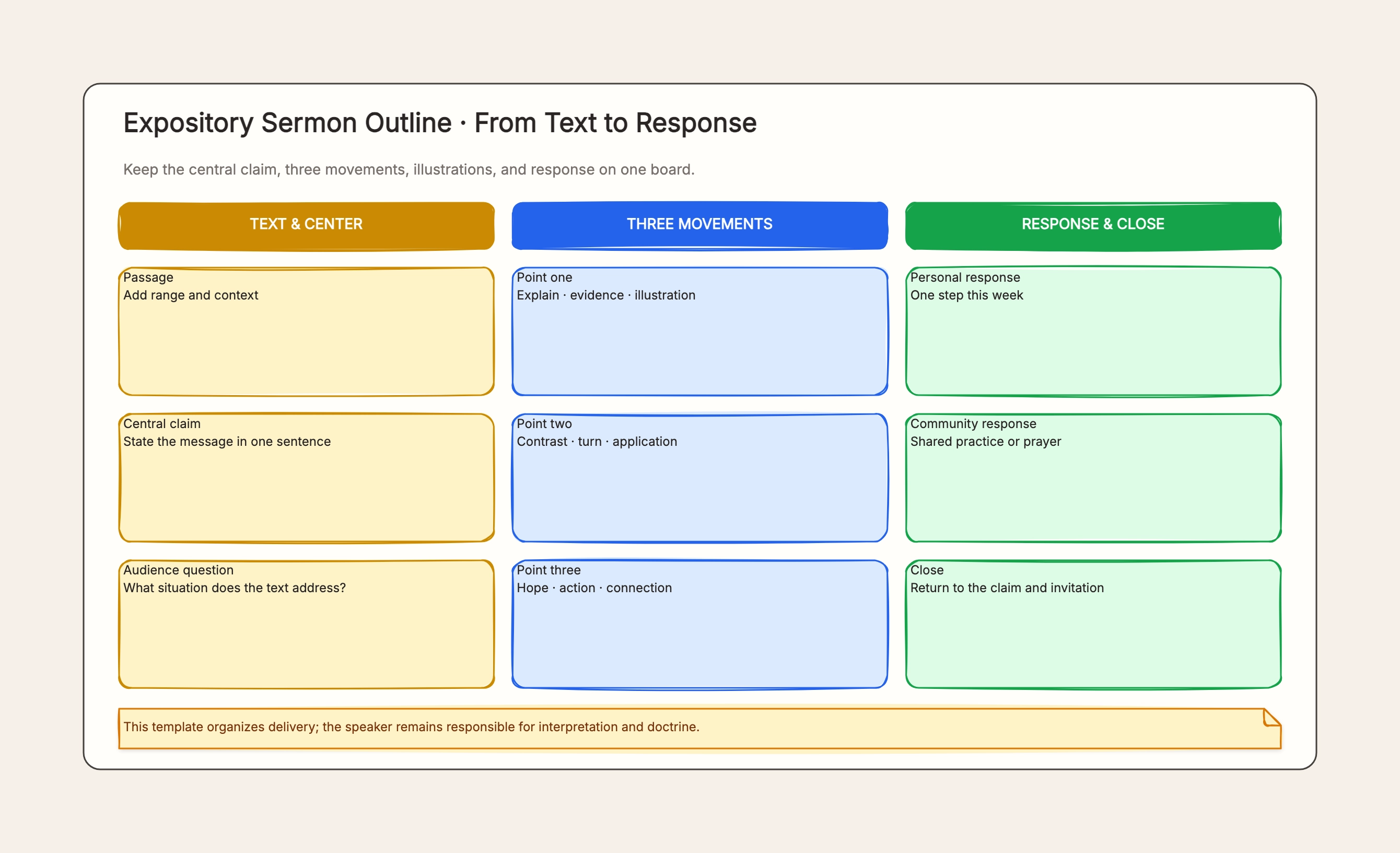
Who uses it: Congregational speaker
Why this works: Keeps the structure moving with the passage.
Who uses it: Series speaker
Why this works: Preserves context around one question.
Who uses it: Small-group leader
Why this works: Limits material to protect clarity.
Who uses it: Worship planner
Why this works: Coordinates the message with a wider service.
Who uses it: Youth leader
Why this works: Connects audience context to the central claim.
Who uses it: Teaching team
Why this works: Prevents repeated messages across weeks.
An outline preserves structure and transitions; a manuscript drafts nearly every word.
An expository outline follows one passage, while a topical outline organizes several sources around one question.
Explanation asks what the text communicates; application asks how listeners respond.
Every movement should advance the same central claim.
Record each passage's context and role instead of collecting isolated lines.
Return to the central claim and a clear response.
Include passage, context, central claim, movements, illustrations, application, response, and timing.
Yes. The first example moves from a passage to a response.
No. It organizes communication and does not replace interpretation, doctrine, or speaker review.
Go back to the template, swap in your own content, and keep the same structure if it fits your project.
Use this template: /editor/new?template=sermon-outline
Create a sermon outline