Seeds theme week
Who uses it: Preschool teacher
Story
Investigation
Movement
Art
Why this works: One question returns through several experiences.
These examples show how preschool planning changes with time span, materials, group, and mode of exploration.
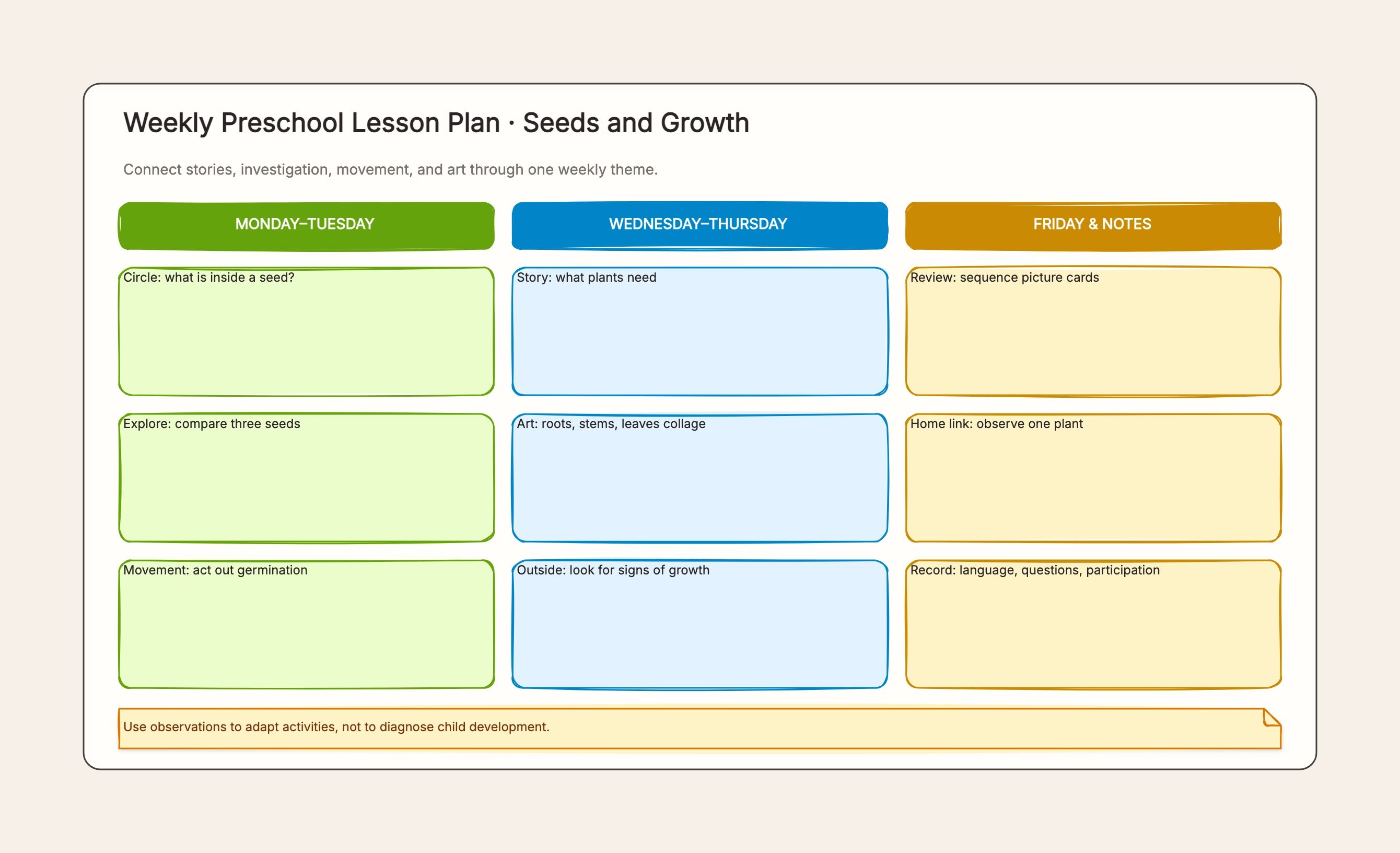
Who uses it: Preschool teacher
Why this works: One question returns through several experiences.
Who uses it: Early-years class
Why this works: Active and quiet periods create a workable rhythm.
Who uses it: Play-based program
Why this works: Open materials help children build a shared setting.
Who uses it: Mixed-age class
Why this works: Different ages can participate at different complexity.
Who uses it: Music facilitator
Why this works: Changes in energy support engagement and recovery.
Who uses it: Family communication
Why this works: Offers a low-pressure extension rather than homework.
Preschool planning emphasizes play, movement, repeated invitations, and transitions rather than long direct instruction.
A daily plan manages a specific rhythm, while a weekly plan deepens one theme over several days.
Classroom notes can guide activities; formal assessment requires an applicable process and qualified staff.
Leave room to investigate, repeat, and change direction.
Cleanup, handwashing, snacks, and outdoor movement shape the real schedule.
Record specific words and actions instead of drawing developmental conclusions from one session.
Include theme, question, activities, materials, rhythm, transitions, observations, and possible extensions.
Yes. The first example develops one theme across five days.
Yes. Edit and export it in the browser without signing up.
Go back to the template, swap in your own content, and keep the same structure if it fits your project.
Use this template: /editor/new?template=preschool-lesson-plan
Create a preschool lesson plan