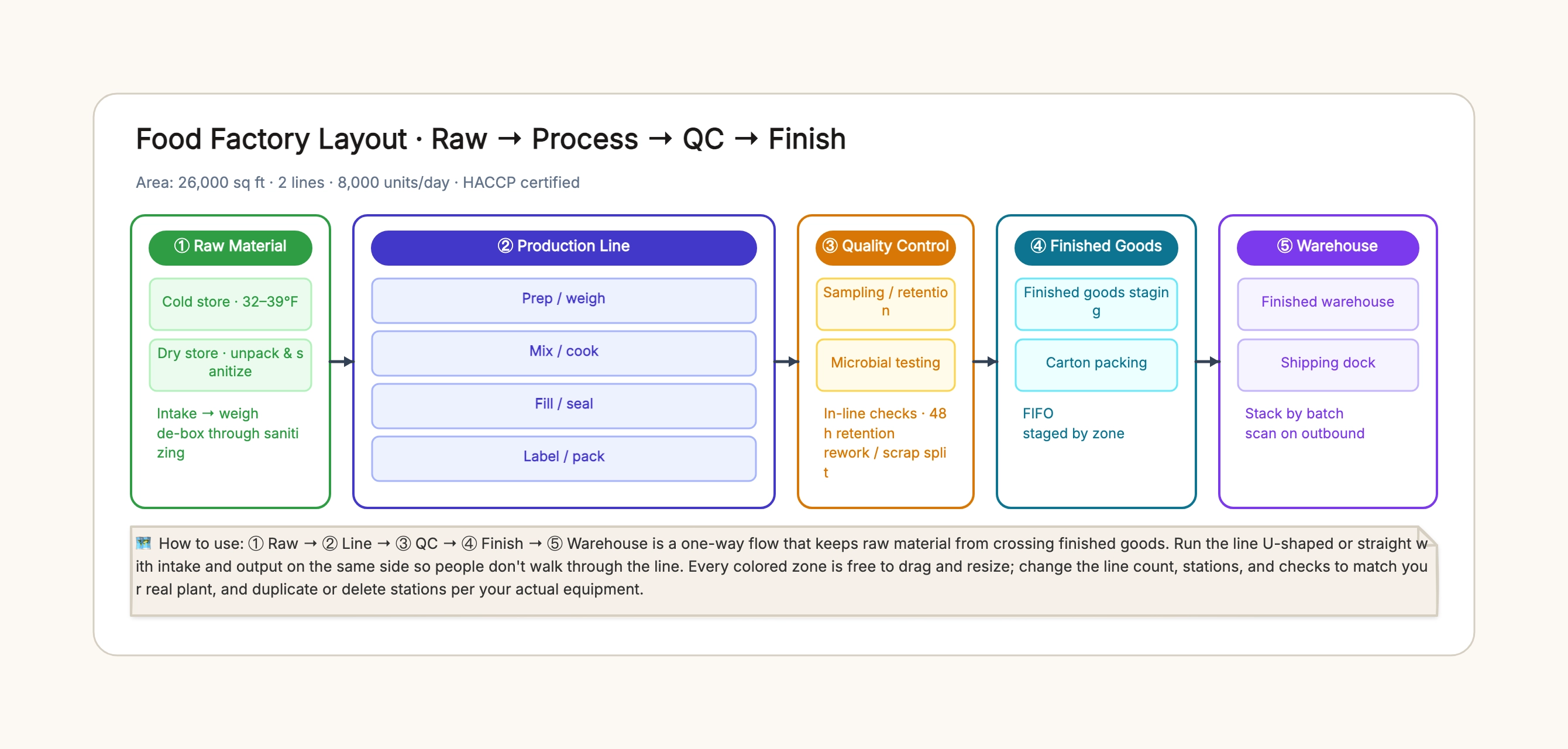
Food processing plant
Who uses it: A plant manager or food-safety lead laying out a HACCP facility
Raw material — cold store, dry store, unpack & sanitize
Production line — prep, cook, fill, pack
QC — sampling, microbial testing
Finished goods — staging, carton packing
Warehouse — finished warehouse, shipping dock
Why this works: Food plants separate raw and finished zones to avoid cross-contamination. The line runs intake-to-output in one direction, and QC sits one step off the line for in-process checks.
Electronics assembly floor
Who uses it: An operations engineer or production lead running an ESD-safe line
Raw material — component store, IQC inspection
Production line — SMT, DIP, assembly, test
QC — AOI, burn-in
Finished goods — ESD packaging
Warehouse — climate-controlled, shipping
Why this works: Electronics lines are ESD-safe and cleanroom-controlled, so the layout keeps components moving forward without backtracking. AOI and burn-in sit beside the line for fast defect rejection.
Garment factory floor
Who uses it: A factory owner or production manager scheduling sewing lines
Raw material — fabric store, trims, relax fabric
Production line — cutting, sewing, pressing, buttons
QC — garment inspection, repair
Finished goods — hang/fold packing
Warehouse — pack by style, shipping
Why this works: Garment floors put cutting next to sewing to cut transport, and inspection one step off the line so bad pieces go straight back for rework instead of reaching packing.
Beverage bottling line
Who uses it: A process engineer designing a continuous fill-and-pack line
Raw material — tank farm, syrup and water intake
Production line — mixing, filling, capping, labeling
QC — fill-level and seal inspection
Finished goods — case packing, palletizing
Warehouse — finished goods, shipping
Why this works: A bottling line is a straight, continuous product layout. Inline inspection after filling catches fill-level and seal defects before they are cased, keeping rework off the packing line.
Machine shop layout
Who uses it: A manufacturing engineer organizing machining cells
Raw material — bar stock and blank storage
Production line — cutting, CNC, deburr, finishing
QC — dimensional inspection
Finished goods — staging, kitting
Warehouse — finished parts, shipping
Why this works: A machine shop often uses a process layout with machines grouped by type. This example keeps bar stock in, parts out, and dimensional inspection beside the cells so non-conforming parts stop early.
Pharmaceutical packaging line
Who uses it: A quality or validation lead in a regulated fill-and-finish area
Raw material — component and label storage
Production line — fill, capping, labeling, cartoning
QC — in-process and finished-product testing
Finished goods — quarantine, release staging
Warehouse — released product, shipping
Why this works: Pharma adds a quarantine step: finished goods wait for release before shipping. The layout keeps released and unreleased product apart and puts in-process testing directly on the line.