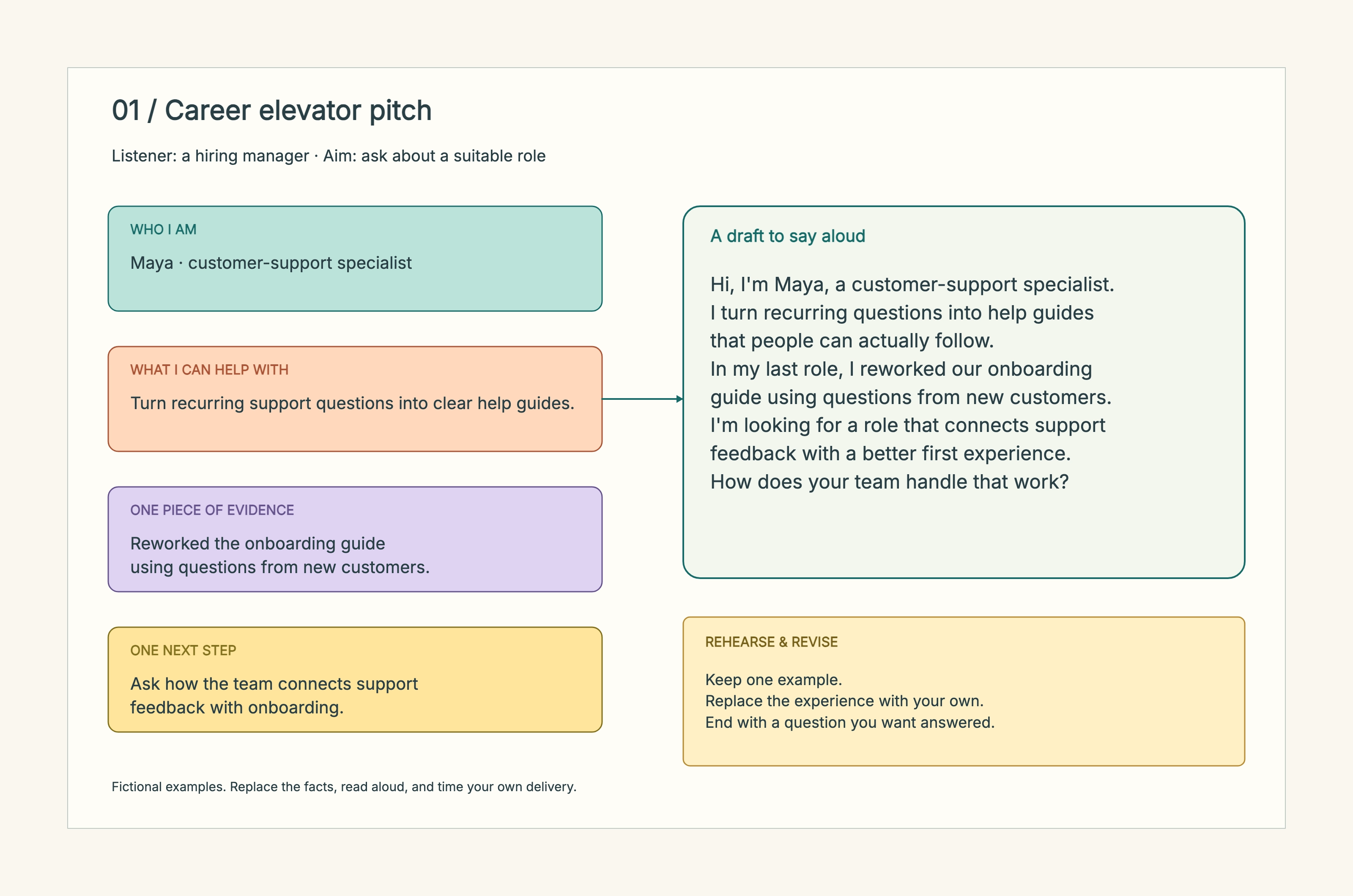
01 / Career elevator pitch
Who uses it: Listener: a hiring manager · Aim: ask about a suitable role
Hi, I'm Maya, a customer-support specialist.
I turn recurring questions into help guides
that people can actually follow.
In my last role, I reworked our onboarding
guide using questions from new customers.
I'm looking for a role that connects support
feedback with a better first experience.
How does your team handle that work?
Ask how the team connects support
feedback with onboarding.
Why this works: Keep one example. Replace the experience with your own. End with a question you want answered.
02 / Student elevator pitch
Who uses it: Listener: a researcher at a campus event · Aim: explore a student project
Hi, I'm Alex, a biology student interested in making research
easier to understand. For a student science event, I made
a visual guide to a lab procedure and used questions from
visitors to revise it. I'd like to work on a project where
I can practice that skill. Does your lab have a project
that could use help explaining its methods?
Ask whether a lab project
could use help explaining
its methods.
Why this works: Coursework counts as evidence. Explain your contribution. You do not need to invent job experience.
03 / Product elevator pitch
Who uses it: Listener: a studio manager · Aim: invite feedback on an early prototype
Small studios often collect client comments across email and chat,
which makes the next revision hard to pin down. I'm building an
approval board that puts changes and a named reviewer in one place.
I have a prototype using a sample project, and I'm testing whether
that structure fits real handoffs. Would you spend ten minutes
reviewing it against a recent project?
Ask for ten minutes to review the prototype using a recent handoff.
Why this works: Name the prototype stage. Do not invent traction. Ask for feedback before claiming results.
04 / Creator collaboration
Who uses it: A photographer speaking with a local museum editor
Hi, I'm Sam, a photographer who makes short visual stories about local craft. My latest personal project follows a ceramicist from clay preparation to a finished piece, with captions explaining each step. I'm looking for a partner who wants to make a collection's process more visible. Would it be useful if I sent a short sample story for your next exhibition?
Next step: permission to send one relevant sample, not an immediate commission.
Why this works: The completed personal project makes the offer concrete. Keep the sample relevant to the editor's collection and respect permission to share other people's work.
05 / Community project
Who uses it: A volunteer explaining a repair event to a potential venue partner
I'm Jo, a volunteer helping neighbors organize a repair afternoon. People would bring small items, and we would match them with volunteers who can assess what help is possible. We have a draft signup form and a list of interested helpers, but no confirmed venue yet. Could we talk about whether your community room is suitable and what rules we would need to follow?
Next step: discuss suitability and venue requirements before announcing the event.
Why this works: This version distinguishes preparation from confirmed arrangements. The request is for a conversation about the venue, not a promise that every item will be repaired.
06 / Freelance service
Who uses it: A developer introducing a focused service to a shop owner
Hi, I'm Lee, a freelance developer. I help small shops make their online ordering steps easier to follow. In a recent personal demo, I rebuilt a confusing pickup form so the date, location, and confirmation appeared in a clear order. I don't yet know where customers get stuck on your site. Would you be open to walking through one order with me?
Next step: a short walkthrough to understand the real problem before proposing work.
Why this works: A personal demo can demonstrate a method without pretending it was a client engagement or claiming increased sales. Discovery comes before a diagnosis.