A vehicle maintenance schedule is the difference between a car you service on time and a car that hands you a four-figure repair bill out of nowhere. It turns "when did I last change the oil?" into a list you check against the odometer, so every service happens before it is overdue — not after the warning light has been ignored for a month.
This guide walks through how to build a mileage-based schedule, then shows the three shapes it takes for a personal car, a delivery fleet, and a commercial truck. You can adapt the vehicle maintenance schedule template and edit the items, intervals, and dates directly in the browser.
What a vehicle maintenance schedule should achieve
A maintenance schedule is not the same as a folder of receipts. It is a planning tool organized around when each service is next due, not around what was fixed in the past. A workable schedule should answer four questions: which items need servicing, at what mileage, when each was last done, and when each is next due.
A useful schedule should produce five outcomes:
- every service item has an interval mileage taken from the owner's manual;
- the odometer reading is recorded at every service, so "last done" is a fact, not a guess;
- the next-due mileage and date are written down and rolled forward after each service;
- overdue items are flagged before they cost you a breakdown;
- the whole thing fits on one board, so a shop visit starts with what actually matters.
Avoid treating every vehicle as the same size. A personal car is one vehicle with fixed intervals; a fleet is many vehicles, each with its own odometer; a commercial truck follows a heavier preventive-maintenance schedule. Start from the same five-item backbone and branch where the vehicle genuinely differs.
How to build a mileage-based schedule
The most useful schedule is organized by service item, not by date alone. When each item carries an interval mileage, you compare it to the odometer and know instantly whether it is due — no memory, no "it probably still has life in it."
1. Get the intervals from the manual
Open the owner's manual or official maintenance schedule and copy the requirements for the exact make, model year, engine, and duty cycle. Choose the severe-service schedule when its listed conditions match how the vehicle is used. Record both mileage and time limits, plus any maintenance-monitor rule, rather than borrowing numbers from a generic chart.
2. List the five core items
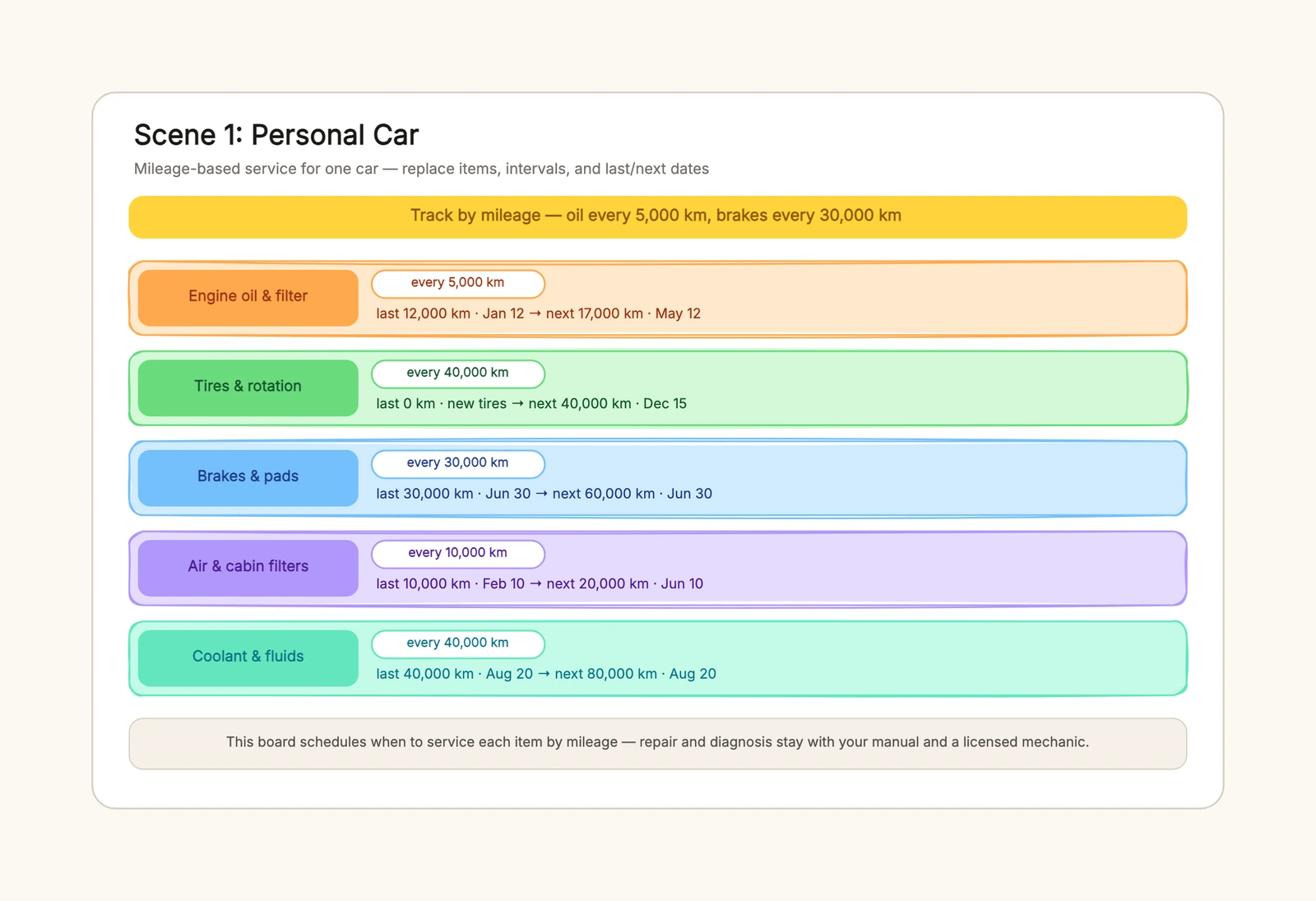
Every vehicle, from a hatchback to a box truck, shares five service items: engine oil and filter, tires and rotation, brakes and pads, air and cabin filters, and coolant and fluids. These five are the backbone. Fleet and heavy-duty vehicles add driveline, air-system, and inspection items on top.
3. Record the last service and calculate the next
For each item, write the mileage and date it was last done, then apply the manual's rule to calculate the next due point. If it says “distance or time, whichever comes first,” track both deadlines. This last/next pair is what makes the schedule a schedule instead of a wishlist.
4. Flag what is overdue first
When an item's current odometer reading has already passed the next-due number, that item is overdue. Put it at the top and book it first. The goal of the schedule is to catch these before they happen, but flagging the ones that already slipped is what keeps a real vehicle on the road.
5. Roll the dates forward after every service
The moment a service is done, update the last-done mileage and date and recompute the next-due. A schedule that is not rolled forward goes stale within one service and quietly stops being useful.
Personal car example
A personal car is the simplest shape: one vehicle with a manufacturer schedule. Oil life may depend on time, distance, engine hours, driving conditions, or an onboard monitor. Tire rotation, brake inspection, filters, and fluids can all follow different rules, so leave example intervals blank until you copy the correct values from the vehicle documentation.
Priority follows the earliest applicable trigger, not a universal order. Compare the current odometer, date, engine hours, monitor status, and observed condition with the correct source rule. Servicing from memory is unreliable because neither the last event nor the relevant duty conditions can be reconstructed accurately later.
Fleet maintenance: what changes
A fleet schedule is not one schedule repeated; it is many schedules side by side. Each vehicle has its own odometer reading, its own last-service date, and its own next-due date. The work shifts from "what does my car need" to "which of these twenty vans is due next."
A delivery fleet may face stop-start driving, idling, short trips, dust, heavy loads, or temperature extremes that trigger severe-duty rules. The discipline is logging mileage, time, engine hours, and duty conditions per vehicle. The board flags the closest next-due item across the fleet, while the OEM schedule—not a fleet-wide generic number—sets the interval.
Commercial truck: what changes again
A heavy-duty truck needs a duty-specific program; its intervals are not automatically longer. Engine hours, idle percentage, load, route, fuel consumption, inspection law, and OEM guidance can all change when work is due. A truck down for an unplanned repair costs the day's revenue, not just a tow.
The schedule also widens. Beyond the five core items, a commercial truck's preventive-maintenance schedule covers the driveline, the air system, filters, and a long list of inspection points that a passenger car never sees. The template keeps the mileage and dates visible; the OEM PM schedule supplies the actual checklist, and a licensed mechanic does the work.
Mileage-based vs. time-based maintenance
Not every service item is driven by the odometer. A mileage-based schedule keys everything to distance, which fits vehicles that rack up kilometres fast. A time-based schedule keys to calendar months, which fits low-mileage cars that sit — brake fluid and coolant degrade by age even when the car barely moves.
Most vehicles need both. Oil, tires, and brakes are mileage-driven; coolant, brake fluid, and the battery are partly time-driven. A low-mileage weekend car still needs its fluids flushed every couple of years even if it only covered a few thousand kilometres. The schedule handles the mileage half; the manual's time-based notes cover the rest.
Common maintenance mistakes
Servicing by memory instead of mileage
Waiting until the car "feels like it needs it" means missing intervals by thousands of kilometres. Record the odometer at every service and compare it to the interval, every time.
Ignoring the owner's manual intervals
Generic online numbers do not match every engine. Use the manual's figures for your exact make, model, and engine, and put those in the schedule rather than a number you half-remember.
Mixing up the last and next dates
A schedule is only useful while the last-done and next-due columns stay current. After each service, roll the next-due date and mileage forward — otherwise the board lies to you within one service.
Forgetting the low-mileage items
Coolant and brake fluid sit for years and go bad by time, not just distance. Keep them on the schedule even when the car does not drive far, or they get skipped for years at a time.
Treating the schedule as a diagnosis
A due service is a trigger, not a verdict. When something is worn or leaking, the schedule flags it for a licensed mechanic — it does not decide what is broken or what to replace.
What a skipped interval can change
Deferred maintenance often stays invisible until a warning, inspection finding, or breakdown. The exact effect cannot be predicted from mileage alone: component condition, operating environment, fluid specification, and vehicle design all matter. Treat an overdue item as a prompt to arrange inspection, not as proof that a specific repair is already required.
The schedule cannot diagnose wear or promise a component lifespan. Its job is to surface a missed requirement before the next trip and preserve a traceable service history for the technician who inspects the vehicle.
There is also a resale angle. A consistent service record — a board or log showing every oil change at its mileage and every fluid at its interval — is worth money when you sell, because it turns "trust me, I maintained it" into a number a buyer can check. The same discipline that keeps the car on the road is the one that keeps its value.
Keep the schedule useful over time
Review the schedule after each service and note what you missed or over-scheduled, so the next interval starts from a better baseline. Keep the five core items on one board, roll the dates forward every time, and the schedule stays a living record instead of a one-time exercise.
Start with the vehicle maintenance schedule template, replace the items and intervals with your manual's numbers, and flag what is overdue first. The same scheduling idea works off the road too — the home maintenance checklist template applies mileage-style intervals to your house, indoors and out.