A party planning checklist is the difference between a party you actually enjoy and one where you spend the afternoon in the kitchen wondering who was supposed to bring the ice. It turns "we'll figure it out" into five things you check off — the guest list, food and drink, decorations, activities, and a timeline that runs from prep through day-of to cleanup.
This guide walks through how to build that five-pillar checklist, then shows how it shifts for a birthday, a graduation, and a housewarming. You can adapt the party planning checklist template and edit every card directly in the browser.
What a party planning checklist should hold
A party checklist is not a shopping list and not a to-do list of errands. It is a planning board organized around the five things every party runs on, and every one of them changes with the party type.
The five pillars are:
- Guest list — who is coming, whether they RSVP'd, and any dietary needs beside their name.
- Food & drink — the cake or catering, snacks, and drinks, sized to the real headcount.
- Decorations — the banner, balloons or flowers, and the table setting that give the party its look.
- Activities — the games, the house tour, the slideshow, or whatever fills the time.
- Timeline — prep, day-of, and cleanup, each with a window and an owner.
The reason to keep all five on one board is that they leak into each other. The headcount drives the food; the food drives the cleanup; the activities drive how long guests stay. When they sit in separate lists, you re-derive the count three times and still get it wrong. On one board, you change the guest list once and see everything downstream.
How to build a party planning checklist
The order matters more than most people expect. Start from the thing that decides everything else and work outward.
1. Pick the party type first
A birthday, a graduation, and a housewarming look nothing alike in formality, so the type decides how the rest of the checklist is weighted. A kid's birthday is casual and short; a graduation is bigger and needs an RSVP-driven headcount; a housewarming is a relaxed open house where the tour is the activity.
2. Draft the guest list and set an RSVP deadline
Write the names first, then add a deadline that leaves time to act on the answers. For a birthday, three weeks out is plenty; for a graduation, a month is safer because catering and seating follow the count. Note dietary needs beside each name — allergies are the easiest thing to forget when the list is just names.
3. Fill food and drink against the headcount
Only after the list is roughly settled do you size the food. A cake and a few trays of snacks for a birthday, catering and a grad cake for a graduation, easy bites and a welcome drink for a housewarming. The rule is the same: lock the count, then the quantities.
4. Add decorations and activities
Decorations set the tone — a theme banner for a birthday, a memory table for a graduation, fresh flowers for a housewarming. Activities fill the time and give the party its shape. If you have no activities, the party ends when the food runs out.
5. Write the timeline
Split the whole thing into prep, day-of, and cleanup, and give each phase a window and an owner. The timeline is the part people skip, and it is where parties fall apart in the last hour.
Birthday party example
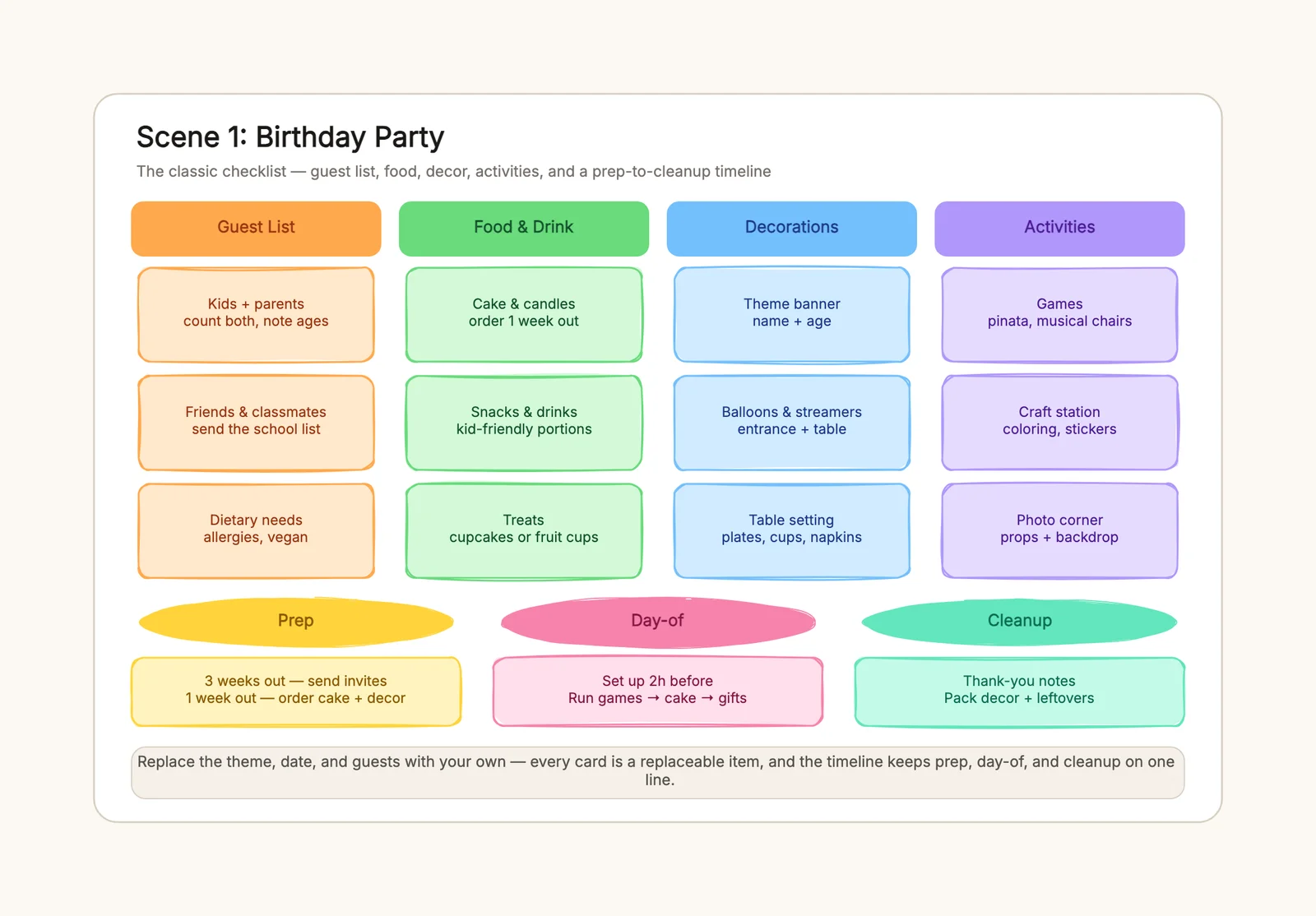
A birthday is the classic use of the checklist. The guest list counts kids and parents separately, because a kid's party has two audiences with different food and seating needs. The food column is a cake and candles ordered a week out, kid-friendly snacks, and treats like cupcakes or fruit cups. The decor column is a theme banner with the name and age, balloons and streamers at the entrance and table, and the table setting itself.
The activities column is what keeps a birthday from stalling: a couple of games like a pinata or musical chairs, a craft station with coloring and stickers for the quieter kids, and a photo corner with props and a backdrop. The timeline starts three weeks out with invites, moves to ordering the cake and decor a week out, then runs the day itself as setup, games, cake, and gifts, and closes with thank-you notes and packing the leftovers.
The birthday mistake that causes the most friction is leaving the food to the last morning. Order or prep the cake and snacks a week ahead, so the day-of column only has setup and the run of show.
Graduation party: what changes
A graduation party is bigger and more formal, and the checklist shows it. The guest list grows to include family, classmates, and teachers, and it is driven by an RSVP deadline a week before the party so catering and seating match who actually shows up. The food column shifts from snacks to a buffet or catering plus a grad cake in the school colors.
The decor column becomes a memory piece: a banner with the name and year, cap and diploma props for photos, and a memory table of photos and the yearbook. Activities turn into a slideshow of milestone photos, a memory book guests sign, and a playlist. The timeline starts a month out with venue and invites, then confirms the headcount a week out.
The graduation mistake that costs the most is ordering catering before the RSVPs are in. Lock the count a week out, then confirm the food — not the other way around. For the birthday-specific side of planning, the birthday party planning template covers theme, budget, and the day-of run of show in more detail.
Housewarming: what changes again
A housewarming is the opposite of a graduation in almost every way — low-key, easy, and built around the home itself. The guest list is new neighbors you want to meet and the friends who helped you move, plus their plus-ones. The food is easy bites that need no heavy cooking, a signature drink for the welcome toast, and coffee and tea for the tour.
The decor is a welcome sign by the door, fresh flowers in the living room, and string lights for a cozy feel. The main activity is the house tour, room by room, with a guest book or wall signature as a keepsake and optional unpacking help as a soft activity. The timeline starts with unpacking the essentials first and setting a date two weeks out.
The housewarming mistake to avoid is overcooking. A housewarming falls flat when the host is stuck in the kitchen instead of showing people around. Keep the food easy and let the tour carry the party.
The timeline: prep, day-of, cleanup
The timeline is worth its own look because it is the part of the checklist most people leave out, and it is where a party either holds together or comes apart.
Prep is everything before guests arrive: sending invites, ordering the cake or catering, buying decor, and confirming the headcount. Give it a start date (three weeks for a birthday, a month for a graduation) and a list of owners.
Day-of is the run of show: set up the food and decor a couple of hours before, then welcome guests and move through the activities in order. Assign each time block an owner so the host is not also the one restocking drinks.
Cleanup is the part nobody plans: thank-you notes or cards, packing the decor and leftovers, and resetting the space for the next day. Planning it means the party ends cleanly instead of leaving a week of tidying.
The three phases carry the when, the four pillars carry the what, and together they are what make a party feel effortless from the guest's side.
Common party planning mistakes
Skipping the RSVP deadline
Without a deadline, the headcount stays fuzzy and food and seating get ordered wrong. Set a deadline that leaves a week to adjust, and chase the people who have not answered.
No timeline
Parties fall apart in the last hour when setup, food, and cleanup are left unplanned. A prep → day-of → cleanup timeline gives each phase a window and an owner.
One person carrying everything
When one host runs guests, food, decor, and activities alone, something gets dropped. Assign an owner to each pillar so the load is shared.
Forgetting dietary needs
Allergies and restrictions get missed when the guest list is just names. Note them beside each guest so the food column accounts for them.
Planning food before the headcount
Ordering a cake or catering before the RSVPs are in means too much or too little. Lock the headcount first, then set the food quantities.
Adapt the checklist to any party
The five pillars do not change between party types — only the details do. A retirement party swaps the birthday banner for a career timeline and the games for speeches. A game-day gathering swaps the theme decor for team colors and the activities for the game itself. Once you have the structure, a new party is mostly a matter of renaming the pillars and swapping the cards.
Start with the party planning checklist template, replace the party type and the cards with your own, and check the timeline once a week before and once the morning of. For a birthday-specific plan that drills into theme and budget, see the birthday party planning template, and for larger events where seating and flow matter, the event floor plan template.