A moving checklist is the difference between a move that closes cleanly and a move where you spend the first week wondering which box holds the kettle. It turns "did we pack the kitchen?" into a list you check room by room, so nothing gets packed twice and nothing is forgotten in the last hour before the truck leaves.
This guide walks through how to build a room-by-room moving checklist, then shows the three shapes it takes for an apartment, a house, and an office. You can adapt the moving checklist template and edit the rooms, items, and phases directly in the browser.
What a moving checklist should achieve
A moving checklist is not the same as a to-do list of errands. It is a packing plan organized around where things end up, not just what needs to be done. A workable checklist should answer four questions: what gets packed, which room it goes to in the new place, what stays with you on moving day, and what order the rooms are packed in.
A useful checklist should produce five outcomes:
- every box is labeled with its destination room and a short contents note;
- the rooms you use least are packed first, so the everyday rooms stay livable;
- a first-night box holds bedding, toiletries, chargers, and a change of clothes;
- valuables and documents are set aside to travel with you, not on the truck;
- the final walkthrough catches what the list missed before the truck leaves.
Avoid treating every move as the same size. A studio move collapses the rooms into one zone, a house move adds a garage and study, and an office move is mostly about IT and records. Start from the same room-by-room backbone and branch where the move genuinely differs.
How to build a room-by-room moving checklist
The most useful checklist is organized by destination room, not by category like "clothes" or "kitchen things." When each box belongs to a room, the movers can place it correctly and you can unpack one room at a time.
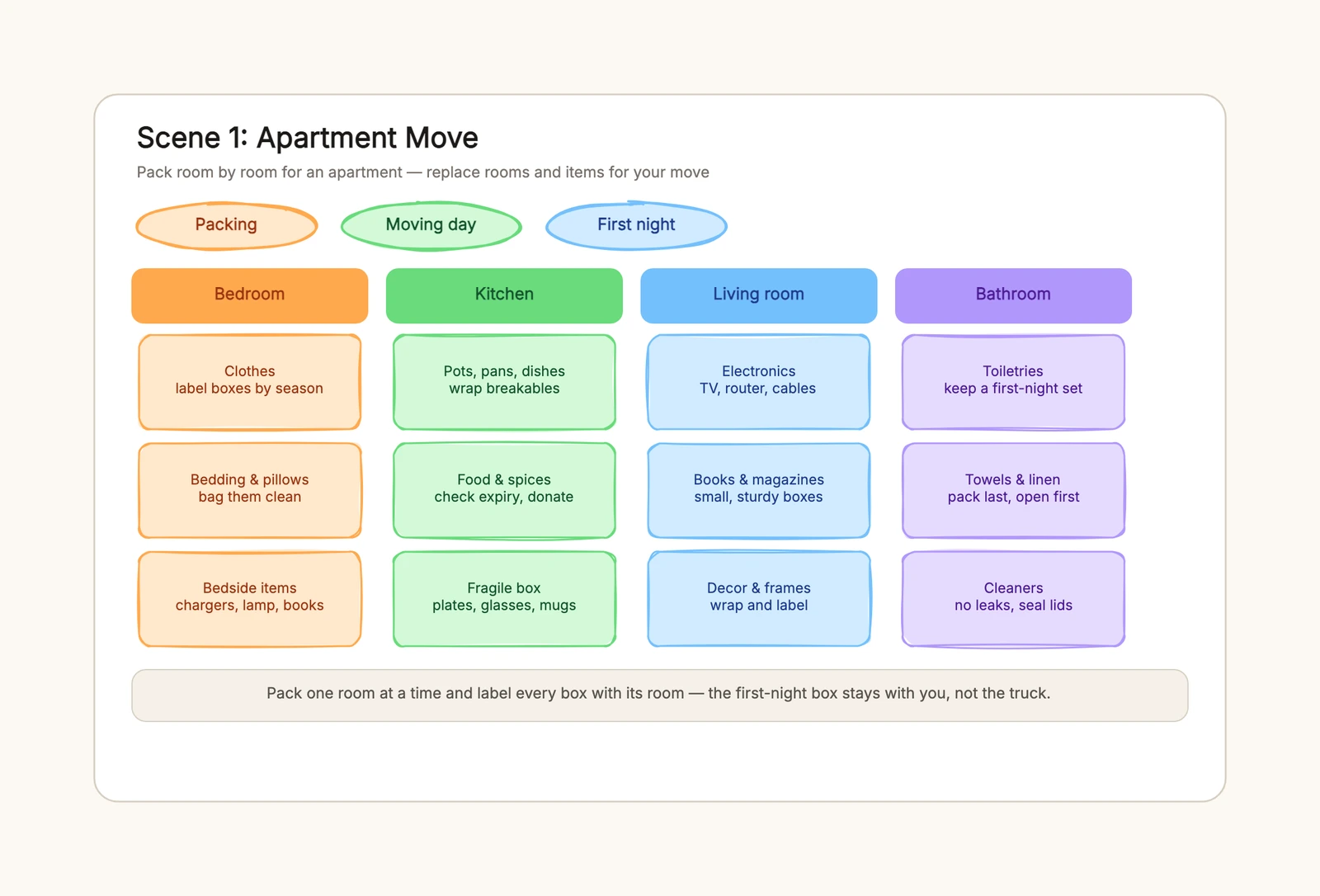
1. List the rooms and the packing order
Write the rooms of the new place first, then order them from least-used to most-used. Packing the storage room and the spare bedroom first keeps the kitchen and bathroom livable until the last day. If you are moving a house, add the garage, storage, and study; if a studio, use a single living zone.
2. Assign items to each room
For each room, list the items that live there rather than grouping by category. The bedroom list is clothes, bedding, and bedside items; the kitchen list is dishes, pantry, and the fragile box. This keeps the checklist aligned with where boxes will be opened.
3. Set aside the first-night box
One box per person holds bedding, toiletries, chargers, and a change of clothes. It rides with you, not on the truck, so the first night in the new place is livable without opening anything else. This single box prevents the most common first-night scramble.
4. Separate the valuables list
Documents, medications, jewelry, and devices travel with you. Write them on a short list and check it off in the car. The truck carries furniture and boxes; it should never carry the one folder you cannot replace.
5. Add the move-day phases
Above the room list, add the three phases — packing, moving day, and first night — so the timeline reads at a glance. The phases are the part people forget to plan, and they are where a move falls apart if left to the last minute.
6. Walk the empty rooms before the truck leaves
After the boxes are out, walk each room, closet, and cabinet with the list. This final pass catches the drawer you forgot and the shelf above the wardrobe. Do it before the truck pulls away, not after.
Apartment move example
An apartment move usually covers four rooms: bedroom, kitchen, living room, and bathroom. The order is simple — pack the bedroom and living room first, then the kitchen, and the bathroom last, because you still use it on the final morning.
The bedroom list is clothes by season, bedding and pillows bagged clean, and bedside items like chargers, a lamp, and books. The kitchen list separates dishes and cookware from pantry items and a fragile box for plates, glasses, and mugs. The living room covers electronics, books, and decor; the bathroom covers toiletries, towels, and cleaners, with a first-night set pulled out before packing.
The key apartment mistake is packing the kitchen too early. Leave enough to make coffee and a simple meal until moving morning, then box the rest.
House move: what changes
A house adds rooms and a different order. Garage and storage go first because you use them least, followed by the study and spare rooms, then the bedrooms, and finally the kitchen and main bathroom. Outdoor items — tools, seasonal gear, sports equipment — get binned and labeled in the garage section, and hazardous items like paint and fuel never go on the truck.
A house move also adds the wardrobe box. Hanging clothes go in a wardrobe box so they hang rather than fold, and the bed frame bolts go in a single labeled bag so the bed can be rebuilt the first night. For more on the after-move steps, the new home checklist template covers utilities, locks, and settling in.
Office move: what changes again
An office move is an IT and records move as much as a furniture move. The list shifts from rooms to work zones: desks, IT equipment, meeting room, and files. Personal items are boxed per person, monitors and docks are labeled with their cable order, and drawers are emptied and sealed.
IT gets its own section — servers and network gear are backed up before power-off, cables and adapters are bagged and labeled, and asset tags are checked against the inventory list. Files split into active files that stay with their owner, archive boxes labeled by year, and confidential documents that are shredded or moved securely.
The office mistake that costs the most is unlabeled cables. A monitor without its labeled cable order becomes a puzzle on the other end. Label everything before it leaves the desk.
Pack, donate, and discard before you box
The fastest way to overpack a move is to box things you no longer use. As you pack each room, sort into three piles — keep, donate, and discard — and let the keep pile be the only thing that goes in a box. This cuts the truck load, the unpack time, and the number of boxes you move twice. The kitchen is the easiest place to start: duplicates, expired food, and appliances you have not touched in a year are the lowest-effort wins.
The moving-day timeline
A simple timeline keeps the day from unraveling: pack non-essentials in the week before, box the kitchen the night before, load the truck by room, and open the first-night box first when you arrive. Reserve the final morning for the last boxes, a walkthrough, and the valuables check. The checklist carries the what; the timeline carries the when, and the two together are what make a move close cleanly.
Common moving mistakes
Packing without room labels
Boxes without a destination room end up stacked in one room and opened twice. Label every box with the room and a short contents note, and mark the side that should face out.
No first-night box
Without a first-night box, the first night means digging through boxes for a toothbrush. Bedding, toiletries, chargers, and a change of clothes should ride with you.
Packing every room at once
Half-packed rooms are easy to lose track of. Pack one room at a time and close it out before moving to the next, so the checklist reflects reality.
Valuables on the truck
Documents, medications, jewelry, and devices should travel with you. The truck carries furniture and boxes; it should never carry the one folder you cannot replace.
Skipping the empty-room walkthrough
A final walk of each room, closet, and cabinet catches what the list missed. Do it before the truck leaves, while you can still open the door and look.
Keep the checklist useful over time
Review the checklist after the move and note what you missed or over-packed, so the next move starts from a better list. Keep a short version — first-night box, valuables, and move-day phases — in your notes, and reuse the full room-by-room list when the next move comes. A move you review once is a move you only pay for once.
Start with the moving checklist template, replace the rooms and items with your own, and walk the empty rooms before the truck leaves. For the packing that happens on a trip rather than a move, see the packing checklist template, and for the cleaning between places, the weekly cleaning schedule template.