Choose Linktree when you want a structured bio page that you can keep updating as your content changes. Choose Carrd when you want to compose a one-page website with an introduction, proof, service details and a deliberate call to action. The difference is how much of the visitor's decision happens on the page itself.
Carrd can make a link collection, and Linktree can do more than list plain links. For a useful Linktree vs Carrd comparison, start with the page you need to publish: a directory that sends people onward, or a small destination that explains an offer before asking them to act.
Linktree vs Carrd: what you are building
This article compares official documentation checked October 30, 2026. The sample page brief is original and hypothetical. We have not timed a build, benchmarked page speed or measured conversions for either service; statements about suitability are editorial judgments based on the described workflow.
| Requirement | What it means for your decision |
|---|---|
| Change the featured destination every week | Favor an editing workflow you can maintain consistently |
| Explain a service before the visitor clicks away | Compare section layout and content hierarchy |
| Publish on a domain you own | Confirm domain eligibility, registration and renewal separately |
| Collect an inquiry | Test the actual form destination and reply process |
| Take payment | Inspect the checkout provider and the post-payment step |
| Attract search traffic | Evaluate useful content and discoverability, rather than assuming a domain guarantees rankings |
A one-page website can be short. Its distinguishing feature is the ability to present a complete argument in an intentional sequence. A directory may be equally useful when the visitor already knows what they want and only needs the right destination.
Pricing: annual Carrd plans and the domain trap
Carrd's Pro page lists Pro Lite at $9 per year and Pro Standard at $19 per year. Lite and Standard are not interchangeable: Standard includes custom domains, forms and embeds. Buying the least expensive Pro plan does not automatically satisfy a custom-domain requirement.
A domain you own has a separate registration and renewal cost. The site plan gives you the ability to connect an eligible domain; it is not the same purchase as owning that address. If you use another paid form, email or checkout service, keep those costs in their own rows as well.
During the final browser check, the Linktree pricing page displayed Starter at $9 monthly and Pro at $17 monthly; annual billing showed $7 and $14 per month respectively. Carrd's annual site price is much lower than those paid subscriptions, but compare the eligible features and external services too. Linktree's free plan can still fit a simple directory.
Compare annual commitments with annual commitments. A monthly equivalent shown beside a yearly bill describes an average, not necessarily a month-to-month cancellation option. Record the amount charged, the renewal interval and what happens if you downgrade. That makes the budget understandable before you connect the page to an active campaign.
Layout freedom: explanation versus navigation
Suppose a visitor reaches your profile after watching a demonstration. A directory can immediately offer the tutorial, materials and next event. If those destinations are already clear, a longer introduction may delay the action the visitor came to take.
Now suppose a potential client finds your profile without knowing your work. They may need to understand the service, see relevant examples and learn what information to send. A composed page gives you room to build that sequence. Carrd's site-building approach is worth investigating for that job.
More freedom brings editing decisions. You need to decide the order of sections, the length of paragraphs, image dimensions and how the page behaves on a phone. These choices can produce a useful page, but they also create maintenance responsibilities that a structured bio workflow can reduce.
Do not choose a platform solely from an empty template. Put your longest real heading and your least conveniently shaped image into the preview. A layout that looks balanced with a three-word sample title may wrap awkwardly with your service name. Judge the actual content you will publish.
An original one-page brief for a freelance audio editor
Consider a fictional audio editor who receives inquiries from podcast hosts. The page's main job is to turn an interested host into a qualified inquiry. It does not need a full archive, a course platform or an elaborate menu to do that job.
| Section | Content to prepare | Question it answers |
|---|---|---|
| Opening | A plain description of podcast editing and the type of client served | Am I in the right place? |
| Work samples | Two representative before-and-after examples with permission to publish | Is this the kind of result I need? |
| Scope | What is included and what the client supplies | Does the service fit my project? |
| Inquiry | A concise form or contact route with useful project questions | What should I send next? |
| Supporting links | A small set of relevant profiles or resources | Where can I learn more? |
For this brief, Carrd is a plausible candidate because the page needs explanation before navigation. Linktree is a plausible candidate if the editor already has a service page elsewhere and needs a simple entrance to that page, samples and contact information.
Download the one-page brief, replace the example sections with your offer and remove any section that does not help the visitor decide. Do this before spending time on colors or animations.
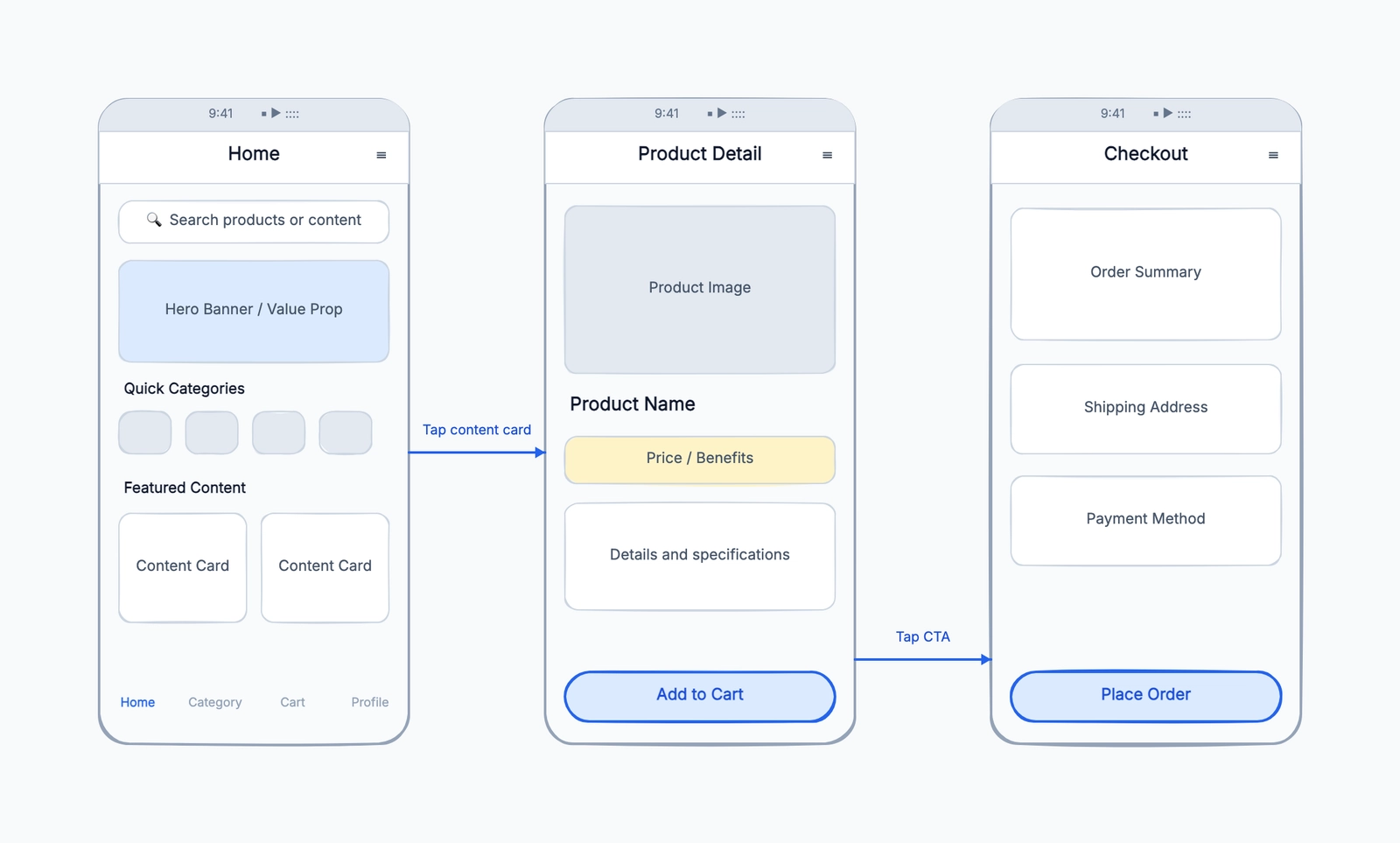
If you want to compare two mobile first-screen arrangements, open the wireframe template below. Replace its placeholders with the opening promise, one proof element and one primary action. CodePic helps you sketch the content order; Carrd or Linktree publishes the finished page.
Forms and checkout: follow the destination
Carrd's published Pro feature descriptions include forms and third-party widgets or embeds. That creates options, but an embedded checkout or form still has an owner and a destination. Understand which system receives the submission or payment and which system is responsible for the next message.
For an inquiry, test a realistic message rather than a single word. Check that the sender knows what to expect, the notification reaches a monitored inbox and the reply address works. If you ask for project files, verify the chosen service supports the intended file workflow instead of adding an upload promise to a text-only form.
For a purchase, distinguish payment confirmation from delivery. A checkout can collect money without hosting the purchased course or sending a usable file. Decide who issues access, handles a lost receipt and responds when the buyer used the wrong email address.
Linktree's digital-product documentation describes native selling on eligible paid accounts in supported countries. Compare that route with linking to an established store. The right choice depends on your specific product and delivery requirements, not an assumption that every bio tool is only a collection of outbound links.
Analytics: measure the question you are asking
Carrd's current Pro information includes native cookie-free analytics as well as third-party analytics options. An older article saying Carrd has no built-in analytics can therefore mislead you. Check the plan and implementation for the specific measurements you require.
Linktree's paid-feature guide describes different analytics history windows. Distinguish having activity data from having enough history to compare a seasonal campaign. Neither issue tells you whether a particular visitor ultimately became a client.
Choose a small measurement chain: page arrival, primary destination click and completed inquiry. If the last step happens in another system, use that system to confirm it. Keep campaign names consistent across the page and destination so a source does not become unrecognizable halfway through the journey.
Do not treat a higher click-through rate as an automatic business improvement. A page that answers a basic question may reduce unnecessary clicks while improving the quality of inquiries. Review the outcome you wanted alongside the intermediate event. We have no measured outcome data for the hypothetical audio editor.
SEO: a custom domain is useful, but not a ranking promise
An owned domain gives you an address you can keep using while changing hosts, subject to the services' domain setup requirements. That can simplify future migrations. It does not make a thin page outrank more useful resources just because the address looks professional.
For a service page, write the service and audience clearly, provide specific evidence and make the main content understandable without relying on decorative images. Use relevant metadata and a sensible share image where the chosen plan supports them. A useful page should answer the visitor's question before asking for a contact detail.
Carrd is a one-page site builder, so consider whether the content will remain one coherent page. If your plan includes dozens of independent tutorials with separate search intent, evaluate a publishing system designed for that structure. Adding more sections to one page is not equivalent to creating a maintained article library.
A public Linktree page can also be discoverable. We are not claiming that one product disables SEO or that changing products guarantees more traffic. Search performance depends on the query, content, links, competition and technical implementation of the published page.
Maintenance and migration: choose the work you can sustain
A weekly content directory needs a repeatable publishing habit. Someone must remove outdated promotions, move the current destination upward and check that labels still match. A custom one-page site needs those checks plus attention to section layout and form behavior as the offer changes.
Before migrating, inventory your existing URL references. Social profiles are only the beginning: old videos, podcast descriptions, email signatures and printed material may still point to the previous address. Keep the original page available during the transition where possible and avoid assuming a vendor URL can redirect automatically.
If you use a custom domain, follow the new host's DNS instructions and retain the previous configuration. Check the destination on mobile after the change, including secure loading, forms and outbound links. Changing DNS successfully is not proof that every visitor route works.
Choose Linktree if your page is mainly a current directory and you value a structured update routine. Choose Carrd if you need a deliberately composed explanation on a one-page site and can maintain its layout and integrations. For a business centered on courses or appointments, compare Stan Store; for a broader shortlist, use our Linktree alternatives comparison.


