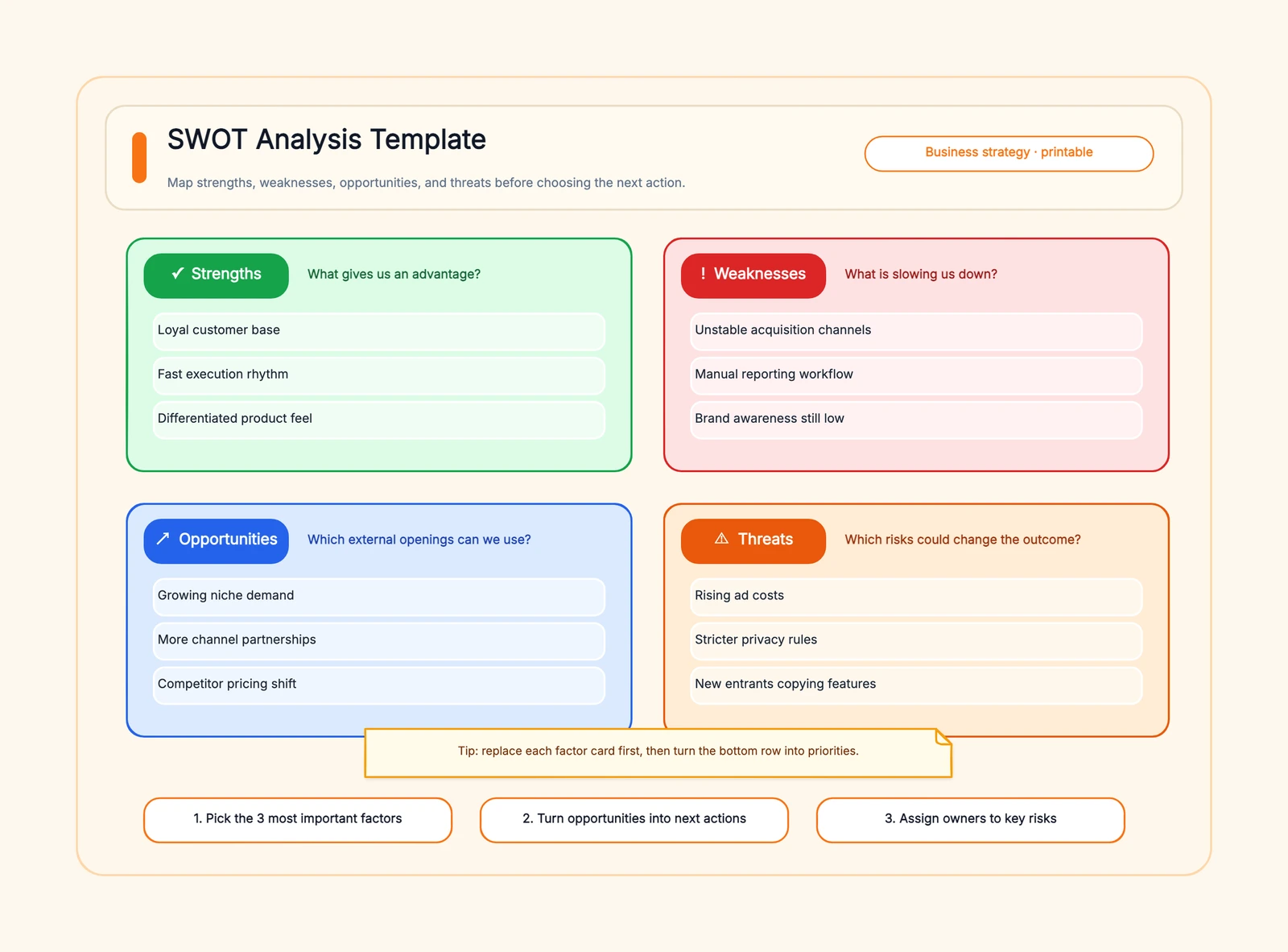
A SWOT analysis is a strategy tool that maps your Strengths, Weaknesses, Opportunities, and Threats into four quadrants — but the four lists are not the point. The point is what you decide to do with them. For the definitions and background, see What Is a SWOT Analysis?; this guide is purely about how to actually do one.
Below is a repeatable process: scope the analysis, fill the four quadrants with specific items, then cross them to produce real actions. Most SWOTs fail at that last step — they end as a tidy grid nobody uses. We'll fix that.
How to Do a SWOT Analysis, Step by Step
Each step below maps to a part of the four-quadrant grid. Work them in order — the quadrants build on each other.
1. Define the subject and the goal. Before any boxes, write down what you're analyzing (a company, a product launch, a team, a personal decision) and why. "SWOT for our 2026 product launch" produces sharper entries than a vague "SWOT for the company." The goal sets the standard for what counts as relevant.
2. List internal Strengths. What do you do well, and what advantages do you control? Strong brand, loyal customers, low costs, proprietary tech, a skilled team. Keep these internal — they live inside your organization. Be specific: "30% lower production cost than competitors" beats "good at operations."
3. List internal Weaknesses. Where are you behind, and what's holding you back internally? Thin cash reserves, gaps in skills, an aging product, weak distribution. These are honest, controllable shortcomings — not external bad luck. The harder these are to admit, the more useful they usually are.
4. List external Opportunities. What outside trends could you ride? A growing market, a competitor stumbling, new regulation in your favor, shifting customer demand, new channels. These are external — they exist whether or not you act. Frame them as openings you could exploit, not things you've already done.
5. List external Threats. What outside forces could hurt you? New entrants, price wars, regulation against you, changing tastes, supply-chain risk. Like opportunities, threats are external and largely outside your control — your job is to anticipate and prepare, not pretend they don't exist.
6. Cross the quadrants into action (SO / WO / ST / WT). This is the step everyone skips. Pair the quadrants to generate strategies:
- SO (Strengths + Opportunities) — use a strength to capture an opportunity. Your offense.
- WO (Weaknesses + Opportunities) — fix a weakness so you can seize an opportunity. Your improvement plan.
- ST (Strengths + Threats) — use a strength to neutralize a threat. Your defense.
- WT (Weaknesses + Threats) — minimize a weakness to avoid a threat. Your damage control.
Each pairing should produce at least one concrete, owned action with a timeline. That is the output of a SWOT — not the grid itself. Open the SWOT analysis maker to build your four quadrants and turn them into an action list.
Tips for a Useful SWOT
- Be specific, not generic. "Good team" tells you nothing. "Two senior engineers with payments expertise" is something you can act on. Vague entries produce vague strategies.
- Keep internal and external separate. Strengths/Weaknesses are about you; Opportunities/Threats are about the world. Mixing them is the most common SWOT error (more below).
- Involve more than one person. A solo SWOT inherits your blind spots. Pull in people across functions — sales sees different threats than engineering does.
- Use evidence, not gut feeling. Back entries with data where you can: market size, churn rate, cost comparisons. Opinions disguised as facts lead to bad strategy.
- Always end with actions. If a SWOT doesn't change what you do next, it was a writing exercise. The SO/WO/ST/WT step is mandatory.
Common Mistakes
Stopping after the four quadrants. The most frequent mistake: teams fill the grid, admire it, and never cross the quadrants into action. A SWOT with no SO/WO/ST/WT step is just a list of feelings.
Confusing internal and external. "The market is growing" is not a strength — it's an opportunity. "We have low cash" is not a threat — it's a weakness. If you misclassify, your strategies aim at the wrong target. Strengths/Weaknesses = inside; Opportunities/Threats = outside.
Being too vague. "Strong brand," "tough competition," "new opportunities" — generic entries can't be acted on. Force every item to be specific and, ideally, measurable.
Treating it as one-and-done. Markets and teams change. A SWOT from two years ago describes a company that no longer exists. Revisit it whenever the goal or environment shifts.
Frequently Asked Questions
How do you do a SWOT analysis?
Define your subject and goal, list internal Strengths and Weaknesses, then external Opportunities and Threats, and finally cross the quadrants (SO/WO/ST/WT) to turn the grid into concrete actions.
What do you do after filling in the SWOT quadrants?
Pair the quadrants into strategies — use strengths to seize opportunities and counter threats, and fix or minimize weaknesses to unlock opportunities and avoid threats. Each pairing becomes an owned action with a timeline.
Ready to run your own analysis? Open the SWOT analysis maker template, choose “Use this template,” fill the four quadrants, and turn them into actions — no signup required.
Related Reading
- What Is a SWOT Analysis? — the definitions and background
- Free SWOT Analysis Template — ready-to-use grids to start from