A home maintenance checklist is the difference between a house you fix on schedule and a house that surprises you with a $4,000 repair at the worst possible time. It turns "I should probably look at the gutters" into a list you check every season, so a loose shingle gets caught in spring instead of leaking through the ceiling in winter.
This guide walks through how to build a seasonal home maintenance checklist — spring, fall, and monthly — then shows the exact tasks for each. You can adapt the home maintenance checklist template and edit the zones, tasks, and frequencies directly in the browser.
What a home maintenance checklist should cover
A maintenance checklist is not the same as a cleaning checklist. Cleaning keeps surfaces presentable; maintenance keeps systems working. Replacing an air filter, testing a sump pump, and clearing a gutter are maintenance — they prevent failures, not just mess. If you only clean and never maintain, the place looks fine right up until the water heater stops or the furnace quits on the coldest night of the year.
A useful checklist organizes tasks three ways at once:
- By zone — indoor, outdoor, and systems. Each zone gets a full pass so you don't check the gutters but forget the furnace.
- By frequency — monthly, seasonal, or yearly. The monthly items repeat on a fixed cadence; the seasonal items only matter twice a year, which is exactly why they get forgotten.
- By season — spring and fall carry the heavy seasonal work, and the monthly scene keeps the standing routine running in between.
A good checklist also draws a hard line on what you do yourself versus what a pro does. Swapping a filter and testing a detector are DIY. A furnace tune-up, an electrical panel check, and a steep-roof inspection are licensed work — the checklist schedules them; it does not teach you how to perform them.
How to build a seasonal home maintenance checklist
The most useful list starts from your actual home — the appliances you own, the climate you live in, and what you can safely reach. Build it in six steps.
1. List your zones and what lives in them
Write three zones first: indoor, outdoor, and systems. Indoor covers filters, detectors, and appliances inside the living space. Outdoor covers the roof, gutters, exterior faucets, and lighting. Systems covers the mechanical gear — furnace, AC, water heater, sump pump, and sprinklers. Putting each appliance in a zone means each zone gets a complete pass instead of a scattered to-do list.
2. Assign a frequency to every task
Every task gets one of three tags: monthly, seasonal, or yearly. The air filter is monthly. Gutters are seasonal — twice a year in most climates. A roof check is yearly. The frequency tag is what keeps the small monthly items from being buried under the big seasonal ones.
3. Build the spring scene
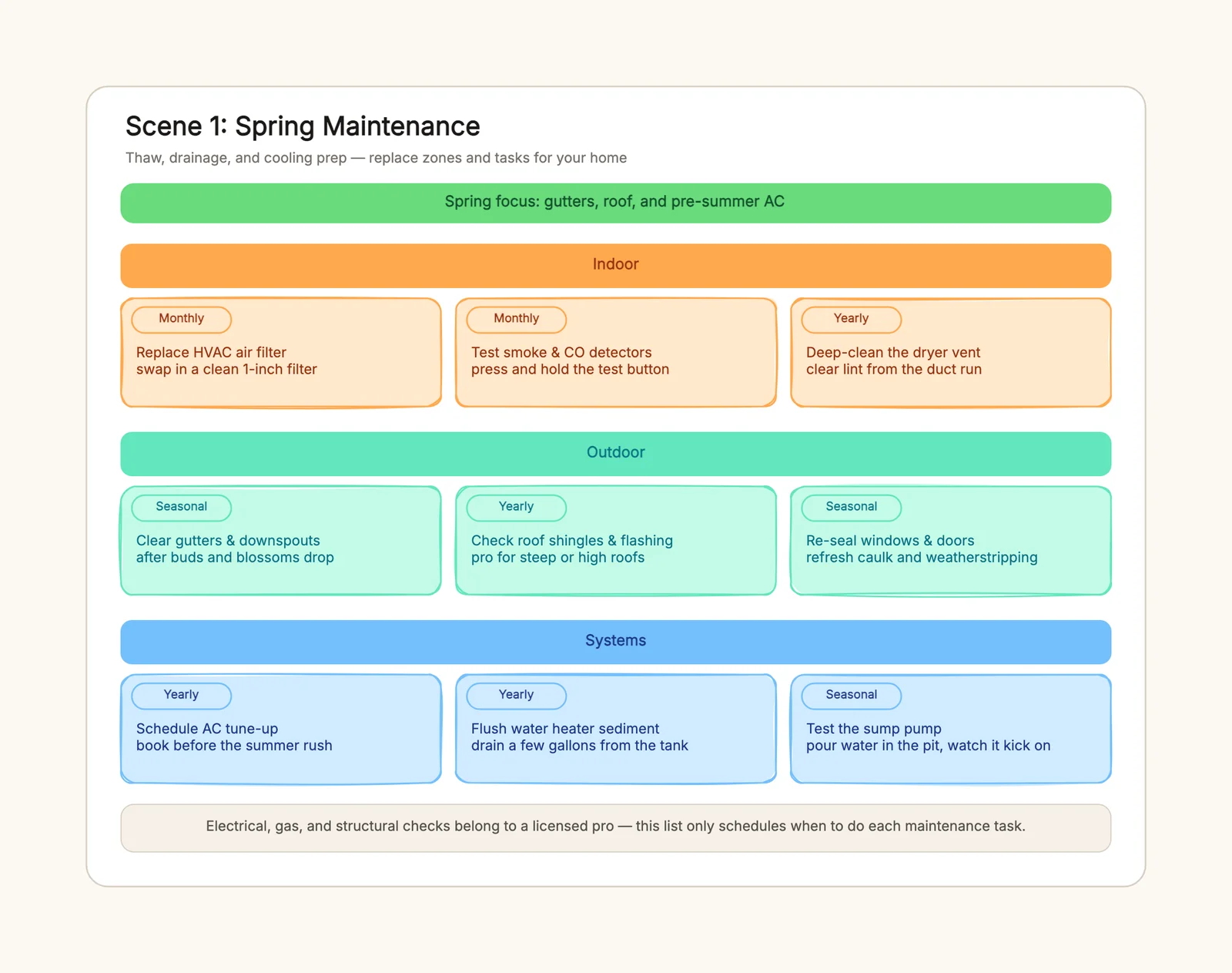
Spring is thaw and drainage season. Clear the gutters after the buds and blossoms drop, check the roof shingles and flashing for winter damage, and re-seal windows and doors where caulk cracked. Inside, flush sediment from the water heater and test the sump pump before the spring rains. Book the AC tune-up now, before the summer rush, when HVAC companies are still cheap and available.
4. Build the fall scene
Fall is freeze-protection season. Clear the gutters and downspouts before the first hard freeze so ice doesn't back up under the shingles. Winterize outdoor faucets — drain the hoses and shut off the valves — and blow out the sprinkler lines. Schedule the furnace tune-up before heating season, and reverse the ceiling fans so they spin clockwise and push warm air down. Check the roof and chimney before winter storms arrive.
5. Build the monthly scene
The monthly scene is your standing routine and should be short enough to finish in ten minutes. Replace the HVAC air filter, test the smoke and CO detectors, and check under sinks and around toilets for leaks. If you have a water softener, check the salt; if you have a sump pump, pour water into the pit and confirm it kicks on. These are the tasks that prevent the slow, silent problems — the drips, the clogged filter, the dead detector battery.
6. Book the pro work on the calendar
Once the seasonal scenes are set, pull out the tasks that belong to a licensed professional and put them on the calendar. The furnace tune-up, the AC service, the electrical check, and any roof or chimney work you can't safely reach. The checklist tracks when to book them; the pro does the work. This is the part people skip, and it's the part that keeps a maintenance plan from becoming a liability.
Spring maintenance example
A spring checklist in a temperate climate might look like this. Indoor: replace the HVAC filter monthly, test the smoke and CO detectors monthly, and deep-clean the dryer vent once a year. Outdoor: clear the gutters and downspouts after the buds drop, check the roof shingles and flashing, and re-seal windows and doors where the caulk has cracked. Systems: schedule the AC tune-up before summer, flush the water heater sediment, and test the sump pump.
The spring mistake that costs the most is skipping the AC tune-up. By July, when the unit fails, every HVAC company is booked out for weeks. Booking in spring is cheaper and gets you on the schedule before the rush.
Fall maintenance example
A fall checklist is mostly about water and heat. Clear the gutters and downspouts before the first hard freeze, check the roof and chimney, and winterize the outdoor faucets — drain the hoses and shut off the valves. Inside, reverse the ceiling fans to clockwise and check the weatherstripping around doors. For systems, schedule the furnace tune-up before heating season, test the sump pump, and drain or blow out the sprinkler system before it freezes.
The fall mistake that costs the most is forgetting the outdoor faucets. A frozen hose bib can crack the pipe inside the wall, and the leak doesn't show until spring when you turn the water back on. Draining and shutting off the valves is ten minutes of work that saves a wall repair.
Monthly maintenance example
The monthly scene is the same list every month, which is the point — it becomes a habit. Replace the HVAC air filter, test the smoke and CO detectors, and clean the kitchen disposal with ice and citrus. Outside, check the gutters for debris, test the exterior lights and sensors, and make sure the downspout extensions point water away from the foundation. For systems, check the water softener salt, test the sump pump, and feel the pipes under sinks for drips.
The monthly list should never be long. If it takes more than ten or fifteen minutes, it won't survive January. Keep it to the tasks that prevent the slow failures — the filter, the detectors, the leaks — and let the seasonal scenes carry the heavy work.
Common home maintenance mistakes
Doing everything only when something breaks
Reactive fixes cost more than a seasonal schedule. A filter swapped on time and a gutter cleared before freeze prevent the emergency call. The checklist exists to front-run the failure, not to document it after the fact.
Treating maintenance like cleaning
Wiping down surfaces does not replace a filter or test a sump pump. If your "maintenance" list is really a cleaning list, the systems never get their own slot. Keep the two separate so the mechanical work gets done.
Forgetting the seasonal tasks
Gutters, furnace, and AC only matter twice a year, which is exactly why they slip. Without a spring and fall scene, they drift to "whenever," and "whenever" becomes "after the leak." Put them on a seasonal list so they surface at the right moment.
Doing pro work yourself
Electrical, gas, and structural checks are licensed work. DIYing a furnace or climbing a steep roof is a safety risk, not a money saver. Schedule the professional and keep the calendar — that's the whole job of the checklist.
No fixed monthly cadence
Without a monthly scene, the filter and detectors drift to "when I remember." A fixed every-month list — the same ten minutes, the same order — turns upkeep into a habit instead of an afterthought.
Keep the checklist useful over time
Review the board once a season and move anything you missed to the next month. When you replace an appliance or move, update the zones and the frequencies, and the checklist grows with the house instead of going stale.
Start with the home maintenance checklist template, replace the example tasks with your own appliances and schedule, and book the pro work the moment you set the season. If you want the cleaning side of the season too, pair it with the spring cleaning checklist template, and if you just moved in, work through the new home checklist template first to establish your baseline before the routine takes over.