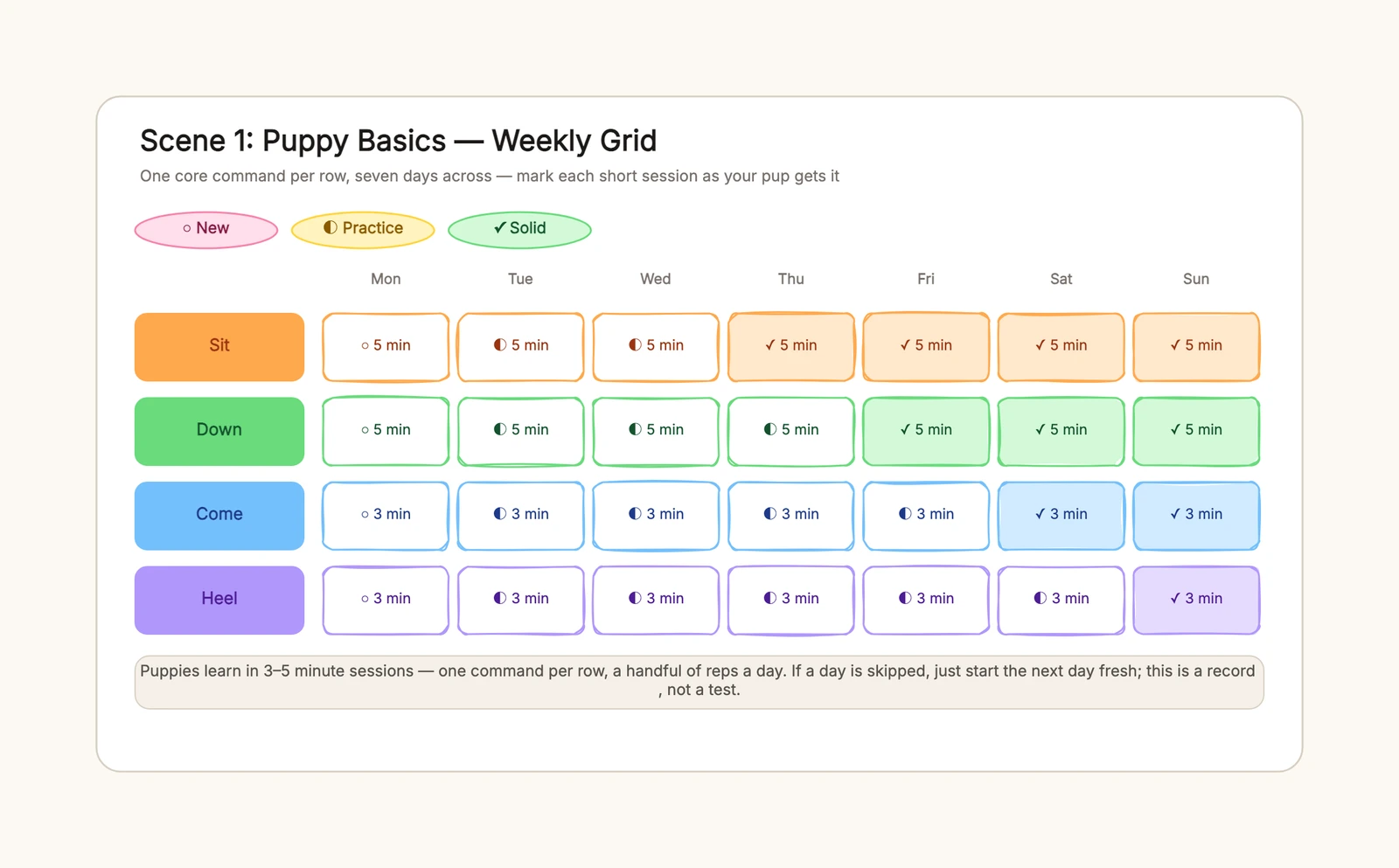
A dog training schedule is the difference between a dog that learns a handful of commands and a dog you keep meaning to train "sometime this week." It turns "we should work on recall" into a row on a grid with a session length in the cell and a checkmark you actually fill in. Sit, down, come, heel — each one gets a row, each day gets a column, and the mark you leave tells you whether the command is new, practiced, or solid.
This guide walks through how to build that schedule, then shows the three shapes it takes for a puppy, an adult dog, and a problem behavior. You can adapt the dog training schedule template and edit the commands, durations, and progress marks in the browser.
What a dog training schedule should achieve
A training schedule is not a to-do list of "train the dog." It is a plan organized around one command at a time, so you always know what to work on today and whether it is working. A usable schedule answers three questions: which command, how long the session is, and whether the dog has it yet.
A useful schedule should produce five outcomes:
- every command sits on its own row, not jumbled into one vague "training" task;
- every cell holds a session length, so a session has an end before it starts;
- progress is marked new, practice, or solid, so improvement is visible;
- a command moves to the next stage only when it holds reliably, not on a date;
- a problem behavior gets a replacement cue, not a punishment.
Avoid treating every dog as the same size. A puppy learns one new command at a time in short bursts, an adult dog is usually past the basics and needs proofing around distraction, and a behavior problem is fixed by teaching what to do instead. Start from the same command-by-command backbone and branch where the dog genuinely differs.
How to build a command-by-command schedule
The most useful schedule is organized by command, not by time of day. When each command owns a row, you can see in one glance what the dog knows and what still wobbles.
1. Pick the commands first
Write down the commands the dog needs most — sit, down, come, heel, and stay if it is an adult. Don't start with tricks. The core four cover most of what a dog needs to live politely indoors and on a leash, and stay is the fifth that makes the difference around doors and mealtimes.
2. Assign a session length
For each command, write how long one session runs. A puppy gets three to five minutes; an adult dog can hold ten to fifteen on a stay or a heel. The length goes in the cell so a session has a stopping point, and you stop on a success rather than when the dog loses interest.
3. Train one command per row
Work one row at a time, a few reps a day. Loading sit, down, come, and heel into a single session confuses the dog and gives you nothing to measure. One command per row keeps the schedule honest.
4. Mark progress, not just completion
Use three states — new, practice, solid — and move a command up only when it holds. A command that works twice out of ten is still new; eight out of ten is solid. The mark is what turns the schedule from a list into a record you can read back.
5. Proof before you call it done
A command that works in a quiet living room often falls apart on a sidewalk with a squirrel going past. Take each command through three stages — indoors, outdoors, then with distraction — and only tick it solid after the last stage holds.
Puppy basics: the weekly grid
A puppy schedule is a weekly grid. The commands sit on the left, the seven days run across the top, and each cell holds a short session plus a mark. The order matters less than the length: a puppy's attention is short, so three to five minutes, a few times a day, beats one long session.
Sit is the first row because almost everything else builds on it — a dog that will sit has an alternative to jumping, pulling, and dashing through a door. Down comes next as a settle position. Come is the recall you will lean on outdoors, so it gets the most repetitions. Heel starts as a few loose-leash steps indoors before it ever meets a sidewalk.
The most common puppy mistake is training too long and stopping too late. End the session on a success, even if that means two minutes instead of five. A puppy that finishes wanting more comes back sharper tomorrow; a puppy that ends bored has learned that training is something to endure.
Adult obedience: proofing the command
An adult dog is usually past the basics, so the schedule shifts from learning to proofing. The same commands stay on the rows, but the columns become stages — indoors, outdoors, then with distraction — and the point is reliability rather than novelty.
Sit gets proofed at the front door, where a visitor or a delivery is the distraction. Down gets proofed while you cook or eat, so the dog can hold a settle while life happens around it. Stay gets time added slowly, with distance and noise before you ask for it anywhere that matters. Heel gets proofed on a real walk, past other dogs and food on the ground.
The rule that governs all of it: move to the next stage only when the current one works eight times out of ten. A date on a calendar does not mean a command is ready. If heel holds eight out of ten in the yard, it earns the sidewalk; if not, it stays in the yard another week.
Behavior correction: swap the cue
Problem behaviors are where a training schedule earns its keep, because they are the easiest to train inconsistently. Jumping, pulling, barking, and chewing are not fixed by saying "no" harder — they are fixed by teaching a replacement cue and practicing it daily.
The schedule becomes a mapping table. Each problem behavior gets a row: the behavior on the left, the replacement cue next to it, a daily practice amount, and a progress note. Jumping up maps to sit-to-greet, practiced three times at the door. Pulling maps to heel, practiced on two short walks. Barking at passers-by maps to quiet-then-settle, practiced once a day. Chewing furniture maps to trade-for-a-toy, with a toy always within reach.
The discipline is to track one behavior at a time. Fixing jumping and pulling and barking all at once spreads the daily practice so thin that none of them improves. Pick the one that costs you the most, run it for two or three weeks, then move to the next.
A blank framework you can copy
The fastest way to start is to copy a blank framework and fill it in, rather than staring at an empty page. Here is the shape that works for most dogs:
- four command rows — sit, down, come, heel — with a session length in each cell;
- seven day columns, so the week reads left to right;
- three progress marks — new, practice, solid — with a short legend at the top;
- for an adult dog, three proofing stages per command — indoors, outdoors, distraction;
- for a behavior problem, a row per behavior with a replacement cue and a daily practice amount.
The dog training schedule template already carries this structure, so you replace the commands and durations instead of building the grid from nothing. When someone else is watching the dog, a separate pet sitter instructions template covers feeding, walks, and contacts — the training schedule is for the training, not for the handoff.
Common dog training schedule mistakes
Training without a session length
Sessions that drag on lose the dog's focus, and you end the day not knowing whether anything stuck. Write a length — three to five minutes for a puppy — and stop on a success.
Training every command at once
Loading sit, down, come, and heel into one session confuses the dog and gives you nothing to measure. One command per row, a few reps a day.
Skipping the distraction stage
A command that works indoors often falls apart outside. Proof it outdoors and around distraction before you tick it solid, or the tick is a lie you will discover at the worst moment.
Punishing instead of teaching a replacement
Saying "no" tells the dog what not to do and leaves it guessing what to do instead. Teach the replacement — sit to greet, heel, trade for a toy — and practice it daily.
Not marking progress
Without a done mark per cell, you cannot tell what is improving. Mark new, practice, and solid so the schedule reflects reality instead of optimism.
Keep the schedule running week to week
Review the schedule at the end of the week and move the marks honestly. A command that held eight out of ten earns the next stage; one that regressed goes back a stage, and that is fine — regression is information, not failure. Keep a short version — the four commands and the current stage of each — in your notes, and reuse the full grid when a new dog or a new behavior arrives.
Start with the dog training schedule template, replace the commands and durations with your own, and train one row at a time. A schedule you review once a week is a dog you train every day, and that consistency is what turns "sometime this week" into a dog that actually listens.