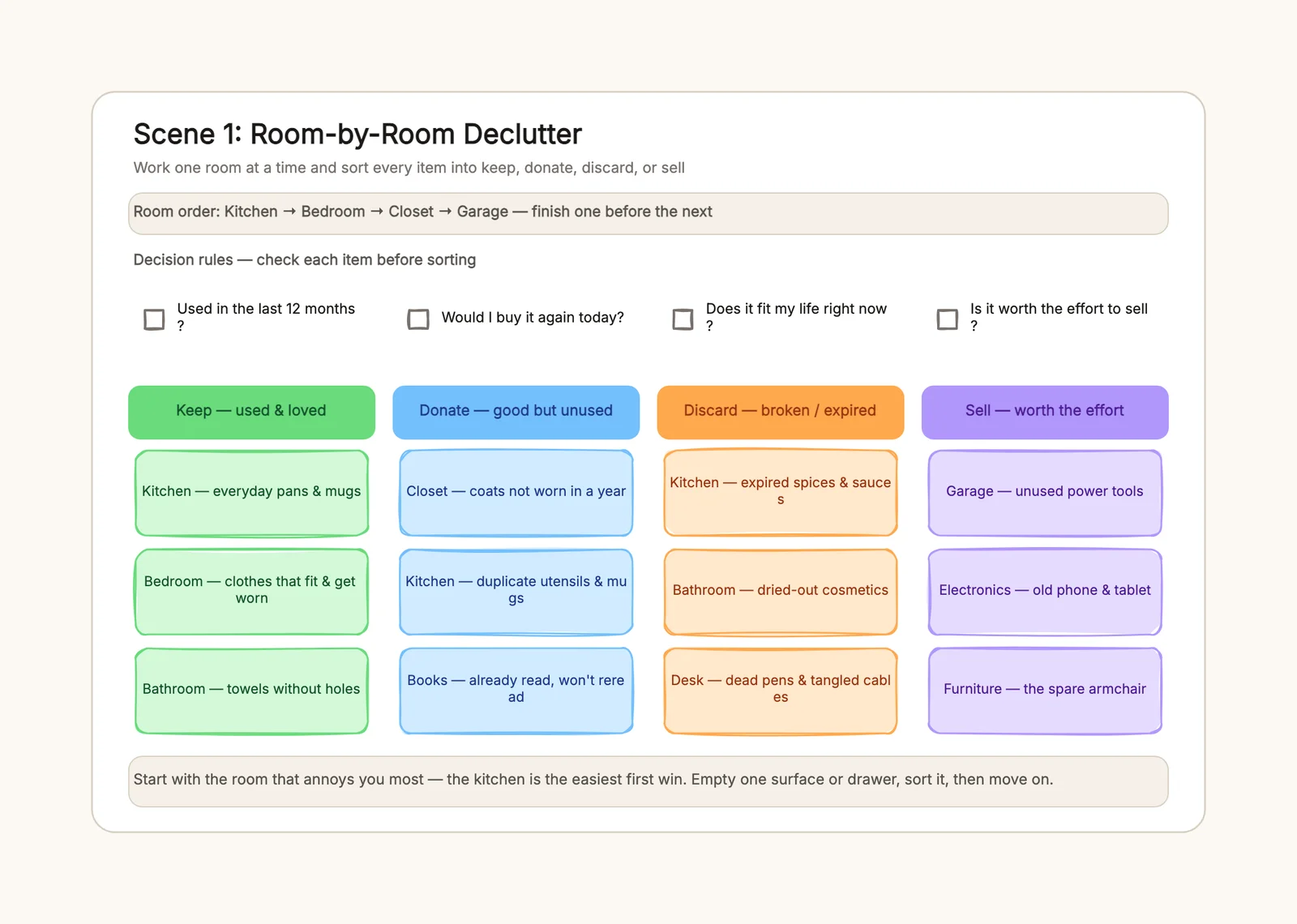
A decluttering checklist is the difference between a room that gets tidied and a room that actually gets lighter. Tidying puts things back where they were; decluttering decides which things don't come back at all. The reason most decluttering attempts stall is not the lifting — it is the deciding. A checklist removes that fatigue by giving every item the same few questions, then four piles to land in: keep, donate, discard, and sell.
This guide walks through how to build a decluttering checklist, then shows the three shapes it takes — a room-by-room pass, a minimalist reset, and an extreme whole-home purge. You can adapt the decluttering checklist template and edit the rules, piles, and example items directly in the browser.
Why a decluttering checklist beats good intentions
"Get rid of some stuff" is not a plan. It has no finish line, no order, and no rule for the hard calls. A decluttering checklist turns that vague intention into a repeatable decision, and that is what makes the difference between a drawer you empty and a drawer you just rearrange.
A useful checklist should do five things:
- give every item the same few questions before you touch the piles;
- sort each item into exactly one of keep, donate, discard, or sell;
- set an order so you work one room or one drawer at a time;
- keep the donate and sell piles moving so they don't drift back;
- leave the keep pile visibly smaller than when you started.
The checklist is the decision engine, not the storage system. Boxes, bins, and labels come after the sort — the sort is where the clutter actually leaves.
How to build a decluttering checklist
The most useful checklist is organized around the four piles, not around a category like "kitchen" or "clothes." When every item has to land in one of four buckets, the decision stops being "where do I put this back" and becomes "does this stay at all."
1. Pick the method first
Room-by-room, minimalist, or extreme — the method sets the pace and the aggressiveness of the rules. Room-by-room is the sustainable default; minimalist is the ongoing standard; extreme is the one-time reset. Pick one and let it decide how strict the questions are.
2. Write your decision rules
Three or four questions cover most calls. "Have I used this in the last year?" "Would I buy it again today?" "Does it fit my life right now?" are the classic set. For a stricter pass, add "would I notice if it vanished?" The rules are the whole trick — they turn a feeling into a check.
3. Empty one surface or drawer at a time
Do not pull the whole room out at once. Empty a single drawer, shelf, or countertop, sort everything in it, then move on. A drawer you finish is proof the method works; a room half-pulled-apart is a reason to quit.
4. Sort into four piles, not three
Keep, donate, discard, and sell — not just keep and get-rid. The sell pile matters because it gives high-value items somewhere to go besides guilt. A second blender, unworn branded clothes, or a spare monitor is a small stack of money, and that stack makes the whole exercise feel worthwhile.
5. Move the out-piles the same week
Donate bags that sit in the hallway get reabsorbed. Schedule the charity pickup or the listing before you start, so the donate and sell piles have a destination and a date.
The room-by-room pass
A room-by-room decluttering checklist works one space at a time, in an order that starts with the room that annoys you most. The kitchen is the classic first win because duplicates and expired food are obvious, but the order is yours — bedroom, closet, garage, whatever nags you.
The kitchen sort is a good template for the method. Keep the everyday pans, mugs, and the knives you reach for. Donate the duplicate utensils and the spare mugs. Discard the expired spices and the cracked containers. Sell the second blender and the appliance you haven't touched in a year. Every drawer runs the same four buckets, so nothing gets to hide.
The room-by-room mistake is starting too big. One countertop is a session; a whole room is a weekend. Keep the unit small enough that you finish it, and the momentum does the rest.
The minimalist pass
A minimalist decluttering checklist applies a stricter test: does this item earn its space? Minimalism is not about owning nothing — it is about owning nothing that weighs on you, and the checklist makes that concrete.
The minimalist rules are sharper. Do I use it every week? Does it bring real joy or use? Could I live without it for a month? Would I notice if it vanished? Run those against a kitchen and the keep pile shrinks fast: one good knife set instead of three, the mugs you reach for instead of the shelf of them, one set of quality towels instead of a linen closet full.
The minimalist mistake is trying to do it as a marathon in one afternoon. Minimalism is a standard you apply again and again, not a single purge. Start with duplicates and "just in case" items — they are the lowest-effort wins and the fastest way to feel the weight lift.
The extreme pass
An extreme decluttering checklist is a one-time reset, not a weekly habit. The rule is deliberately aggressive: if you hesitate, it leaves. Keep only what you would pack for a fresh start, and let the sell pile do real work.
The extreme questions are the moving test — would I take this if I moved tomorrow? Have I touched it this year? Is it broken or hard to fix? Can I sell it for real money? Run those across a whole home and the keep pile collapses to documents, daily-use kitchen and clothes, and the tools you actually reach for. Everything else lands in donate, discard, or sell.
The extreme mistake is doing it without a place for the out-piles. A whole-home purge generates a lot of stuff in one weekend — book the charity pickup and the listing window before you start, or the hallway becomes a staging area that never clears.
Decluttering vs. cleaning: the one-line difference
People confuse the two, and the confusion is why a room can be spotless and still feel cluttered. Cleaning removes dirt; decluttering removes things. A spring-cleaning checklist template asks how to wipe and scrub a surface; a decluttering checklist asks whether the object on that surface still earns its place. Do the declutter first, and the spring clean becomes faster — you can't clean what you've already cleared away.
Common decluttering mistakes
Reorganizing instead of removing
Moving items into prettier boxes still leaves you with the same amount of stuff. Sort into the four piles first — storage is for what survives the sort, not a substitute for it.
No rule for the "maybe" pile
A "maybe" pile quietly becomes a keep pile. If you hesitate, run the decision rules again and default to donate rather than back to the drawer.
Tackling the whole house at once
Decluttering every room in one go is overwhelming and usually gets abandoned. Work one room, or even one drawer, at a time and finish it before moving on.
Letting the out-piles drift
Bags meant for charity sit in the hallway for months and get reabsorbed. Give the donate and sell piles a date and a destination before you start.
Keeping "just in case" items
"Just in case" is how clutter survives every declutter. If an item has not been used in a year and is cheap to replace, it belongs in the donate or discard pile.
Give every outgoing pile an exit
Sorting is only half the job. Add a destination and a deadline to every non-keep item: donation center on Saturday, textile recycling on Tuesday, marketplace listing tonight, or hazardous-waste drop-off on the next collection date. Put bags and boxes beside the door or directly in the vehicle, not in a new “temporary” corner.
For sale items, set a minimum price and an expiry rule before listing. If the item has not sold after the chosen period, reduce the price once and then donate it. This prevents the sell pile from becoming long-term storage. Photograph valuable items as you decide, and remove personal data from electronics before they leave the home.
Keep the checklist working after the big day
The declutter is not the end — it is the new baseline. After the sort, walk the keep pile once more and question anything you hesitated on, then set a lighter rhythm: a ten-minute daily tidy and one drawer or shelf a week. The extreme pass is the reset; the room-by-room rules are the habit that keeps it from building back up.
Start with the decluttering checklist template, swap in your rooms and items, and let the four piles do the deciding. When the surfaces are clear and you want them deep-cleaned, the spring-cleaning checklist template picks up exactly where the declutter leaves off.