A college packing list is the difference between a move-in day that takes a couple of hours and a first week spent texting home for a hair dryer or a second pillow. The people who struggle on move-in day usually did not forget the big things — they forgot the small, dorm-specific ones, and they packed by bag instead of by category.
This guide walks through how to build a college packing list that fits an actual dorm room, then shows how to add modules for study, personal care, sports, accessibility, climate, and hobbies. You can adapt the college packing list template and edit the categories and items directly in the browser.
What a college packing list should actually do
A college packing list is not a shopping list and not a bag list. It is a plan organized around the room and desk you are moving into, not around the luggage you are carrying. A workable list answers four questions: what the bed needs, what the closet needs, what the desk needs, and what the shared bathroom needs.
A useful list produces five outcomes:
- the bed is ready the first night, with the right sheet size and a made-up bed;
- the closet holds a week of clothes plus season layers, not every item you own;
- the bathroom kit fits in a shower caddy and survives the shared-bath walk;
- the desk has a lamp, a power strip, and the study supplies you actually use;
- everything you pack is allowed by the hall, because you checked before you bought it.
Avoid treating a dorm move-in like a home move or a vacation. A home move is room-by-room and includes a kitchen; a vacation is a few days and returns home. A dorm move-in is one furnished room that has to work for a semester, so the list is smaller but the dorm-specific items matter more.
How to build a college packing list from zero
The most useful list is organized by category, not by box or bag. When every item belongs to a category — bedding, clothing, toiletries, storage, study — you can check a category off completely instead of hunting through a half-packed suitcase for a power strip.
1. Check the hall rules and the climate first
Before you write a single item, get two things: the hall's allowed-item list and the weather you are moving into. Many dorms ban toasters, space heaters, and certain kettles, and buying those before you read the rules means carrying them back home. The climate decides how much bedding and how many coat layers you bring, which is the single biggest lever on how much you pack.
2. Confirm the mattress and the room
Most dorm mattresses are twin XL, not twin, and the difference matters because a twin fitted sheet will not stay on. Confirm the size, then decide whether you want a mattress topper. Also measure the desk and closet if you can — a dorm desk is small, and knowing its width stops you from buying organizers that will not fit.
3. Assign items to each category
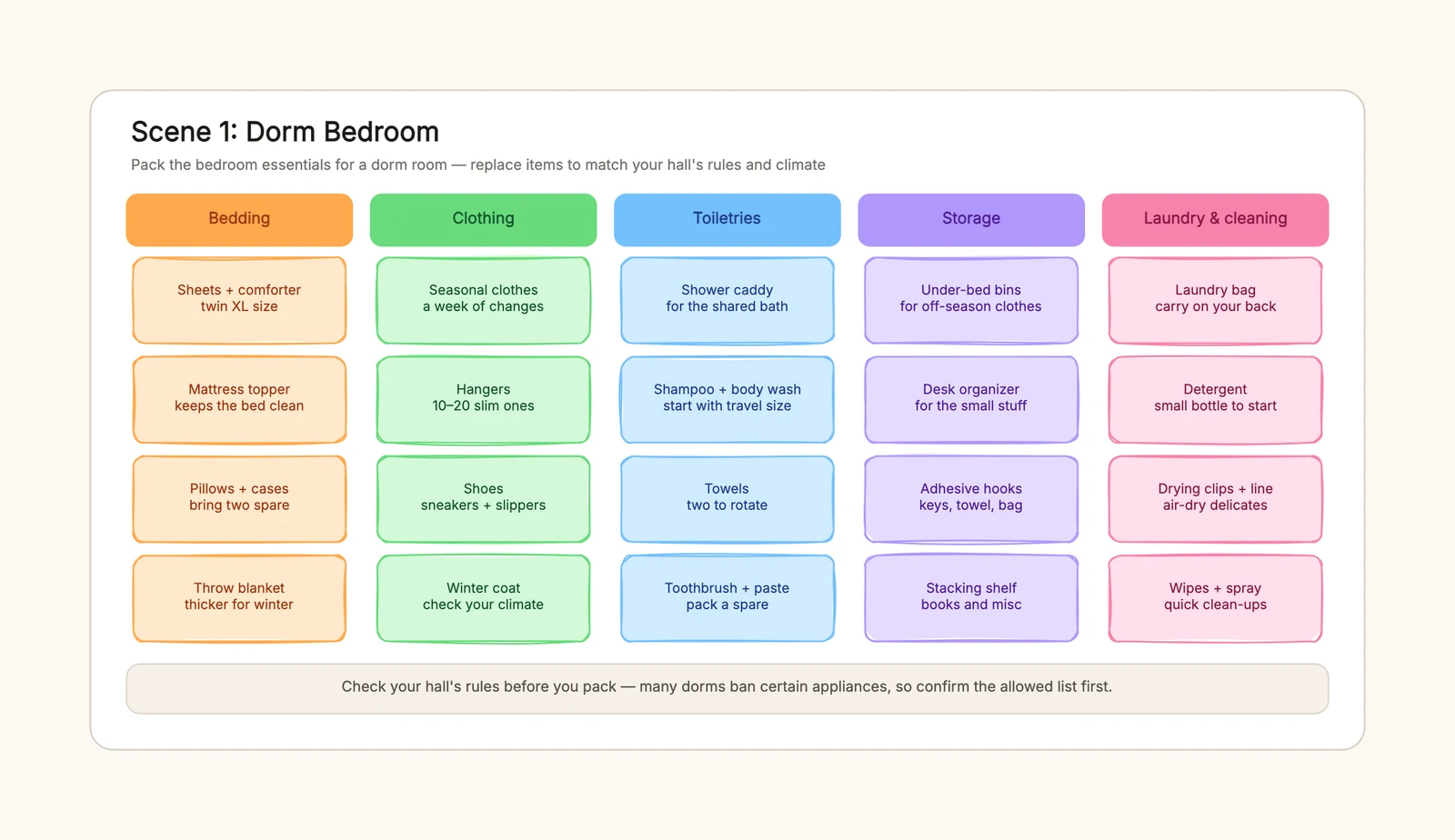
Write the categories down the left side — bedding, clothing, toiletries, storage, study, electronics — and fill real items under each. Bedding gets twin XL sheets, a comforter, a mattress topper, and two pillows. Clothing gets a week of changes, ten to twenty slim hangers, sneakers, and slippers. Toiletries get a shower caddy, travel-size shampoo and body wash, two towels, and a spare toothbrush. Keeping the items concrete means you check them off instead of guessing.
4. Separate the study kit from the bedroom kit
The desk is where dorm rooms get cluttered, because study supplies and bedroom items get mixed in the same pile. Give the study kit its own category — notebooks, pens and highlighters, sticky notes, folders — and the electronics their own — desk lamp, power strip with USB ports, laptop and charger, headphones. This split keeps the desk clear and makes it obvious when you are overpacking gadgets.
5. Coordinate with your roommate
Before you finish the list, send it to your roommate. Two mini-fridges, two printers, and two routers do not fit one room, and splitting them early saves both of you money and floor space. This is also the moment to agree on quiet hours, shelf space, and who brings the shared cleaning spray and paper towels.
6. Do a two-pass check
Check the list once before you load the car, then again on move-in day after the bed is made and the desk is set up. The second pass catches the things the first one assumed — the extension cord that does not reach, the hooks you did not buy.
A complete freshman example
A freshman moving into a shared hall for the first time is the most common case, and the list usually lands on five categories. Bedding is twin XL sheets, a comforter, a mattress topper, and two pillows, with a throw blanket for winter. Clothing is a week of changes, slim hangers, sneakers, and slippers, plus a winter coat if the climate needs it. Toiletries live in a shower caddy — travel-size shampoo and body wash to start, two towels, a toothbrush and paste with a spare. Storage is under-bed bins for off-season clothes, a desk organizer for the small stuff, adhesive hooks for keys and a towel, and a stacking shelf. Laundry and cleaning rounds it out with a carry laundry bag, a small bottle of detergent, drying clips, and wipes plus a spray for quick clean-ups.
The freshman mistake that costs the most is packing the study kit last and it being a mess of loose items. Treat the desk as its own room: lamp, power strip, laptop, and the notebooks you will actually use, in one category you can check off whole.
The study zone: what actually earns a spot
A dorm desk is small, so the study kit should earn its place. Start with the supplies that get used every day — one notebook per class, pens and highlighters in a few colors, sticky notes and index tabs for the textbook, and folders plus a stapler for handouts. Then add the electronics that change how the desk works: a clip-on desk lamp that saves surface, a power strip with USB ports so the laptop and phone charge at once, the laptop and a spare cable, and headphones that block out the hall.
Desk and chair are the forgotten category. A desk mat protects the surface, a seat cushion makes long sessions survivable, an extension cord reaches the outlet that is always on the wrong wall, and bookends keep the textbooks upright. Textbooks and notes close it out — confirm the reading list before you buy, keep printouts in one folder per class, bring an exam-approved scientific calculator, and use a backpack for the daily walk to class.
The rule that keeps the desk from becoming a shelf: if you have not used an item in a semester, it does not go on the desk. The packing checklist template is the trip-sized cousin when you just need a bag for a weekend home.
Add modules by need, not gender
Every student starts from the same bedrock: bedding, clothing, toiletries, storage, and study supplies. Build optional modules around what the student actually does and what the room allows. This makes the list more accurate without assuming that personal care, sports, tools, or decoration belong to one gender.
The personal-care module can include skincare, hair care, shaving supplies, menstrual products, a mirror, and a compact organizer. The sports module can include training clothes, shoes, recovery items, and a gym bag. Keep each module separate so students can select it, trim it, or skip it without disturbing the essentials.
Other useful modules cover cold or wet weather, prescribed medication, mobility or sensory needs, religious practice, creative hobbies, and a small repair kit. Check accommodations and prohibited items with the housing office before buying specialized equipment.
No optional module is fixed. Adapt it to climate, hall rules, budget, laundry access, and distance from home. Writing extras down turns them into deliberate choices instead of a last-minute store run.
Common college packing mistakes
Buying before checking the rules
Dorms ban more than people expect, and a banned appliance is a wasted purchase plus a trip home. Read the allowed list, then buy.
Getting the sheet size wrong
Twin XL is not twin. Confirm the mattress size before you buy sheets and a mattress topper, or the fitted sheet will not stay on.
Doubling the bulky electronics
Two mini-fridges and two printers do not fit one room. Compare lists with your roommate and split the big items before move-in.
Forgetting the dorm-only essentials
A power strip, shower caddy, and adhesive hooks are the items nobody thinks about until the first night. Put them at the top of the list.
Overpacking the closet
Closet space is small and you will go home on breaks. Pack a week of changes plus season layers and rotate, instead of bringing everything you own.
Keep the list useful next semester
After the first month, note what you used, what sat untouched, and what you still had to buy. That edit turns the list into a starting point for next semester, so you pack less and forget less each time. Store a short version — the dorm-only essentials plus the study kit — in your notes, and reuse the full category list when the next move-in comes. A list you review once is a list you only build once.
Start with the college packing list template, replace the categories and items with your own, and check the hall rules before you buy anything with a plug. For leaving home in the first place, the moving checklist template covers the room-by-room packing, and for a weekend trip home, the packing checklist template is the shorter version.