A Christmas shopping list is the difference between a December that closes cleanly and one where you are still ordering gifts on December 23rd. It turns "did I get something for Dad?" into a list you check person by person, so no one is forgotten and the total spend stays where you can see it.
This guide walks through how to build a person-by-person Christmas shopping list, then shows the three shapes it takes for family gifting, an office gift exchange, and gifts for kids. You can adapt the Christmas shopping list template and edit the people, gifts, and budgets directly in the browser.
What a Christmas shopping list should achieve
A Christmas shopping list is not the same as a grocery list. A grocery list tracks items on shelves; a gift list tracks people. The moment you organize by recipient instead of by aisle, the list starts answering the question that actually matters: is everyone covered, and are we over budget?
A useful list should produce five outcomes:
- every person you are gifting has their own row, so nobody is skipped;
- each row carries a gift, a budget, and a done status — not just a name;
- the budget column adds up to your holiday total, so the spend never drifts;
- firm-date gifts — anything ordered online or hard to find — are bought first;
- the done box flips from empty to checked as gifts are bought and wrapped.
Avoid treating every kind of giving as the same list. Family gifts are open-ended, an office exchange is price-capped, and kids' gifts are keyed to age. Start from the same person-by-person backbone and branch where the giving genuinely differs.
How to build a person-by-person Christmas shopping list
The most useful list is organized by recipient, not by category like "toys" or "candles." When each row is a person, you can see at a glance who is done and who is still an empty box.
1. List the people first
Write everyone you are gifting before you write a single item. This is the step that keeps the list honest — if a person is not on the list, they do not get a gift. Include the easy-to-forget people: the dog walker, the neighbor, the coworker you drew in the exchange.
2. Give each person a gift and a budget
For each row, write a gift you actually think they would use and a budget. The budget is what keeps the list from drifting — without a number on each row, one person quietly gets a $10 candle while another gets an $80 wallet, and the total lands where it lands.
3. Set the total before you shop
Decide the holiday total up front, then split it across the rows. If the per-person amounts do not add up to the total, adjust them before you buy anything, not after. The savings tracker template uses the same logic — set a goal and watch the balance move — and the habit transfers to a holiday fund.
4. Buy firm-date gifts first
Anything ordered online, personalized, or hard to find should be bought first, because it has a real deadline. The done box is where those deadlines live. Once a gift is bought, check the row and keep the receipt with it.
5. Review the unchecked rows before wrapping week
A few days before you plan to wrap, look at the rows that are still empty. Those are the gaps — the people you meant to buy for and the gifts still sitting in a cart. Catching them here beats the last-minute scramble.
Family gifting example
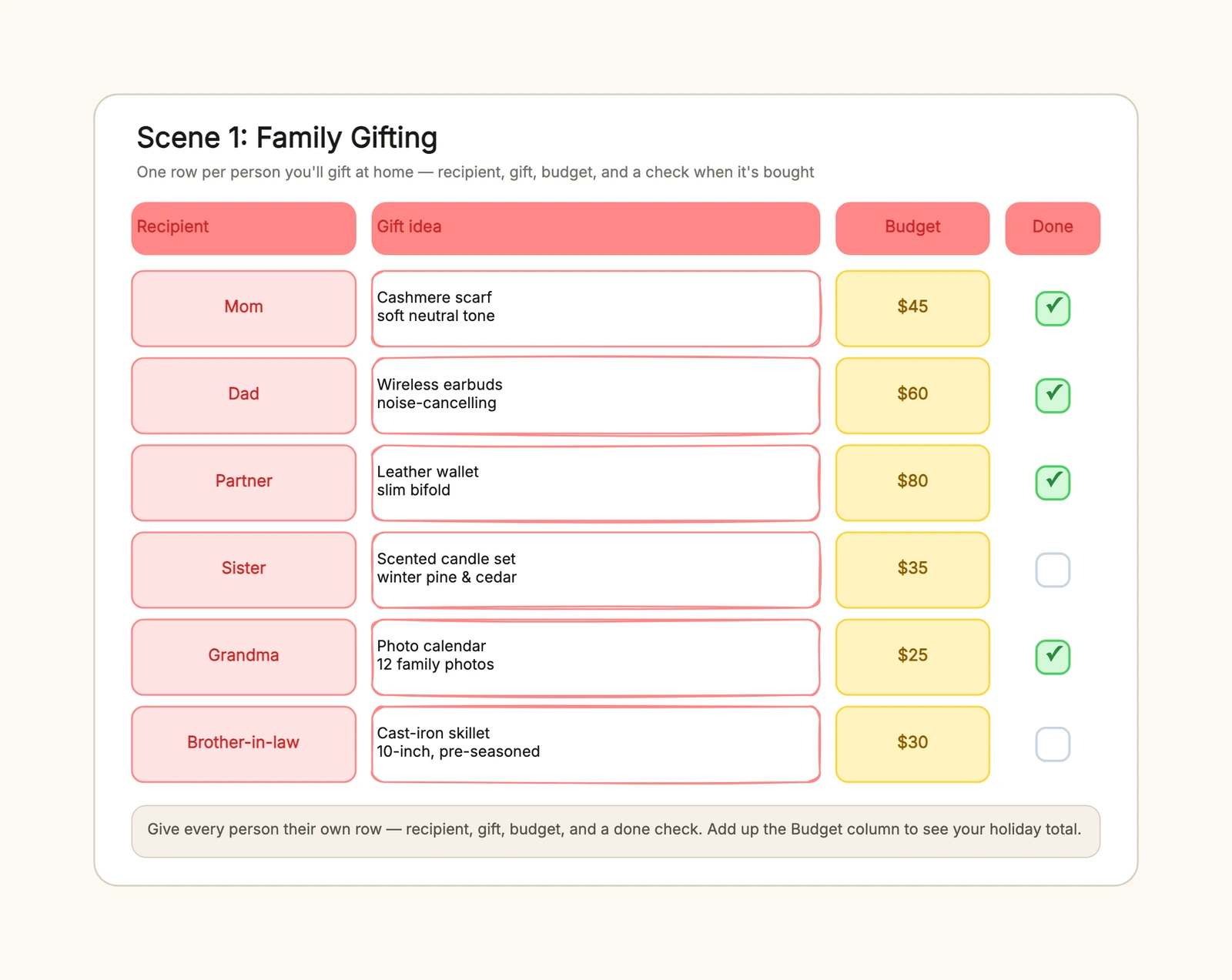
Family gifting is the core use of a Christmas shopping list. The list usually covers the people you gift at home — a partner, parents, siblings, grandparents — each on their own row with a gift and a budget.
A worked example might read: Mom — a cashmere scarf — $45 — done; Dad — wireless earbuds — $60 — done; Partner — a leather wallet — $80 — done; Sister — a scented candle set — $35 — to buy; Grandma — a photo calendar — $25 — done. The mix of checked and unchecked rows is the point: the checked rows are settled, and the unchecked rows are exactly what is left to do.
The key family mistake is listing items instead of people. A flat list of "scarf, earbuds, wallet, candles" hides who each is for, so you cannot tell whether Sister is covered until you dig through the bags. One row per person keeps it obvious.
Office gift exchange: what changes
An office exchange changes the list's constraint: instead of an open budget, there is a price cap. Secret santa and white-elephant exchanges usually set a limit — $20 or $25 — and every row should stay under it so the swap stays fair.
The rows shift from family names to exchange roles: the secret santa pick, the white-elephant gift, the team lead, the new intern, the admin staff. Each gets a gift, a budget at or under the cap, and a done check. The new intern gets a notebook and pen set; the team lead gets gourmet coffee; the admin staff gets a coffee gift card. Writing in whoever you draw keeps the exchange traceable, and the done box shows who has already been bought for.
Gifts for kids: what changes again
Kids' gifts add one field the other lists do not need: age. A gift list for a six-year-old and a twelve-year-old are different lists, so each row carries the child's age next to the name.
A worked list reads: Emma (age 6) — a LEGO set — $40 — done; Liam (age 9) — a board game — $30 — done; Sophie (age 3) — a plush teddy bear — $20 — done; Noah (age 12) — wireless headphones — $50 — to buy; Mia (age 5) — an art supply kit — $25 — done. The age is not decoration — it is the field that keeps you from buying a twelve-year-old something meant for a preschooler.
Budgeting the list without losing the magic
A budget does not make Christmas less generous; it makes it less stressful. The simplest method is a total, a split, and a buffer. Decide the total, split it across recipients, and keep a small buffer for wrapping paper, cards, and the gift you forgot to budget for.
The budget column is what turns the wishlist into a plan. When every row has a number and the column adds up to your total, the question stops being "can we afford this?" and becomes "who is left to buy for?" That is a calmer question to carry into December.
When to start the list
Draft the list earlier than you think you need to. The ideal moment is before the big shopping days arrive, while stock is full and prices have not started climbing. You do not need to buy everything then — you need the names and budgets on paper, because those take thought, not money.
Two things benefit from an early start. The first is online orders: anything shipped has a cutoff date, and the closer you get to the season, the tighter that window becomes. The second is the people whose gifts take research — the hard-to-shop-for uncle, the child with a very specific wish. Give those rows extra time instead of leaving them for a rushed trip.
A rough rule: start the list when you start hearing holiday music, not when the tree goes up. By the time the tree is up, the list should already be half checked off.
Common Christmas shopping mistakes
Listing items, not people
A flat list of "toys, candles, headphones" hides who each gift is for. One row per recipient makes it obvious who is covered and who is still empty.
No budget per person
Without a number on each row, the total drifts and the gifts end up uneven. Assign a budget to every person and add the column up.
Forgetting the done box
A list without a status means re-buying what you already wrapped. Check each row as the gift is bought and wrapped.
Leaving firm-date gifts to the last minute
Anything ordered online or hard to find has a real deadline. Buy it first, before the shipping window closes.
One list for every kind of giving
Family gifts, office exchanges, and kids each have different rules — budgets, price caps, ages. Keeping them in separate scenes is cleaner than one long list.
Keep the list useful after the season
When the season ends, save the list. Next year you start from the same people, swap the gifts, and adjust the budgets — you do not rebuild from scratch. Note what worked and what you over-bought, and the following year's list is faster and closer to right.
Start with the Christmas shopping list template, replace the people and gifts with your own, and check each box as the gifts land. For the celebration that follows the season, the birthday party planning template carries the same person-and-budget logic into a party, and for the money side of the season, the savings tracker template helps you save toward a holiday fund and watch the balance grow.