A bedtime routine chart is the difference between a wind-down that drifts and a wind-down that closes cleanly. Instead of repeating "brush your teeth" three times and negotiating over one more episode, you point at the chart and the next card tells everyone what happens now.
This guide walks through how to build a bedtime routine chart, then shows the three shapes it takes for a toddler, a school-age kid, and a teen. You can adapt the bedtime routine chart template and edit the times and steps directly in the browser.
What a bedtime routine chart should achieve
A bedtime routine chart is not a to-do list of chores. It is a sequence organized around winding down, where the order and the timing do the work for you. A workable chart should answer three questions: what happens in which order, when each step starts, and what the last step before lights out is.
A useful chart should produce five outcomes:
- the order is the same every night, so the routine becomes automatic;
- each step has a time point, so the child can see the night closing in;
- every step is checkable, so finishing one visibly leads to the next;
- the last hour is calm — reading or a quiet activity, not screens;
- lights out is a hard stop the child can point to, not a debate with you.
Avoid treating every age as the same routine. A toddler needs a short, parent-led sequence with an early lights out. A school-age kid can run most of the steps alone. A teen resents being managed step by step — their chart is short and mostly about moving the phone out of the room.
How to build a bedtime routine chart
The most useful chart is built backward from lights out. You start with when the night actually ends, then place the steps so they fit the window in front of it.
1. Set lights out first
Pick the time the child needs to be asleep, not the time you hope to start. For a school-age kid who wakes at 7:00 and needs about ten hours, lights out lands around 8:30, and the wind-down starts around 7:45. Work backward from there.
2. Pick five steps in order
Five is the right number for most children. Too few and the wind-down feels rushed; too many and it becomes a list nobody finishes. The classic order is bath, teeth, pajamas, story, lights out — replace it with your own, but keep the sequence steady once it works.
3. Give each step a time point
A time turns each step from a request into a fact. "7:45 — pajamas" is something the chart says, not something you nag. The times also let the child watch the routine close in, which is what prevents the endless stalling at the last step.
4. Make every step checkable
A checkable card gives the child a small win and a clear "next." Checking off "story time" makes "lights out" feel like the natural end rather than an interruption. Print the chart and let the child mark the cards themselves.
5. Keep the last hour screen-free
The single most effective change in most bedtime routines is moving screens out of the final hour. A tablet or phone keeps the brain alert right up to the moment you ask for lights out. Replace it with reading, a quiet conversation, or a journal.
6. Review after a week
A chart that keeps slipping is usually a start-time problem, not a last-step problem. After a week, adjust the times that keep running late and protect the first step's time, then leave the order alone.
Toddler bedtime routine chart
A toddler bedtime routine is short and parent-led. The child is not running the steps yet — you are — so the chart is less a list of responsibilities and more a visual of the evening's shape, with an early lights out.
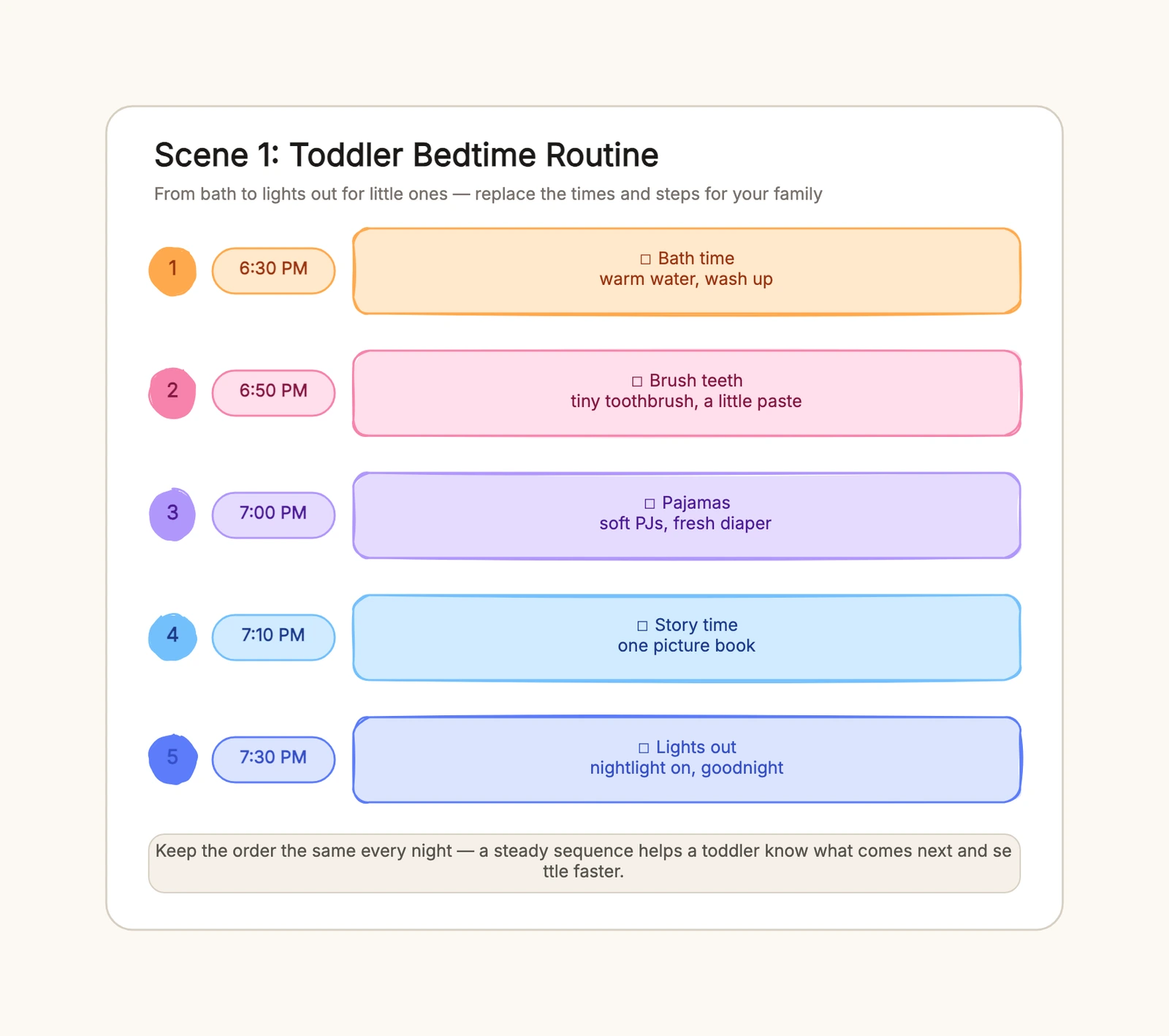
A typical toddler sequence starts with a warm bath around 6:30, brushing teeth with a tiny toothbrush around 6:50, soft pajamas and a fresh diaper at 7:00, one picture book at 7:10, and lights out with a nightlight at 7:30. Each step is one simple card the toddler can point to, and the steady order is what does the settling.
The toddler mistake that causes the most trouble is changing the order. A toddler leans on the sequence to know what happens next; vary it night to night and the wind-down loses its signal. Keep the order fixed and change only the times as the child's schedule shifts.
School-age bedtime routine chart
A school-age routine shifts the work to the child. They shower, brush, and read on their own, so the chart becomes the reminder instead of you. The sequence is the same backbone, but the times move later and the steps get slightly more independence.
A typical school-age sequence runs from a 7:15 shower, to brushing and flossing at 7:35, pajamas and picking tomorrow's clothes at 7:45, twenty minutes of reading at 7:55, and lights out at 8:15. The detail that matters here is the time points — a child who can read the clock can run the whole wind-down without being reminded twice.
For the morning half of the day, the kids morning routine chart template covers wake-up to out the door, and pairs naturally with this evening chart.
Teen bedtime routine chart
A teen's routine is less about the steps and more about the boundary. The chart is short — shower, brush and floss, change, a screen-free wind-down, lights out — and the real work is in what it leaves out: screens in the last hour.
A typical teen sequence runs from a 9:00 shower, brushing and flossing at 9:25, changing into sleep clothes at 9:35, a screen-free wind-down at 9:45, and lights out at 10:00 with the phone charging outside the bedroom. The phone leaves the room, not as a punishment, but as the thing that makes the last step possible.
The teen mistake that undoes the routine is treating lights out as a negotiation. When the phone is already out of the room and the wind-down has been screen-free, lights out is just the last card on the chart, not a fight you re-run every night.
Printable bedtime routine chart
A printable bedtime routine chart lives where the steps happen — the fridge, the bedroom door, or the bathroom mirror. The value of printing it is that the chart, not you, becomes the authority: the child checks off the card in front of them instead of waiting for a reminder.
Print the chart, let the child mark each card, and replace the printed copy when the times change. For families that split the week between two homes, a printed chart at each home keeps the routine identical in both places.
Common bedtime routine mistakes
No time points
Steps without times turn bedtime into an open-ended negotiation. Give each step a time so the child can see the routine closing in.
Changing the order every night
A routine only becomes automatic when the order stays the same. Change the times, not the sequence, once a working order is in place.
Screens too close to lights out
A tablet or phone in the last hour keeps the brain alert. Put the screen step earlier, or move it out of the wind-down entirely.
Too many steps for the age
A toddler needs five simple steps, not a fifteen-line list. A teen resents being managed step by step — keep theirs short and about winding down.
Starting the wind-down too late
If lights out keeps slipping, the problem is usually the start time. Work backward from lights out and protect the first step's time.
Run a seven-night timing check
For one week, write the actual start and finish time beside each step without changing the routine midstream. At the end, look for the delay that repeats: a bath that regularly takes twenty minutes, a missing glass of water, or a story choice that becomes a negotiation. Change one cause, not the whole chart. Move preparation earlier, narrow the choice, or add a five-minute transition cue.
Judge the chart by whether the sequence becomes more predictable, not by whether a child falls asleep at an exact minute. Illness, travel, school events, and developmental changes will disrupt some nights. Keep a simple reset version—wash, teeth, toilet, one story, lights out—for those evenings, then return to the normal sequence the next day.
Keep the chart useful over time
Review the chart every time the family's schedule shifts — a new school start time, an activity that runs late, a growth spurt that changes sleep needs. Keep the order, move the times, and let the chart absorb the change so the boundary stays calm.
Start with the bedtime routine chart template, replace the times and steps with your own, and hang a printed copy where the wind-down actually happens. For the earliest sleep days, the baby sleep schedule template tracks naps and feeds; for the rest of the household's routine, the chore chart template turns daily responsibilities into a visual list.