A back to school checklist is the difference between the two weeks before the first day running smoothly and those same two weeks turning into a series of last-minute trips to the store. It turns "what do we still need?" into a list you tick off category by category, so the pencils, the uniform, and the enrollment form all get handled in the right order.
This guide walks through how to build a back to school checklist, then shows the three shapes it takes for a student, a parent, and a teacher. You can adapt the back to school checklist template and edit the categories, items, and timeline directly in the browser.
What a back to school checklist should achieve
A back to school checklist is not a shopping receipt. It is a plan organized around what each person is responsible for before the first day, and the order those things have to happen in. A workable checklist should answer four questions: what needs buying, what needs filing, what needs to be ready the night before, and which deadlines close before the first day itself.
A useful checklist should produce five outcomes:
- the teacher's supply list is matched item by item, not guessed at;
- the uniform is tried on and bought in the correct fit under the school's sizing guidance, with a spare PE kit where needed;
- the admin — enrollment, bus and meal forms, health records — is filed before the deadlines;
- everything a child can lose is labeled with their name;
- the night before is reserved for packing the bag and setting out the uniform, not for shopping.
Do not treat every checklist as the same size. A student checks off four categories, a parent adds a fifth that is mostly paperwork, and a teacher's list is about setting up a room rather than buying for one. Start from the same category backbone and branch where the responsibility genuinely differs.
How to build a back to school checklist
The most useful checklist is organized by category, not by store aisle. When each item belongs to a category — stationery, uniform, supplies, health, admin — you can see at a glance which part is done and which still has open items.
1. Start from the supply list, not the store
Every grade and teacher sends out a list of what to bring. Before buying anything, get that list and put it at the top. A generic school set usually means duplicates and a missing specific binder, notebook, or calculator. The teacher's list is the source of truth; everything else follows from it.
2. Split into categories
Group the items into stationery, uniform, supplies, and health, and add admin if you are the parent. Keeping them separate matters because they move at different speeds: stationery is a single trip, the uniform needs a try-on and a size decision, and admin has hard deadlines that have nothing to do with shopping.
3. Try on the uniform before the deadline
Kids grow over the summer, so the size that fit in June may be wrong by September. Try everything on and use the supplier's and school's fitting guidance; do not automatically jump a full size if that makes footwear or clothing unsafe. A spare PE kit can help where the school permits it.
4. File the admin first
Enrollment, bus and meal forms, and health records usually close weeks before the first day. Put them at the top of the parent list and confirm each deadline, because a missed form keeps a child out of class even when the backpack is perfectly packed. This is the part of the checklist that has a calendar, not a cart.
5. Label what can be lost
An unlabeled water bottle or jacket disappears on day one. Name everything — clothes, bottles, lunchbox, and locker gear — so lost items find their way back. For younger children this is as important as buying the item in the first place.
6. Reserve the night before for packing
The night before is for packing the bag, setting out the uniform, and putting the lunch plan in place — not for buying pencils. If the checklist is built backward from the first day, the final evening is a five-minute check rather than a panic.
Student checklist example
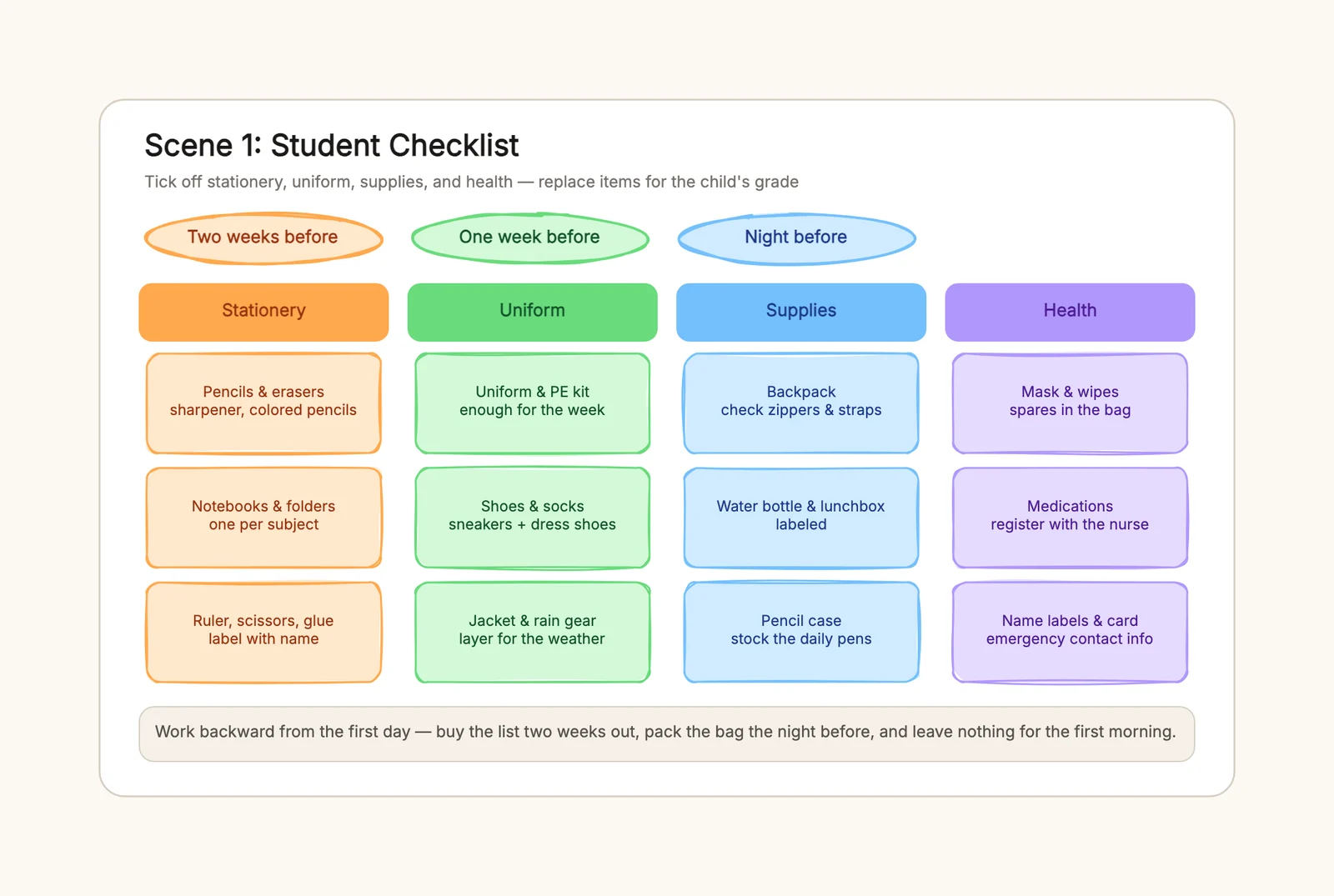
A student's list covers four categories: stationery, uniform, supplies, and health. The order is simple — stationery first because it is one trip, then the uniform because it needs a try-on, then supplies, and health last because it is a small check rather than a purchase.
Stationery is pencils and erasers, notebooks and folders one per subject, and a ruler, scissors, and glue stick, all labeled with the child's name. The uniform is the shirt and PE kit, shoes and socks for both indoor and outdoor use, and a jacket plus rain gear layered for the weather. Supplies is the backpack itself, checked for zippers and straps, plus a labeled water bottle and lunchbox. Health is a mask and wipes with spares in the bag, any medications registered with the school nurse, and a name label with emergency contact information.
The key student mistake is treating the list as something the parent does alone. By middle school the student can own most of it, and handing the list over is part of the point. For more on the university version of this list — the one where a student moves into a dorm — see the college packing list template.
Parent checklist: what changes
The parent list adds a fifth category the child's list never has: admin. It is not more shopping; it is deadlines. Enrollment and registration have a cutoff, bus and meal forms usually have to be submitted online, and health records — the checkup, the shots, the allergy note written to the teacher — close weeks before the first day.
The parent list also reframes the shopping categories. Match purchases to the teacher's list, confirm uniform fit under the school's guidance, and decide the lunch plan—school meal or packed—along with the bus or pickup route. Update emergency contacts and put school events into the calendar.
The parent mistake that costs the most is treating the admin as an afterthought. A child can start school with a secondhand backpack and be fine; a child cannot start without the enrollment form filed. Put the deadlines at the top and the shopping below.
Teacher checklist: what changes again
A teacher's list is less about shopping and more about setup. The room, the plan, and the safety records all have to be ready before students walk in, and none of them can be bought in a single trip the way a pencil case can.
Stationery is red pens and whiteboard markers with a spare set, grading stamps to speed up marking, and labels and sticky notes for student files. The classroom category is the seating and duty chart posted at the front, the bulletin board with pins and borders, and the roster with supply bins sorted by group. Admin is the syllabus and lesson plans laid out for the week, the textbooks and workbooks checked for the right edition, and the class rules plus parent letter printed and filed. Safety and health is the first-aid kit, the allergy and medication log posted where it is visible, and the evacuation routes memorized.
The teacher mistake that costs the most is leaving the safety and health records until the last minute. A missing allergy log is not a missing marker — it is a liability. Set it up before the room fills. For the seating arrangement itself, the classroom seating chart template gives you a starting layout.
The two-week run-up
A simple timeline keeps the whole thing from collapsing into one weekend. Two weeks before, read the supply list, buy the stationery, and try on the uniform. One week before, file the admin — enrollment, forms, and health records — and confirm the bus or pickup route. The night before, pack the backpack, set out the uniform, and put the lunch plan in place.
The timeline and the checklist do different jobs. The checklist carries the what, organized by category; the timeline carries the when. Together they are what turn "back to school" from a rush into a sequence you can actually finish.
Common back to school mistakes
Buying before reading the supply list
A generic school set means duplicates and a missing specific item. Get the teacher's list first and match it line by line.
Forgetting the admin deadlines
Enrollment and health records close before the first day, not on it. A checklist that only covers shopping misses the paperwork that keeps a child out of class.
Buying uniforms in the exact size
Children grow over the summer. Try everything on, follow the uniform supplier's fitting guidance, and keep a spare PE kit if the school allows one.
Leaving everything for the night before
The night before is for packing the bag, not buying pencils. Work backward from the first day so the final evening stays calm.
Not labeling anything
An unlabeled water bottle disappears on day one. Name everything a child can lose so lost items find their way home.
Keep the checklist useful year over year
Review the checklist after the first week and note what was over-bought, what was missed, and which deadlines nearly slipped. A checklist you review once is a checklist you only build once — next year starts from a better list, with the grade and the requirements updated in a few minutes.
Start with the back to school checklist template, replace the categories and items with your own, and work backward from the first day. For the dorm move that comes after K-12, see the college packing list template, and once school starts, the kids morning routine chart template keeps the mornings on track.