Babysitter instructions are the difference between a sitter who follows your routine and one who texts you every half hour to ask what comes next. Written well, a single page answers everything a sitter could need — when the child eats and sleeps, how much to feed, what is off-limits, who to call, and what to do when something goes wrong. The sitter's job is not to memorize your household; it is to keep your child safe and happy on your routine. The page is what makes that possible without a running conversation.
This guide walks through the five sections every set of babysitter instructions needs, then shows how the same structure changes from an infant to a toddler to a school-age child. You can adapt the babysitter instructions template and replace every time, amount, and phone number in the browser.
What babysitter instructions should achieve
A good page has one job: the sitter never has to guess. That is a higher bar than "write down the basics." It means the feeding line says how much, not just when; the safety line says back to sleep, not be careful; and the contact list names a backup for when you are unreachable.
A useful page should answer five questions in a fixed order:
- What is the schedule — wake, naps, meals, and bedtime, with real times;
- What and how much does the child eat, at each meal and snack;
- What are the safety rules, and where must the sitter stay watchful;
- Who does the sitter call, and in what order when something goes wrong;
- What are the house rules — screen time, visitors, and handwashing.
Keep the order the same every time you write one. A sitter who has seen this structure once can find the feeding line in two seconds at 6 p.m., which is exactly when you do not want a phone call.
The five sections, in order
The order is not arbitrary. Schedule comes first because it anchors everything else — feeding follows from the times, and safety follows from knowing where the child will be. Contacts and rules come last because they are reference material, not part of the minute-by-minute flow.
Schedule
Write wake, naps, meals, and bedtime as times, not as "mid-morning" or "after lunch." A time gives the sitter a target; a phrase gives the sitter a decision to make. For an infant the schedule is a loop of feed, wake, and sleep; for a school-age child it is a short list — snack, homework, dinner, lights out.
Feeding
The feeding section fails if it says "feed around noon." Attach a quantity to every time: 120–150 ml per bottle, a toddler plate with three items, or a school-age snack of fruit and yogurt. Amounts matter most for infants, where under- or over-feeding is the thing a new sitter worries about most.
Safety
Safety is where vague language hides. "Be careful" tells the sitter nothing; "back to sleep, firm crib, no pillows" tells the sitter exactly what to do. Write the rules that are specific to your home — gates on the stairs, no small objects within reach, the baby monitor on — not generic caution.
Emergency contacts
This section has two jobs: list who to call, and state the order. Parents first for routine questions, the backup adult for when you are unreachable, and the local emergency number for anything urgent. Writing the order means the sitter is following a list, not making a judgment call under stress.
House rules
Screen time, visitors, handwashing, and tidying up are the parts a sitter will otherwise improvise. A few concrete rules — "no TV before nap," "no visitors without our OK" — remove the most common source of post-sitting friction.
A complete infant example, start to finish
The infant scene is where most parents start, so it is worth walking through one fully. Suppose the baby is six months old, takes a bottle every three to four hours, and naps twice.
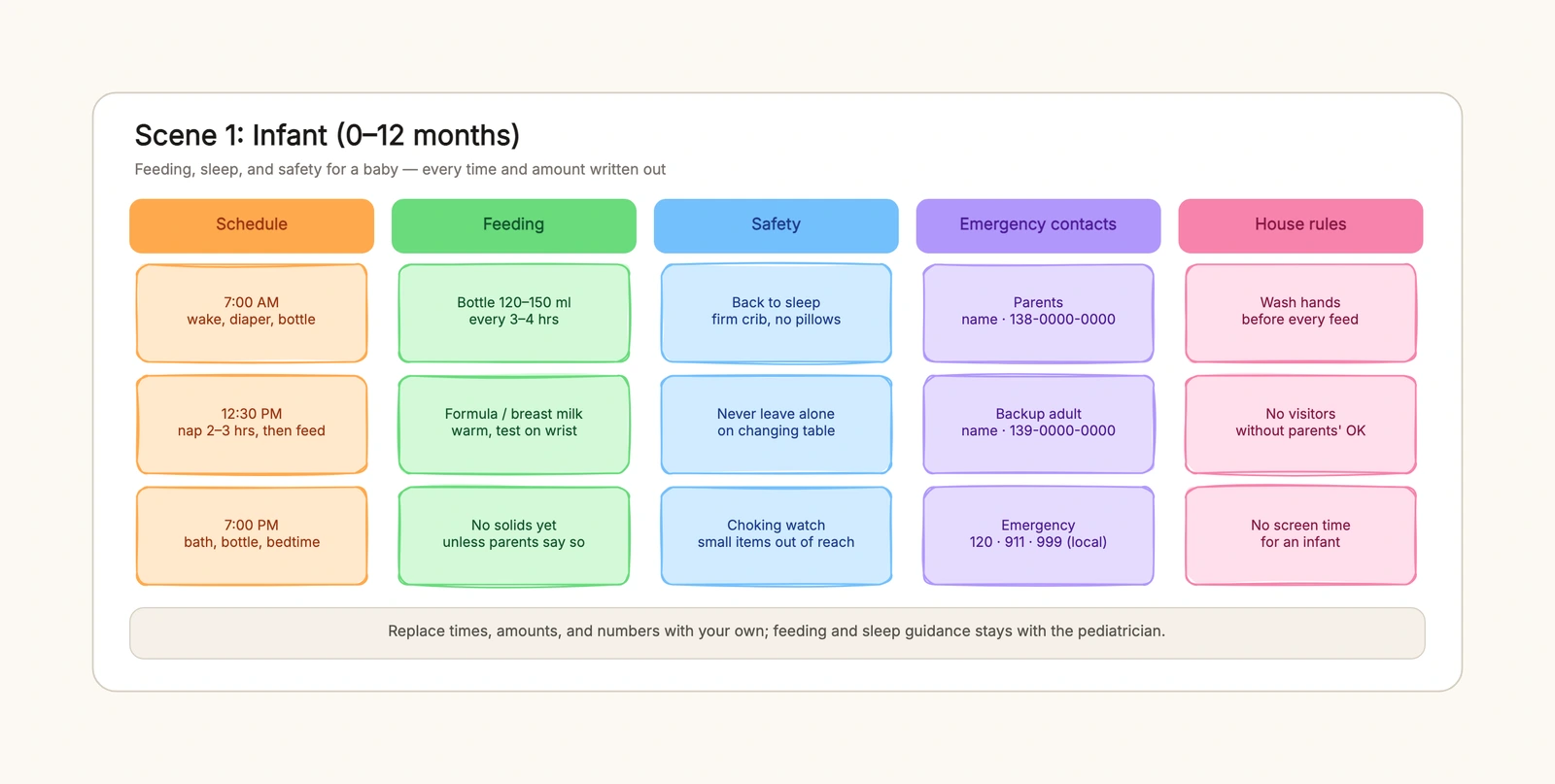
The schedule reads: 7:00 wake, diaper, bottle; 12:30 nap for two to three hours, then feed; 7:00 bath, bottle, bedtime. The feeding section says "bottle 120–150 ml every 3–4 hours," adds "formula, warm and test on your wrist," and notes "no solids yet unless we say so." The safety section has three lines: back to sleep on a firm crib with no pillows; never leave the baby alone on the changing table; keep small objects out of reach. Contacts list the parents, a backup adult, and the emergency number, and rules say wash hands before every feed, no visitors, and no screen time.
The value of this level of detail is that it removes every decision. A sitter who has never met your baby can run the whole day from the page — that is the point of the babysitter instructions template, and it is why each card holds a real example rather than an empty field.
Toddler instructions and the supervision problem
A toddler changes the page in one specific way: feeding and sleep stop being the hard parts, and supervision becomes the hard part. A one-year-old can climb, reach, and put things in their mouth faster than a sitter expects, so the safety section grows.
Feeding becomes three meals plus two snacks, with food cut small and no whole grapes or nuts. The safety section adds childproof gates on stairs and the kitchen, eyes-on supervision near any water, and locked cabinets with cleaners and medicines up high. The schedule keeps a nap — usually one to two hours after lunch — and a predictable bedtime.
The mistake to avoid with toddlers is writing the same page you wrote for a baby. Bottle amounts are no longer the thing the sitter needs; constant watchfulness is. If the safety section is shorter than the feeding section, you have written the wrong page for the age.
School-age instructions and the rules problem
By school age the page flips again. The child can tell you what they want, so the sitter's challenge is not supervision but boundaries — homework, screens, and friends.
The schedule shrinks to the after-school window: snack and homework at 4:00, dinner at 6:00, lights out at 8:30 with no devices. Feeding becomes simple — an after-school snack, a dinner portion served without forcing. The sections that grow are the pick-up plan (who may collect the child, and from where) and the rules: homework before screen time, no friends over without permission, the same bedtime routine every night.
The school-age page is where parents most often write too little, because an older child "seems easy." The child's ease is exactly why the rules need to be on the page — the sitter has to hold a line you set, not invent one on the spot.
The emergency order, written down
Every set of instructions should carry an emergency order, not just a list of numbers. The order is: emergency number first for anything urgent, then the parents, then the backup adult. For a toddler, add poison control to the list; for a school-age child, add the school office.
Writing the order matters more than the numbers themselves, because in a real emergency people freeze. A sitter who has to decide who to call first is a sitter who loses seconds. A sitter who reads "call 120, then us, then the neighbor" follows the list and acts.
For the pet in the house, the same principle applies — the pet sitter instructions template uses the identical routine, contacts, and rules structure, which is why the two pages feel familiar even though one is about a child and the other about a dog or cat.
Handing the page over
The page does half the work; the handoff does the other half. When the sitter arrives, walk the page with them instead of pointing at the fridge. Show them the schedule, confirm they can find the feeding amounts, and ask one question about the safety rules to make sure they actually read them.
A two-minute walkthrough catches the mismatch between what you wrote and what the sitter assumes. "I'll just check the baby at bedtime" is fine only if bedtime is on the page; if the sitter says something that contradicts a rule, fix the page or fix the understanding before you leave. The goal is that once the door closes, the sitter stops needing you — not that you leave a page and hope.
Keeping the instructions current
Instructions decay the moment the routine changes. A child who drops a nap, starts solids, or gains a screen-time allowance makes the page wrong in a way you will not notice until a sitter follows the old version.
Keep a copy of the page and update it whenever the schedule or a rule changes, not just when you book the next sitter. A page that is current is one you can send a new sitter without a preamble; a page that is stale is one you have to re-explain every time, which defeats the point of writing it down.
Start with the babysitter instructions template, pick the scene that matches your child's age, and replace every time, amount, and number with your own. If the sitter is watching a pet instead, the pet sitter instructions template gives the same handoff structure for the animal; for the baby's full day rather than just the sitter's shift, the baby daily schedule template covers feeds, naps, and play across the whole day.