A baby sleep schedule is a 24-hour map of when a baby sleeps, feeds, plays, and is awake — and the most important thing to know about it is that it is a description, not a promise. You cannot make a three-month-old keep to a clock. What you can do is write down the rhythm your baby already has, so the day stops feeling like an endless blur and starts reading as a pattern you can plan around.
This guide walks through how to build that schedule, then shows the shapes it takes at three months, four months, and six months. You can adapt the baby sleep schedule template and drag the blocks to your own times right in the browser. Everything here is an editable example, not medical advice — feeding amounts, sleep training, and developmental questions belong to your pediatrician.
What a baby sleep schedule is for
A sleep schedule is not the same as a to-do list, and it is not a training plan. It is a record with a shape. When you lay the day out as a horizontal 24-hour line with sleep, feed, play, and wake in different colors, three things get easier: you can see total sleep at a glance, you can spot where the day is drifting, and you can hand the whole picture to someone else without a twenty-minute briefing.
A useful schedule answers four questions: when does the baby usually sleep, when do they feed, when are they awake and playing, and where does the night actually begin. If a schedule only lists nap times and skips the overnight hours, it is missing half the story — for a baby, night sleep is often the largest single block of the day.
Color does the heavy lifting here. Sleep, feed, play, and wake each get their own color, so the pattern reads before you parse a single time. That matters when you are glancing at the board mid-day with one hand free — the shape of the day should be visible from across the room, not just from a careful read.
Avoid treating every age as the same size. A three-month-old's day is usually several naps strung between feeds; a six-month-old's day is often two longer naps and a more settled night. Start from the same 24-hour backbone and change the blocks where your baby genuinely differs.
How to build a baby sleep schedule
The most useful schedule starts from observation, not from a chart you found online. Watch for a few days, note roughly when things happen, then put the pattern on a timeline.
1. Pick the age that is closest
Start with the scene nearest your baby's age — three, four, or six months — so the example already has the right rough shape. You are choosing a starting point to edit, not a target to hit.
2. Lay out the overnight sleep first
Put night sleep on the line as its own block. Because a 24-hour day starts at midnight, night sleep spans it: the late-evening stretch and the early-morning stretch sit on opposite sides of the axis. Keeping them both visible is what makes total sleep easy to read.
3. Add the naps
Add the daytime naps as their own colored blocks. For a three-month-old that might be three or four short naps; for a six-month-old, two longer ones. The point is to show how the day is actually shaped, not how a textbook says it should be.
4. Split the feeds from the wake time
A feed is its own block, not just the opening note of an awake stretch. Splitting feeds out makes the rhythm clearer when you look back over a week, and it makes the schedule more honest about what a full day really contains.
5. Color the awake time
The gaps between naps are not empty — they are play, bath, floor time, outings, and wind-down. Color them as play and wake blocks so the schedule reads as a full day, not as a series of naps with blank space in between.
6. Add a note for whoever is on duty
A single line at the bottom — "bath around 18:00, last feed around 19:30" — is enough for a partner, grandparent, or sitter to keep the rhythm without you. Keep it practical and skip anything that sounds like a rule.
3-month-old sleep schedule example
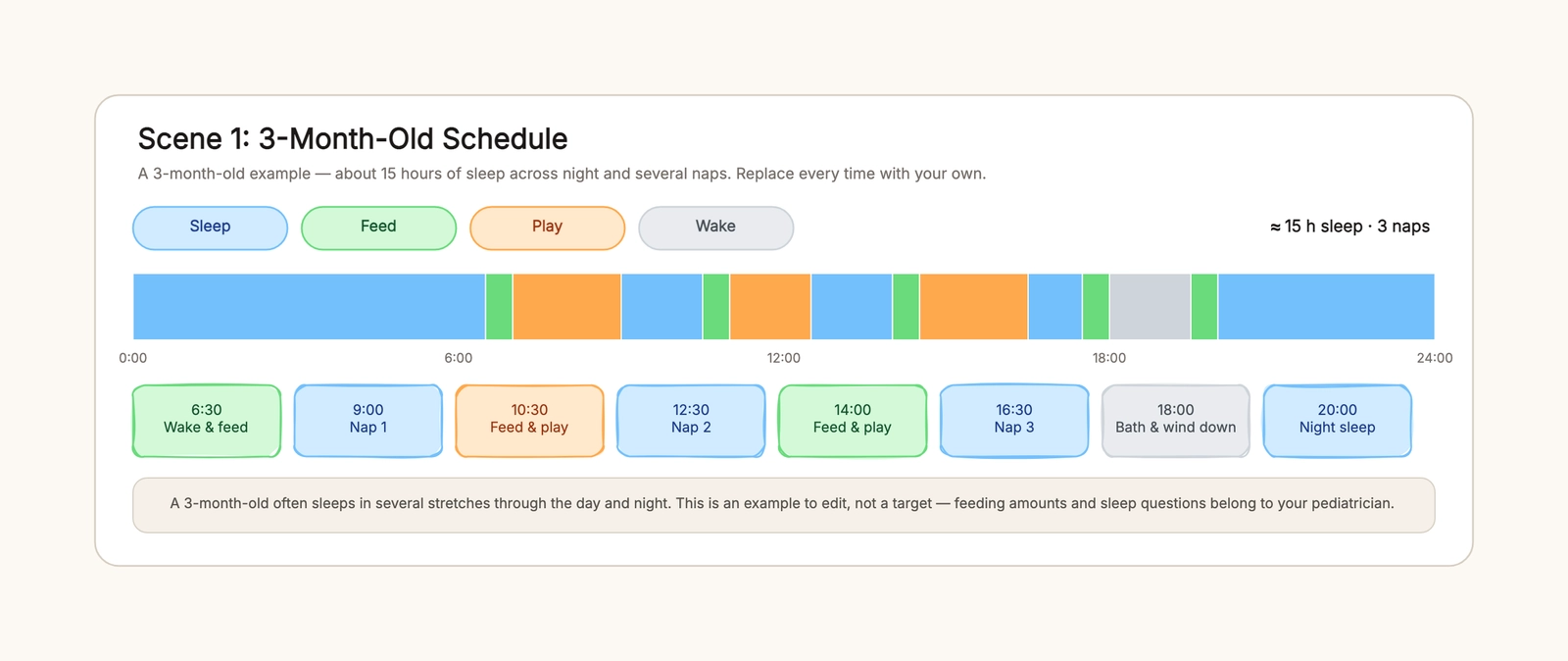
A three-month-old commonly totals around 15 hours of sleep across a long night and several daytime naps, though the range is wide and the pattern is still loose. The day often looks like a night sleep block from roughly 20:00 into the early morning, a wake-and-feed around 6:30, and three naps scattered through the day — for example around 9:00, 12:30, and 16:30.
The useful part of the three-month schedule is not the exact times; it is seeing that the day is still made of several short stretches rather than two clean naps. That tells you not to expect the long, predictable nap windows of an older baby yet, and to plan flexibly around whatever the day actually gives you.
The common three-month mistake is trying to stretch awake time to force longer naps before the baby is ready. If the baby needs a nap at 9:00 and again at 12:30, that is the schedule — record it, don't fight it.
4-month-old sleep schedule: what changes
Around four months, the picture shifts. Awake stretches lengthen, and naps often move later or merge together. A day might still hold four naps, but they drift — an 8:45 nap, an 11:30 nap, a 14:30 nap, and a short 17:00 catnap — while the night stays anchored around 20:00.
This is the age where a schedule is most likely to feel "wrong" a week after you write it, and that is normal rather than a failure. The four-month scene in the template reflects this by keeping the blocks loose and encouraging you to adjust as the pattern settles. Record what you actually see for a few days before you commit to new times, and expect to revisit the board again in a week or two. Rather than chasing the exact minute a nap moved, watch the awake windows. When the gap between naps stretches from ninety minutes toward two hours, the naps naturally slide later and often drop from four to three.
6-month-old sleep schedule: what changes again
By six months, many babies settle toward two longer naps and a more continuous night — around 14 hours total. A typical shape is a wake-and-feed at 7:00, a morning nap from about 9:30 to 11:00, an afternoon nap from about 13:30 to 15:00, a bath and wind-down around 18:00, and night sleep from about 20:00.
The two longer naps are the real change. They create two dependable quiet windows in the day, which is why this is the schedule working parents and anyone with a side project tend to reach for first. Mark those windows clearly and you can plan the rest of your own day around them — for more on the full-day picture, the baby daily schedule template tracks feeds, diapers, and play hour by hour.
Common baby sleep schedule mistakes
Treating the example times as targets
The 15-hour and 14-hour figures are averages, not requirements. If your baby sleeps more or less, that is not a failure — edit the blocks to match reality instead of pushing toward the example.
Leaving night sleep off the timeline
Night is often the biggest sleep block of the day. If you only chart naps, you cannot see total sleep, and you will not notice when bedtime is creeping later or the morning wake is drifting earlier.
Merging feeds into wake time
A feed is its own event. Keeping it separate makes the week's rhythm readable and helps you spot when a "nap" is actually a feed that ran long.
Forgetting the midnight boundary
Night sleep crosses midnight, so it belongs in two blocks — one at the end of the evening and one in the early morning. Trying to fit it on one side of the axis is the easiest way to misread the whole day.
Building a strict schedule too early
A newborn's day is irregular, and that is normal. Use the schedule as a record and a loose plan, not a clock to enforce — and bring feeding, sleep, and development questions to your pediatrician rather than to a chart.
Keep the schedule useful over time
Baby sleep changes fast in the first year, so treat the board as a living record. Revisit it every couple of weeks, slide the blocks to the new times, and let the older version go. The goal is never a perfect schedule — it is a picture of your baby's day that you can read, share, and adjust without starting over each time.
Start with the baby sleep schedule template, pick the age closest to yours, and drag the blocks to your own times. For the hour-by-hour record of feeds, diapers, and play, see the baby daily schedule template, and when your child outgrows naps, the kids morning routine chart template carries the same idea into a step-by-step morning.