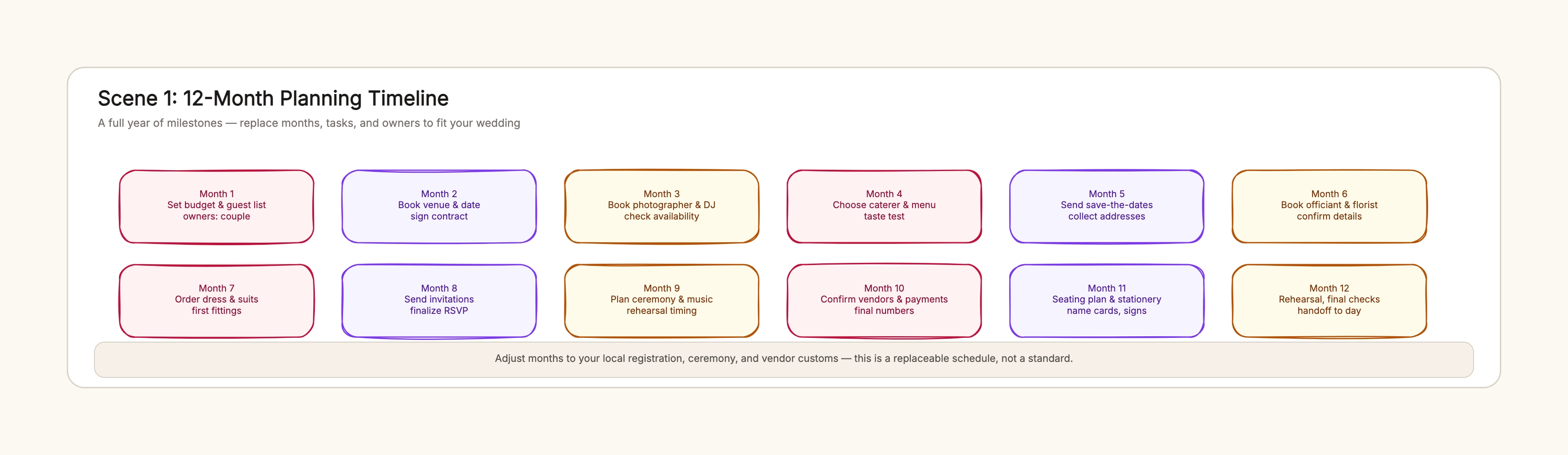
12-month engagement
Who uses it: A couple with a full year to plan
M1 Budget & guest list → M2 Venue → M3–M4 Vendors & caterer
M5–M6 Save-the-dates, officiant, dress order
M7–M8 Invitations → M9–M10 Details & payments
M11–M12 Seating, rehearsal, handoff
Why this works: A full year lets each milestone breathe: venue and key vendors first, dress fittings mid-year, invitations with RSVP buffer, and the final month for details and the handoff.
6-month lean plan
Who uses it: A couple planning on a shorter runway
M1 Venue, date, budget → M2 Key vendors
M3 Caterer & dress → M4 Invitations
M5 Seating, music, confirm → M6 Rehearsal & handoff
Why this works: A lean plan compresses the critical path: lock the venue and key vendors in the first two months, order the dress early, and keep the handoff as the last milestone.
Destination wedding
Who uses it: A couple planning away from home
M1–M2 Venue & travel research → M3 Book flights & rooms
M4–M5 Invitations with travel info
M6–M8 Local vendors & tasting
M9–M11 RSVPs, seating, permits
M12 Arrive early, rehearsal, handoff
Why this works: A destination plan adds travel logistics and local vendor research to the timeline, and ends with arriving early enough for a rehearsal before the day.
Wedding-week run of show
Who uses it: A couple and coordinator managing the final days
6 days out — final guest count to venue
4 days out — confirm all vendors
2 days out — rehearsal & walk-through
Day — hair, ceremony cues, toasts, send-off
Why this works: The final week is a different rhythm: confirmations and rehearsals, then owned tasks for the day itself. Every item has an owner and a backup.
Budget-first plan
Who uses it: A couple planning around a fixed budget
M1 Budget cap & guest list → M2 Venue within cap
M3–M4 Prioritize vendors — photo, DJ, caterer
M5–M6 Trim list, negotiate contracts
M7–M12 Plan within the committed lines
Why this works: A budget-first plan makes the cap the first milestone and ranks every vendor decision against it, so later months stay within the committed spending.
Multiple planners
Who uses it: A wedding with family members owning different parts
Venue — parents | Vendors — couple | Catering — family member
Stationery — friend | Music — couple
Final confirmations — coordinator
Why this works: When several people plan different parts, each milestone carries a named owner. The timeline keeps the whole picture visible so no part gets dropped.