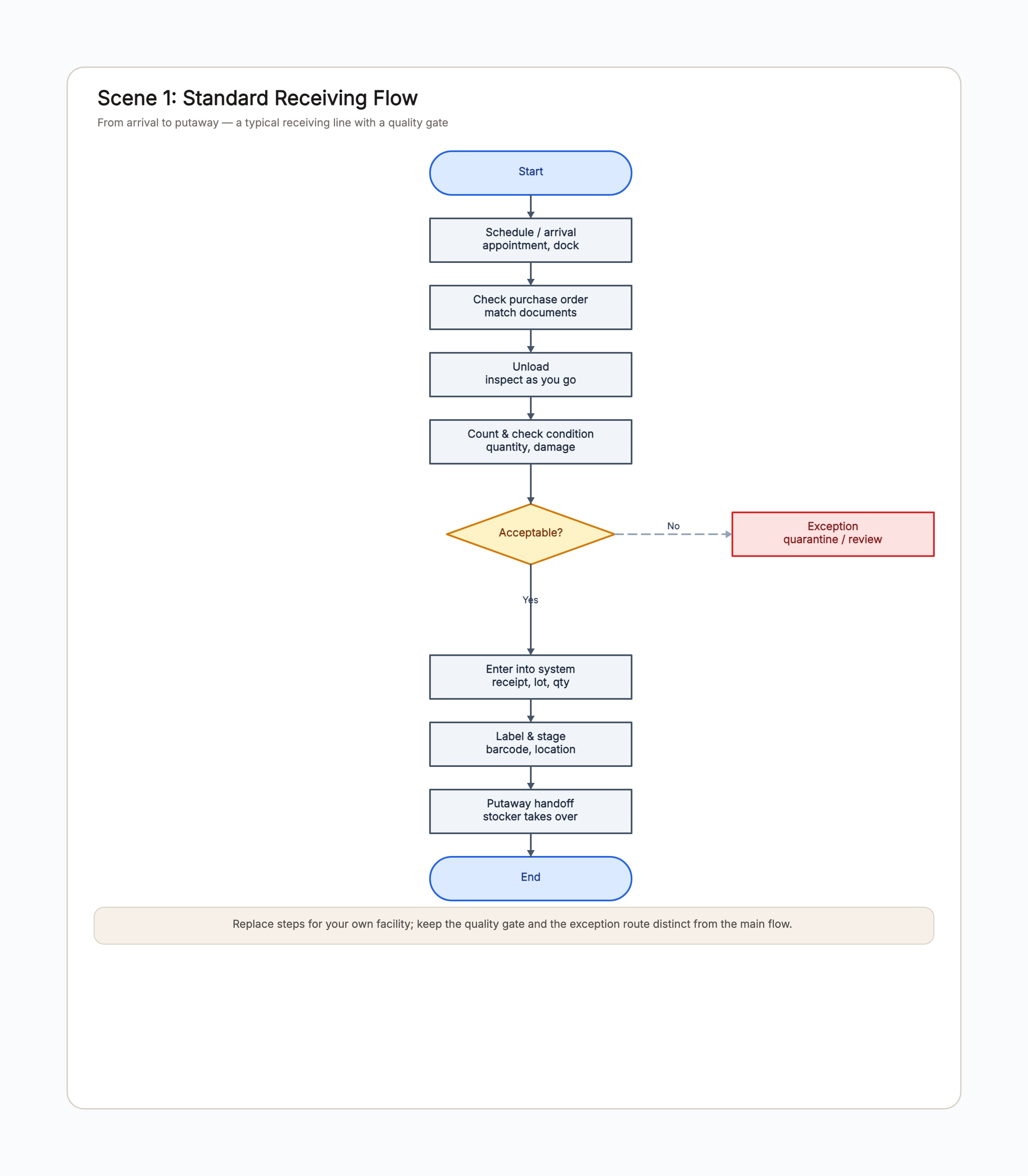
Standard receiving line
Who uses it: A warehouse documenting its daily receiving flow
Arrival → Check PO → Unload
→ Count & inspect → Acceptable?
Yes → Enter → Label & stage → Putaway
No → Exception (dashed)
Why this works: The standard line keeps the main flow clean and puts the quality gate after the physical check, so acceptable goods move straight to entry and putaway.
Receiving with exception branches
Who uses it: A facility handling frequent discrepancies
Match to PO → Valid PO? No → Hold, contact buyer
Count → Qty correct? No → Record short / over
Inspect → OK? No → Quarantine, review
All pass → Enter → Putaway
Why this works: Decision diamonds at each check make the exception routes explicit — no PO, quantity discrepancy, damage — each with a labeled branch and a distinct quarantine path.
Return-to-stock receiving
Who uses it: A warehouse processing customer returns
RMA check → Receive → Condition check
Sellable → Restock | Refurbish → Repair queue | Scrap → Dispose
Update inventory → Notify finance / CS
Why this works: Returns route to one of three dispositions before inventory is updated, so the stock status always matches what the item can actually do.
Cross-dock receiving
Who uses it: A facility moving goods straight to outbound
Arrival → Check PO → Verify count & labels
Acceptable? Yes → Cross-dock to outbound
No → Quarantine / return
Why this works: A cross-dock flow skips putaway and sends acceptable goods straight to outbound, with the same quality gate and exception route protecting the operation.
Receiving with quality hold
Who uses it: A warehouse with an inspection hold area
Receive → Quarantine hold area
Inspect → Pass → Release to stock
Fail → Return / scrap
Why this works: A quality hold separates inspection from the receiving line, so nothing enters available stock until it has passed the check.
Small warehouse receiving
Who uses it: A small operation with a lean team
Dock arrival → Quick PO check → Unload & count
Spot-check condition → Enter system → Putaway
Any doubt → Set aside for review
Why this works: A small warehouse compresses the steps but keeps the decision — any doubt goes aside for review rather than into stock.