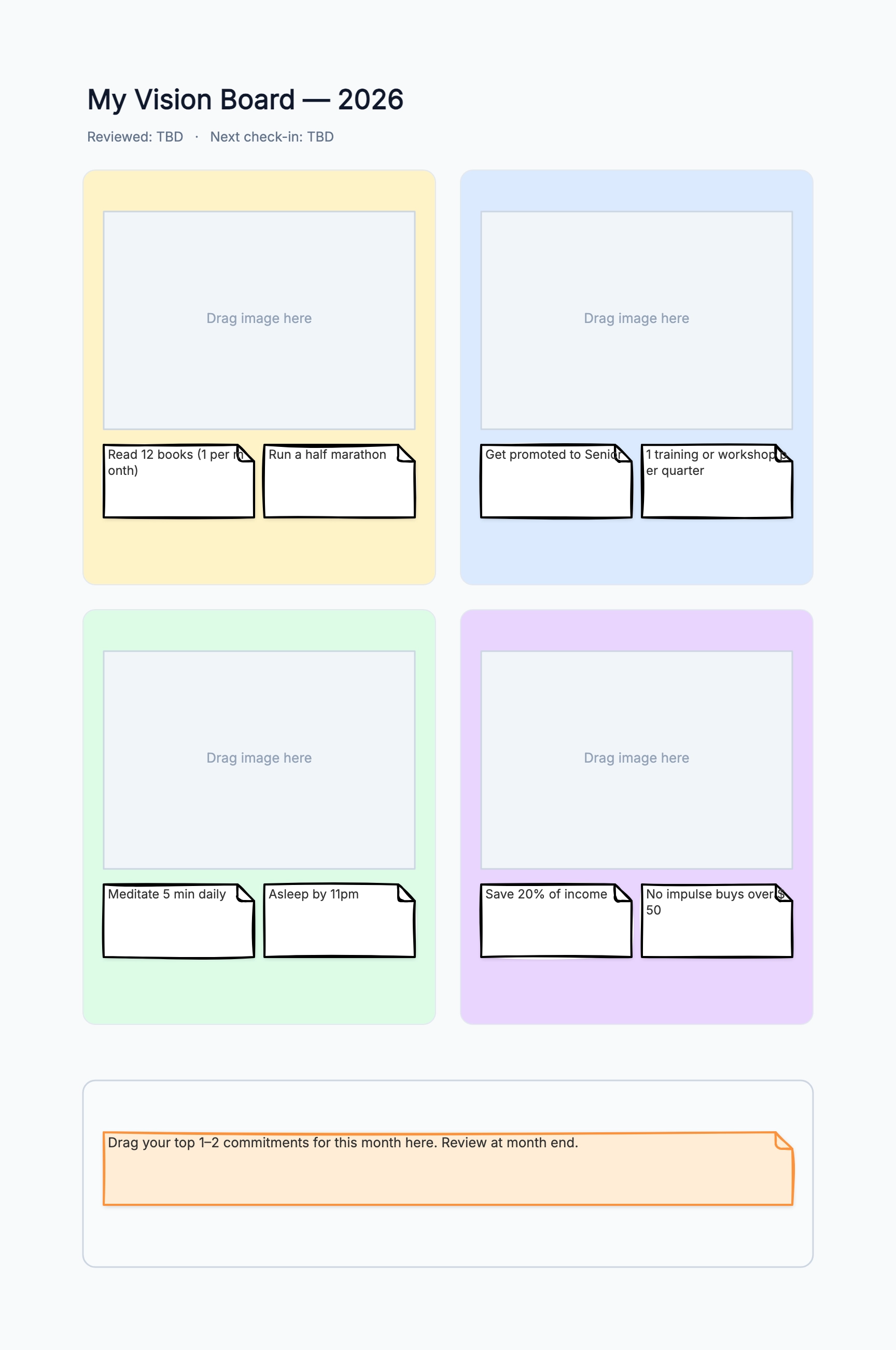
Yearly reset — 12-month goal planning
Who uses it: Someone starting a new year and wanting to set clear annual milestones
Frame 1: Yearly Goals — 3 quarterly milestones with progress bars
Frame 2: Career — 2 upskilling targets (certification + new role)
Frame 3: Lifestyle — 2 wellness habits + 2 travel destinations
Frame 4: Financial — monthly savings target + investment check-in dates
Monthly Commitment: focus on one quarter's milestone each month
Why this works: This layout works for an annual reset because it forces you to spread goals across all 4 life dimensions. The Monthly Commitment frame keeps you from overloading any single theme in a given month.
Career pivot — job change prep
Who uses it: Professional planning a career change or promotion
Frame 1: Yearly — 'Get promoted to Senior by Q3' with quarterly checkpoints
Frame 2: Career — skills to learn, conferences to attend, portfolio projects
Frame 3: Lifestyle — 'Don't let work consume personal time' boundary reminders
Frame 4: Financial — savings runway for possible salary dip during transition
Monthly Commitment: 'Complete 1 portfolio project per month'
Why this works: A career pivot often impacts finances and lifestyle, not just the Career frame. This layout puts the transition into a holistic context — the Lifestyle frame acts as a burnout guardrail.
Wellness reset — health and balance
Who uses it: Someone recovering from burnout or wanting a lifestyle overhaul
Frame 1: Yearly — 'Sleep 7+ hours by March, meditate daily by June'
Frame 2: Career — 'No work emails after 7pm' as a boundary note
Frame 3: Lifestyle — morning routine, evening wind-down, weekly hiking
Frame 4: Financial — 'Save for a wellness retreat' as a motivator
Monthly Commitment: one new habit per month (start small)
Why this works: For a wellness reset, the Lifestyle frame naturally becomes the center of gravity. The Career frame only exists to set boundaries — not to add more work goals. This avoids the trap of turning a wellness board into a productivity board.
Financial freedom roadmap
Who uses it: Someone working toward FIRE (Financial Independence, Retire Early)
Frame 1: Yearly — '6 months emergency fund by December'
Frame 2: Career — 'Side income reaches 30% of salary' as a career/finance crossover goal
Frame 3: Lifestyle — 'No-spend weekends: 2 per month' as a lifestyle adjustment
Frame 4: Financial — investment targets, debt payoff schedule, savings rate
Monthly Commitment: 'Review monthly spending vs budget'
Why this works: Financial freedom boards work best when the other 3 frames exist to support the Financial frame — career for income growth, lifestyle for spending discipline, yearly for timeline accountability. A finance-only board without lifestyle context often fails because it ignores the behavioral side of money.
Student vision board — goals + study habits
Who uses it: College or high school student planning academic and personal growth
Frame 1: Yearly — GPA target, graduation milestones, application deadlines
Frame 2: Career — internship targets, skills to learn, networking goals
Frame 3: Lifestyle — exercise, sleep schedule, hobby time
Frame 4: Financial — part-time income, scholarship applications, savings
Monthly Commitment: 'Apply to 2 internships this month'
Why this works: Students often think only about academics. This layout makes Career, Lifestyle, and Financial visible alongside Yearly Goals — preventing the trap of focusing entirely on grades while neglecting professional growth and personal health.