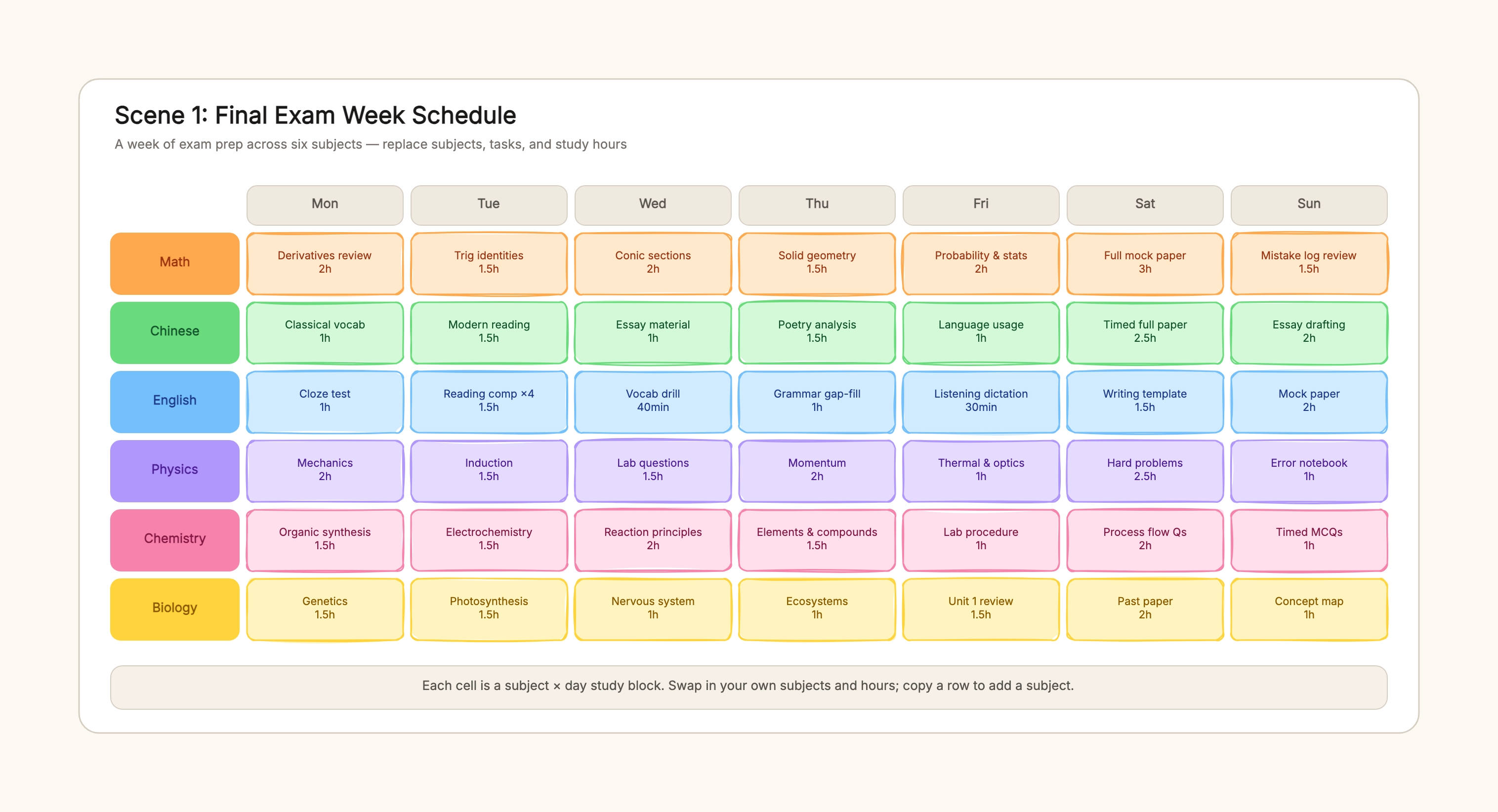
Final exam week for a high-school student
Who uses it: A student prepping for end-of-term exams across six subjects
Math — derivatives, trig, full mock paper
Physics — mechanics, induction, lab questions
Chemistry — organic synthesis, reaction principles
Biology — genetics, photosynthesis, past paper
Saturday — full mock paper; Sunday — mistake review
Why this works: The rows are subjects and the columns are days, so the whole week is one grid. Color-coding each subject makes the balance visible, and the weekend is reserved for a mock paper and review.
MCAT study schedule
Who uses it: A pre-med student prepping for the MCAT
Bio/Biochem — amino acids, metabolism, enzyme kinetics
Chem/Phys — thermodynamics, electrochemistry, fluids
CARS — timed passages, main-idea drills
Psych/Soc — theories, terms, research methods
Practice — one full section each weekend, review next day
Why this works: MCAT prep is section-based, so the rows are the four sections plus a practice row. Content review lives on weekdays and timed sections on weekends.
LSAT study schedule
Who uses it: A law-school applicant prepping for the LSAT
Logical Reasoning — weaken, flaw, sufficient-assumption drills
Reading Comp — passages, comparative reading, outlining
Logic Games — ordering, grouping, hybrid games
Practice — full PTs plus blind review the next day
Why this works: The LSAT is skill-based, so each row is a section type. Timed section drills are mixed with full practice tests, and every test is blind-reviewed before the next one.
NCLEX study schedule
Who uses it: A nursing graduate prepping for the NCLEX-RN or NCLEX-PN
Fundamentals — safety, infection control, basic care
Pharmacology — drug classes, side effects, dosages
Med-Surg — cardiac, respiratory, GI systems
Practice — question-bank sets plus one full CAT exam a week
Why this works: An NCLEX study schedule swaps the rows for nursing content areas and fills the cells with question-bank sets. The same grid keeps every content area in rotation.
College midterm week
Who uses it: A college student juggling four courses
CS 101 — algorithms, data structures, past quizzes
Calculus II — integration, series, practice sets
Organic Chem — mechanisms, reactions, flashcards
Writing — outline, draft, edit the term paper
Why this works: A college schedule is shorter and denser. Rows are courses, and each cell names a concrete deliverable so the week does not blur into "study everything".
Language exam prep
Who uses it: A learner prepping for a proficiency exam like IELTS or TOEFL
Listening — dictation and note-taking drills
Reading — timed passages, skimming practice
Writing — task 1 and task 2 templates
Speaking — recorded responses, self-review
Why this works: A language exam splits into four skills, so the rows are listening, reading, writing, and speaking. Each cell holds a focused drill rather than generic "practice English".