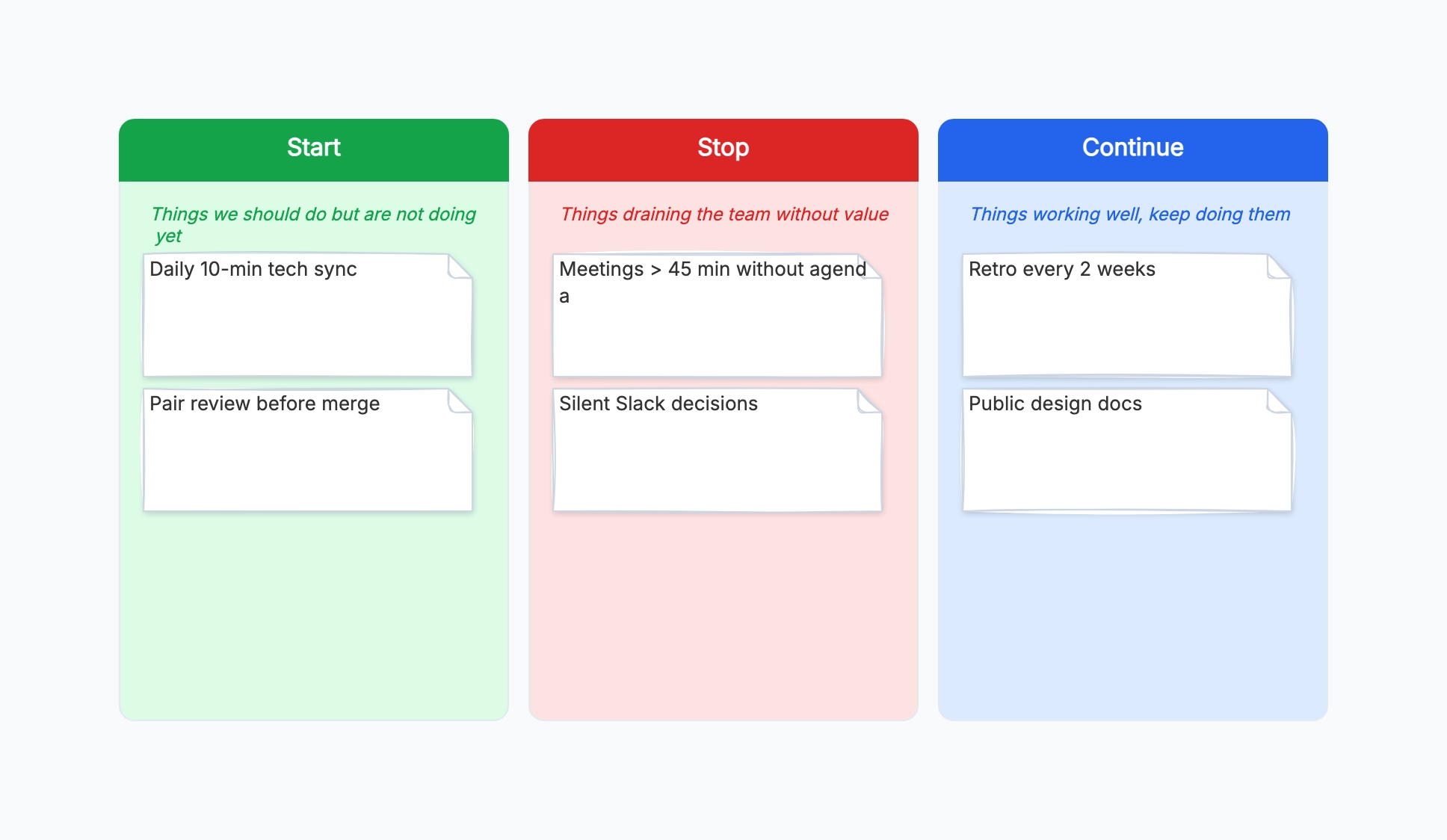
3–5 person squad — Start / Stop / Continue in 45 minutes
Who uses it: Small scrum squad running a lightweight retrospective
Duration: 45 minutes
Format: Start / Stop / Continue
Facilitator: rotate per session, no dedicated role
Silent writing: 3 cards per person, 5 minutes
Discussion: round-robin, one card at a time
Action items: 1–2 items, owner + deadline
Why this works: Small teams don't need a dedicated facilitator — rotating the role every session builds shared ownership of the practice. The 3-card limit prevents the session from dragging on with low-priority items.
8–15 person standard team — 4L in 60 minutes
Who uses it: Standard scrum team wanting broader reflection than 3 columns
Duration: 60 minutes
Format: 4L (Liked / Learned / Lacked / Longed for)
Facilitator: Scrum Master leads + rotating note-taker
Silent writing: 5 minutes independent, then post to shared board
Clustering: 15 minutes group similar cards, label each cluster
Dot-voting: 3 dots per person for priority
Action items: 2–3 items with owner and deadline
Why this works: 4L surfaces positives (Liked, Learned) alongside gaps (Lacked, Longed for). Teams that only ask 'what went wrong' miss the chance to consciously reinforce what already works.
30+ person large group — Sailboat with subgroups
Who uses it: Department or program-level retrospective across multiple teams
Duration: 75–90 minutes
Format: Sailboat (wind / anchors / rocks / island)
Main facilitator + 1 sub-facilitator per 5–7 person group
Subgroup work: 10 minutes internal convergence
Aggregation: subgroups post top clusters to main board
Whole-group voting and action item selection
Why this works: At 30+ people, direct discussion doesn't scale. Subgroups converge locally first, then only top clusters reach the main board. The Sailboat metaphor helps visualize systemic issues that cross team boundaries.
Remote team retrospective — async input + sync discussion
Who uses it: Distributed team across time zones
Async input: team adds sticky notes 24 hours before the sync meeting
Cards capped at 140 characters to fit on screen
Dedicated writing area per member — no visual crowding during silent writing
Sync: 45 minutes discussion + voting only, no writing
Dot voting replaces verbal polls
Action items: small, specific, immediately actionable
Why this works: Async input ensures quieter members contribute equally and that sync time is spent on discussion, not typing. The 140-character cap keeps the board scannable when everyone is on a laptop screen.
First retrospective for a new team — 4L with facilitator prompts
Who uses it: Newly formed team running its first-ever retrospective
Extra 10 minutes upfront to explain the format and rules
Facilitator writes example cards to prime the team
Emphasize psychological safety: 'this is not a performance review'
Focus on Liked and Learned first to build positive momentum
Cap action items at 1 — establish the habit before scaling
Why this works: For a first retrospective, the meta-goal is to make the team want to do it again. Starting with positives (Liked, Learned) before problems (Lacked, Longed for) builds trust in the process before it's used to surface hard issues.
Post-conflict retro — Mad / Sad / Glad
Who uses it: Team recovering from an interpersonal conflict or a difficult sprint
Facilitator must be senior enough to manage emotions
Explicit ground rule: describe events, not people
Mad: what frustrated you — must include specific event, not person
Sad: what disappointed you — same rule
Glad: what you appreciated (helps balance the emotional tone)
Action items focus on preventing recurrence, not blame
Why this works: Mad-Sad-Glad works when the team needs to vent, but the facilitator has to actively drive discussion toward causes and actions, not stop at emotion. The 'describe events, not people' rule prevents the session from becoming personal.