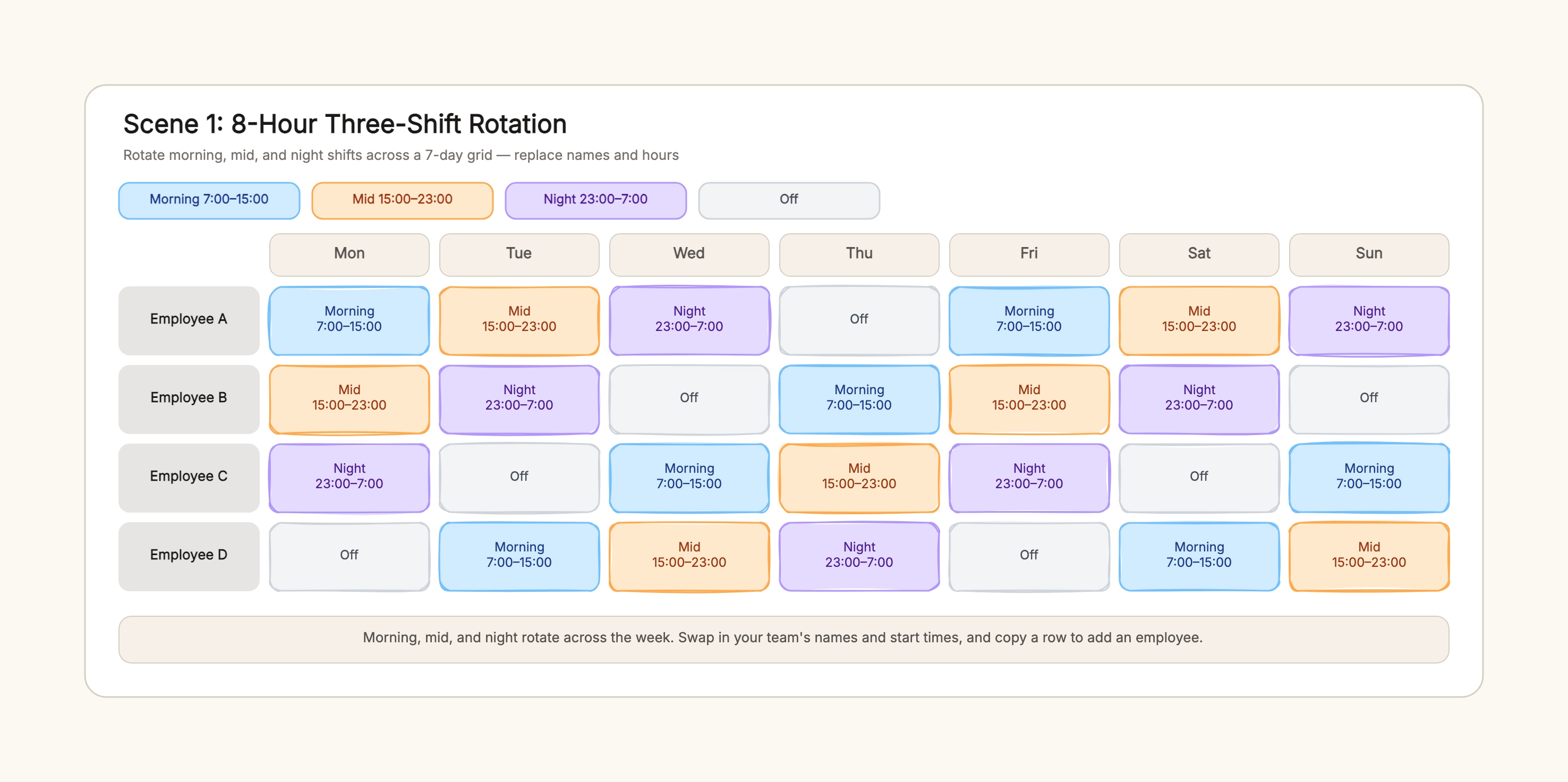
Retail store three-shift week
Who uses it: A store manager covering opening, mid-day, and closing
Why this works: An 8-hour three-shift rotation keeps every day fully covered while rotating who works the closing and night shifts.
These shift schedule examples cover the rosters teams actually run: an 8-hour three-shift rotation, a 12-hour two-shift rotation, and a 24/7 coverage map. Pick the one closest to your operation and swap in your names and times.

Who uses it: A store manager covering opening, mid-day, and closing
Why this works: An 8-hour three-shift rotation keeps every day fully covered while rotating who works the closing and night shifts.
Who uses it: A shift lead scheduling a 24-hour facility
Why this works: A 12-hour two-shift schedule uses longer blocks and fewer handovers, with rest days built into each row.
Who uses it: A nursing supervisor confirming round-the-clock staffing
Why this works: Flipping the grid to shifts-by-day makes an uncovered slot immediately visible, which is the point of a coverage check.
Who uses it: A team lead spreading night shifts fairly
Why this works: Color-coding nights and offs in one grid shows at a glance whether one person is carrying all the late shifts.
Who uses it: A small team balancing weekday and weekend hours
Why this works: A weekly grid makes the weekend burden visible, so you can rotate who works Saturday and Sunday.
Who uses it: A manager publishing the month for a larger team
Why this works: Duplicating the weekly grid into a monthly shift schedule template lets the whole team see the month at once.
Go back to the template, swap in your own content, and keep the same structure if it fits your project.
Use this template: /editor/new?template=shift-schedule
Use this template