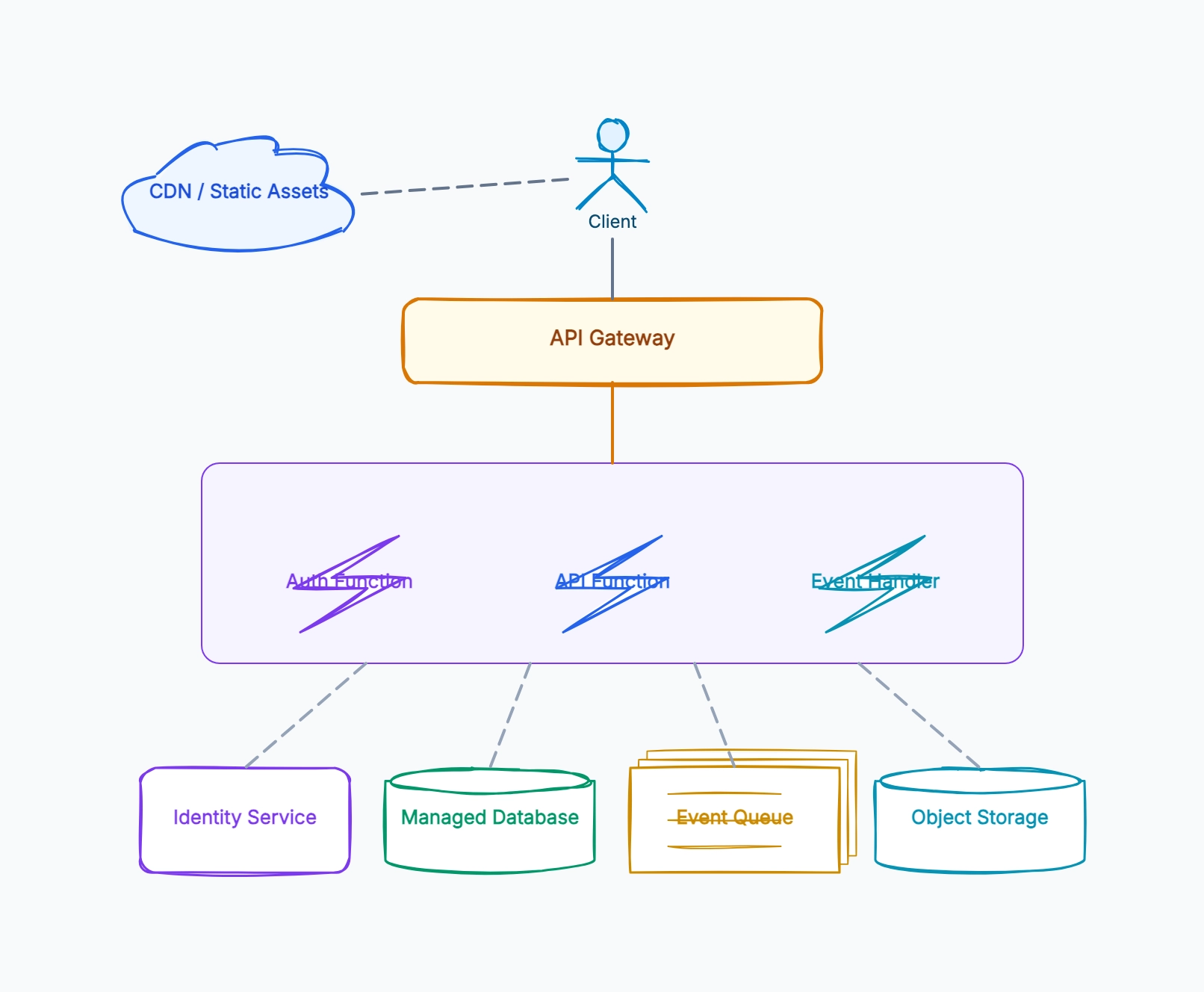
Serverless web app (the baseline)
Who uses it: Team shipping a small product without ops overhead
Static frontend on a CDN (S3 + CloudFront, Vercel, Netlify)
API Gateway → Lambda for backend endpoints
DynamoDB or Aurora Serverless for the database
Cognito or Auth0 for identity
Pay-per-request; scales to zero when idle
Why this works: The baseline serverless web app is the cleanest start — the diagram has no servers to provision, and the entire stack scales to zero. Trade-offs: cold starts on first request, and per-service vendor lock-in.
Event-driven serverless
Who uses it: Team building async workflows on cloud events
S3 upload → Lambda processes the file
DynamoDB stream → Lambda updates aggregates
SQS / SNS / EventBridge fans events to multiple handlers
No API Gateway needed for purely async paths
Each event source has its own throttling and DLQ policy
Why this works: Event-driven serverless skips the gateway entirely — the diagram puts event sources at the top instead, with functions reacting to events from S3, DynamoDB streams, or a message bus.
Serverless API with streaming
Who uses it: Team adding real-time updates to a serverless app
WebSocket support via API Gateway WebSocket APIs
AppSync subscriptions for GraphQL real-time
Functions push updates to connected clients
Connection state stored in DynamoDB
Combines request/response and pub/sub
Why this works: Streaming on serverless usually means API Gateway WebSockets or AppSync subscriptions — the diagram adds a connection store, because functions need somewhere to remember who's subscribed between invocations.
Edge serverless
Who uses it: Team running functions close to users
Functions deployed to edge POPs (Cloudflare Workers, Lambda@Edge)
Sub-50ms execution near the user
Limited runtime (no long-lived state, smaller deps)
Origin functions still handle heavy work
Used for auth, redirects, A/B testing at the edge
Why this works: Edge serverless adds a second function layer at CDN POPs — the diagram has edge functions before the origin API gateway, doing fast work (auth check, routing) close to the user and falling back to origin for heavier requests.