Back to template

Restaurant Database Schema Examples

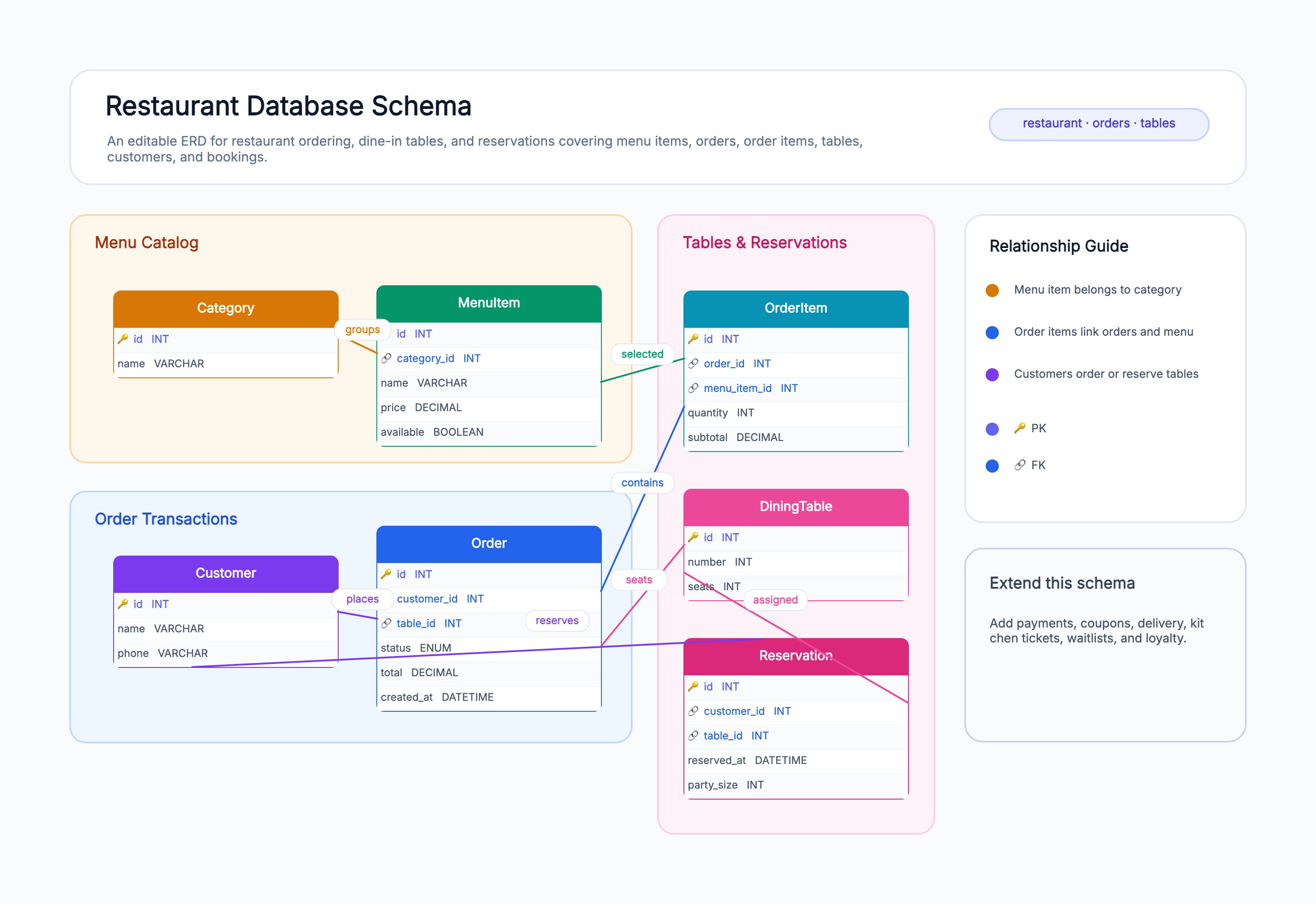
These restaurant schema examples show how the same menu-order-table core adapts to dine-in service, delivery, multi-location chains, and reservation-heavy fine dining.

Restaurant Database Schema Examples

Real examples

Dine-in ordering (the baseline)

Who uses it: Developer building a first restaurant ordering system

MenuItem (id, category_id, name, price, available)
Order (id, table_id, status, total, created_at)
OrderItem (id, order_id, menu_item_id, quantity, subtotal)
RestaurantTable (id, number, seats)
Order links to a table; no delivery address needed

Why this works: Dine-in is the cleanest starting schema — an order belongs to a table, and the order-item table resolves the many-to-many between orders and menu items, which is the single most important relationship to get right.

Delivery / takeout

Who uses it: Team building an online food ordering app

Order gains delivery_address, delivery_fee, and a courier_id
Customer (id, name, phone, address) becomes central
No table link — orders are tied to customers, not tables
OrderStatus enum extends to preparing, out-for-delivery, delivered
Optional Courier table for delivery assignment

Why this works: Delivery shifts the order's anchor from a table to a customer address — the diagram drops the table relationship and adds delivery fields, which is the core difference between dine-in and off-premise schemas.

Multi-location chain

Who uses it: Team running several restaurant branches on one system

Location (id, name, address) added at the top
MenuItem can be location-specific via a location_id or a join table
Orders and tables both reference a location
Pricing can vary per location (price on a menu-location join)
Reporting rolls up orders by location

Why this works: A chain adds a Location entity that nearly every other table references — the design decision is whether menu and pricing are global or per-location, which the diagram should make explicit with a join table when prices differ.

Reservation-focused fine dining

Who uses it: Team where table booking matters as much as ordering

Reservation (id, customer_id, table_id, reserved_at, party_size, status)
A table has many reservations across different times
Availability query checks for overlapping reserved_at windows
Order optionally links to a reservation
Waitlist table for when no table is free

Why this works: Reservation-heavy restaurants make the booking relationship first-class — the diagram emphasizes the table-reservation link and the overlap check, because preventing double-booking is the schema's main job here.

Tips for better study mind maps

  • Always resolve orders-to-menu-items through an OrderItem table; a direct link can't carry quantity or per-line price.
  • Store the price on OrderItem at order time, not just on MenuItem — menu prices change, but historical orders must keep their original totals.
  • Give Order a status enum so the kitchen and front-of-house can query open vs completed orders.
  • For reservations, model the time window explicitly so an availability query can detect overlaps.

Start editing online

Go back to the template, swap in your own topics, and keep the same structure if it fits your class or project.

Use this template: /editor/new?template=restaurant-database-schema

Edit this restaurant schema template