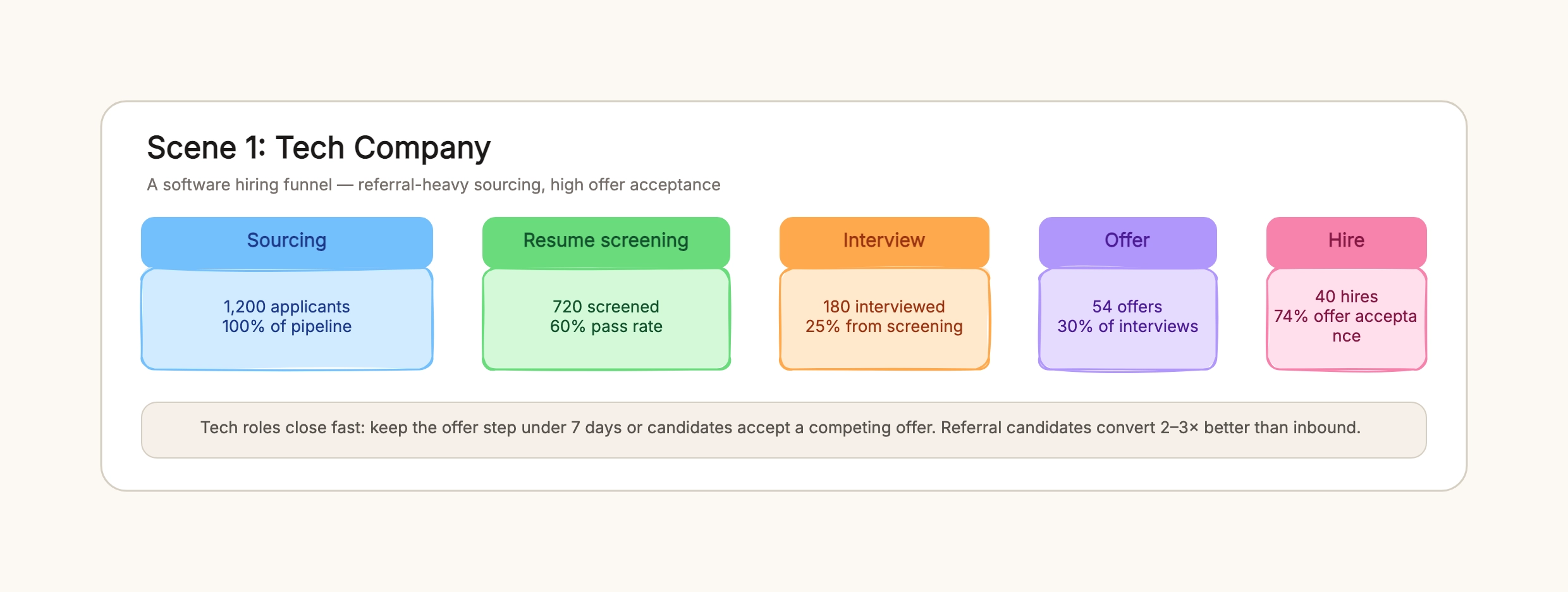
Software engineer requisition
Who uses it: A tech recruiter filling a senior engineering role
Sourcing — 1,200 applicants, referral-heavy
Resume screening — 720 pass (60%)
Interview — 180 (25% from screening)
Offer — 54 (30% of interviews)
Hire — 40 (74% offer acceptance)
Why this works: Tech funnels are referral-heavy and the offer step is the risk point — a slow offer loses candidates to competitors, so the pipeline tracks the interview-to-offer ratio closely.
Retail storefront hiring
Who uses it: A store manager hiring hourly crew
Sourcing — 3,000 applicants across boards
Screening — 1,200 pass (40%)
Interview — 360 (30% from screening)
Offer — 180 (50% of interviews)
Hire — 150 (83% offer acceptance)
Why this works: Retail runs high volume and fast screening. The funnel is wide at the top and the offer-acceptance rate is high, so the fix is usually in the screening stage, not the offer.
Clinical nurse requisition
Who uses it: A hospital HR lead hiring licensed nurses
Sourcing — 500 applicants, licensed only
Screening — 250 pass credential checks (50%)
Interview — 100 (40% from screening)
Offer — 40 (40% of interviews)
Hire — 30 (75% offer acceptance)
Why this works: Healthcare funnels narrow early because credential and background checks cut the pool before interviews. The pipeline shows that the early gate, not the interview, does most of the filtering.
Startup first hire
Who uses it: A founder hiring the first full-time employee
Sourcing — 200 applicants via network
Screening — 40 pass (20%)
Interview — 15 (37.5% from screening)
Offer — 3 (20% of interviews)
Hire — 1 (33% offer acceptance)
Why this works: A startup's first hire is a low-volume, high-touch funnel. The pipeline shows a small pool and a careful interview stage, where the founder spends more time per candidate.
Agency recruiter pipeline
Who uses it: A recruiter managing many client roles at once
Sourcing — 800 candidates across roles
Screening — 320 pass (40%)
Interview — 96 (30% from screening)
Offer — 40 (42% of interviews)
Hire — 32 (80% offer acceptance)
Why this works: An agency runs several funnels in parallel. Tracking one pipeline per role keeps the conversion math clean and shows which client's roles are hardest to fill.
Campus graduate hiring
Who uses it: A campus recruiter hiring new graduates
Sourcing — 1,500 applications from fairs
Screening — 450 pass (30%)
Assessment — 180 (40% from screening)
Interview — 90 (50% from assessment)
Offer — 45 → 38 accepts (84%)
Why this works: Campus hiring adds an assessment stage between screening and interview. The funnel shows high volume up top and a strong offer-acceptance rate, so the leak is early screening.