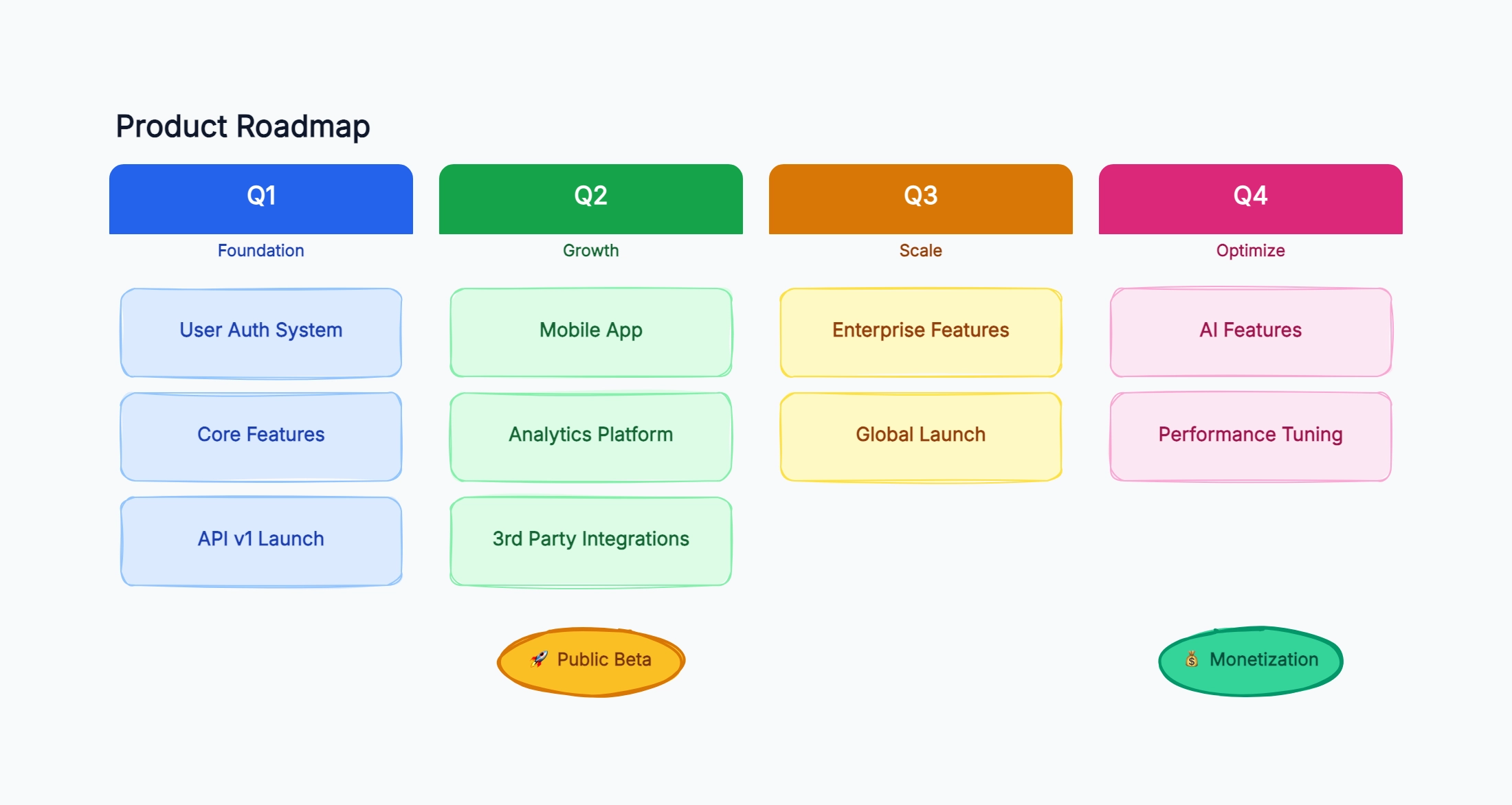
Startup now-next-later roadmap
Who uses it: Founder or early-stage PM communicating product direction without fixed dates
Now: core MVP features — auth, create, share
Now: critical bug fixes and performance
Next: collaboration features — comments, mentions
Next: integrations with top 3 tools
Later: mobile app
Later: enterprise SSO and admin controls
Why this works: Now-next-later roadmaps avoid the false precision of quarterly dates when the team is still learning what users need — they communicate priority and sequence without committing to a deadline that will slip.
SaaS quarterly roadmap
Who uses it: Product manager presenting to engineering and leadership at a B2B SaaS
Q1 Theme: Activation — get users to first value faster
Q1 Initiatives: onboarding wizard, empty state redesign
Q2 Theme: Expansion — move upmarket to teams
Q2 Initiatives: roles and permissions, audit log, SSO
Q3 Theme: Retention — reduce monthly churn below 2%
Q3 Initiatives: health score, proactive nudges, CS dashboard
Why this works: Naming each quarter with an outcome theme rather than a feature list shows leadership that the team understands the business goal — it also makes it easier to add or remove features within a theme without changing the strategy.
Mobile app roadmap
Who uses it: Mobile PM planning iOS and Android releases across three quarters
Q1: Core feature parity with web (iOS and Android)
Q1 Milestone: App Store launch
Q2: Offline mode and sync
Q2: Push notifications and engagement flows
Q3: Social features — follow, share, profile
Q3 Milestone: 100k downloads target
Why this works: Mobile roadmaps benefit from explicit App Store milestones because submissions require lead time — putting the milestone on the roadmap makes the engineering deadline visible weeks before the actual date.
B2B platform roadmap for sales
Who uses it: PM creating a roadmap to share with sales and customer success teams
Q1: API v2 (unblocks enterprise integrations)
Q1: Bulk import/export (requested by 12 accounts)
Q2: Advanced permissions (enterprise deal requirement)
Q2: SOC 2 Type II certification (milestone)
Q3: Custom branding (upsell opportunity)
Q3: Dedicated infrastructure option (large enterprise)
Why this works: A roadmap shared with sales should include the customer reason for each initiative — 'requested by 12 accounts' gives the sales team context they can use in deal conversations without over-promising.
Post-launch iteration roadmap
Who uses it: PM managing a product after initial launch with active users
Month 1: Critical bug fixes (from launch feedback)
Month 2: Performance improvements (p99 latency)
Month 3: Top-requested feature #1 (power user segment)
Month 3: Onboarding improvements (activation data)
Month 4: Top-requested feature #2
Month 4: A/B test pricing page
Why this works: Post-launch roadmaps should explicitly include bugs and performance work in early months — leaving them off signals to engineering that stability is less important than new features, which is rarely true.
Internal tool roadmap
Who uses it: Engineering or IT team building and maintaining internal tools
Q1: Migrate legacy admin panel to new stack
Q1: Self-service user management (reduce IT tickets)
Q2: Reporting dashboard for ops team
Q2: Automated onboarding workflows
Q3: Single sign-on across all tools
Q3: Audit and compliance logging
Why this works: Internal tool roadmaps gain credibility when each initiative maps to a measurable reduction in support tickets, manual work, or time spent — quantifying the business impact justifies the engineering investment.