Back to template

Priority Matrix Examples

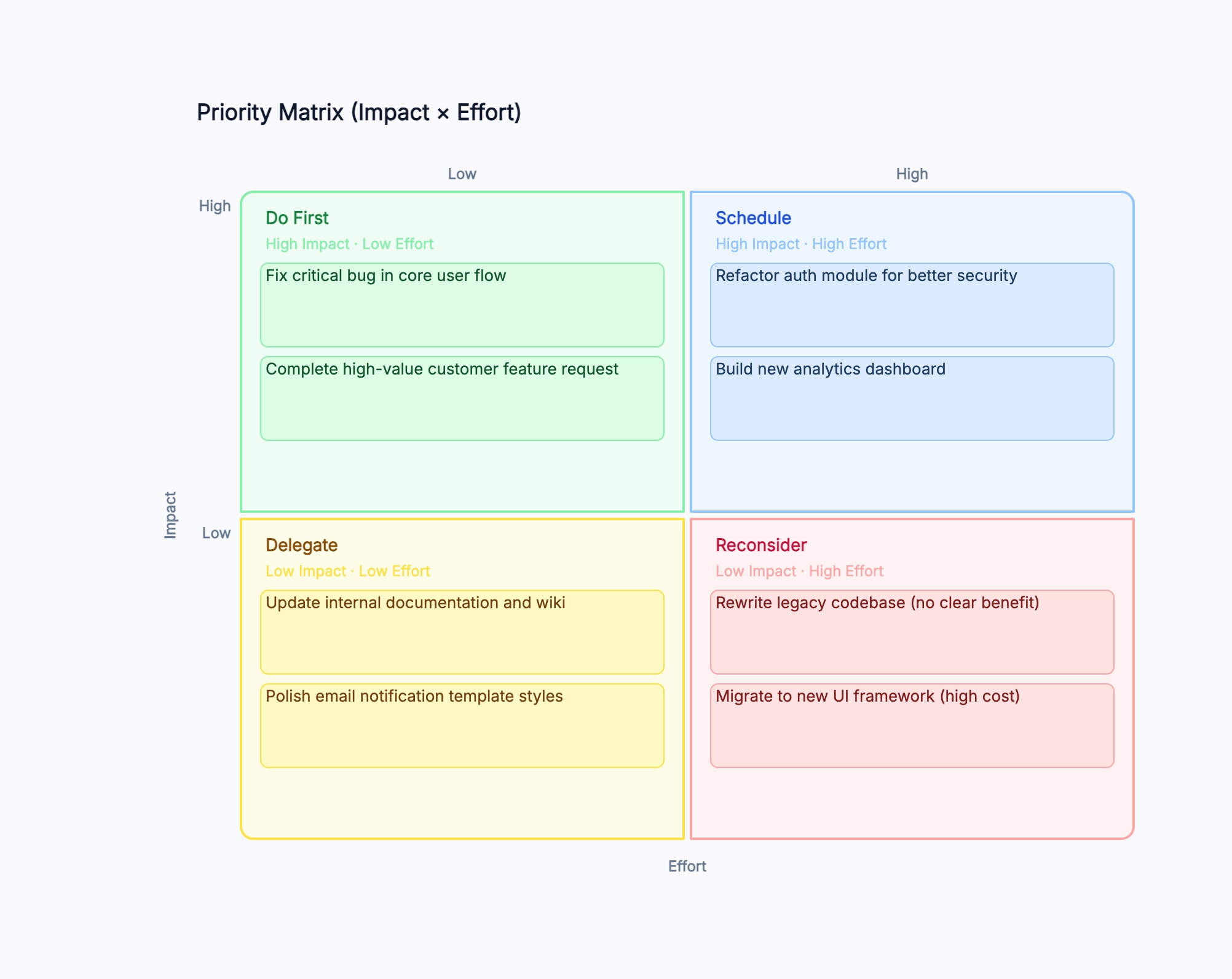
These priority matrix examples show how different teams sort tasks, features, and decisions across four quadrants. Use them as a reference when setting up your own matrix — the quadrant labels can be adapted to match how your team thinks about priority.

Priority Matrix Examples

Real examples

Product feature backlog

Who uses it: Product manager grooming a backlog before quarterly planning

Do First: fix checkout bug (high conversion impact, 1 day), add CSV export (requested by 40% of users, 2 days)
Schedule: redesign onboarding flow (high retention impact, 3 weeks), build API v2 (enables new integrations, 6 weeks)
Delegate: update help center articles (low urgency, 1 day), improve email templates (nice to have, 1 day)
Reconsider: rewrite backend in new language (no user value, 6 months), add dark mode (low demand, 3 weeks)

Why this works: The checkout bug and CSV export in Do First were easy to miss in a flat backlog sorted by creation date. The matrix made the quick wins immediately visible.

Marketing campaign tasks

Who uses it: Marketing manager planning a product launch

Do First: write landing page copy (launch-critical, 1 day), set up tracking links (enables attribution, 2 hours)
Schedule: produce video demo (high conversion, 1 week), launch affiliate program (strong ROI, 2 weeks)
Delegate: update social media bio across platforms (low impact, 30 min), refresh blog header images (aesthetic only)
Reconsider: redesign entire website for launch (high effort, unclear incremental lift)

Why this works: The matrix prevented the team from spending pre-launch time on a website redesign that would not have meaningfully moved conversion rate.

Engineering team sprint planning

Who uses it: Tech lead scoping a two-week sprint

Do First: fix memory leak causing crashes (P0, 4 hours), add rate limiting to public API (security, 1 day)
Schedule: migrate to new database schema (enables new features, 2 weeks), implement full-text search (high request rate, 1 week)
Delegate: update API documentation (needed, not urgent), refactor test utilities (dev experience, low risk)
Reconsider: switch CI/CD pipeline to new vendor (operational risk, 3 weeks, no user value)

Why this works: Rate limiting appeared in Do First after the team agreed it was a security risk (high impact) and already had the implementation pattern from a previous project (low effort).

Startup operations prioritization

Who uses it: Founder deciding what to focus on in the next 30 days

Do First: call the 5 churned customers to learn why (insight, 2 hours), fix broken referral link (revenue loss, 1 hour)
Schedule: set up CRM and sales pipeline (growth infrastructure, 3 days), hire first customer success person (scaling need, 2 weeks)
Delegate: redesign logo (low business impact now), set up fancy office (premature optimization)
Reconsider: build a mobile app (no evidence of demand, 3 months)

Why this works: Calling churned customers was identified as the single highest-information action at low cost — it would inform all other priorities. Without the matrix, the founder was about to spend two weeks on a CRM setup first.

UX research team workload

Who uses it: UX researcher prioritizing studies for the next quarter

Do First: usability test on new checkout flow (launch decision depends on it, 1 week), survey on cancellation reasons (high churn, quick to run)
Schedule: generative research on next-year feature set (strategic value, 6 weeks), competitive UX audit (useful for roadmap, 2 weeks)
Delegate: update persona documents (useful but not urgent), archive old research reports (maintenance)
Reconsider: full accessibility audit (important long-term, but no budget or timeline yet)

Why this works: The checkout usability test surfaced as Do First because a launch date was already set and the team needed findings before it — deadline-driven impact is a valid input to the matrix.

Personal productivity planning

Who uses it: Professional managing a mix of work and side-project tasks

Do First: submit expense report (blocks reimbursement, 15 min), respond to job offer (time-sensitive, 30 min)
Schedule: write quarterly performance review (career impact, 3 hours), finish side-project MVP (personal goal, 2 weeks)
Delegate / Drop: organize old email archive (low value, 4 hours), redesign personal website (nice to have)
Reconsider: learn a new programming language (high effort, unclear ROI vs. current skills)

Why this works: The matrix works for personal use too. It makes the opportunity cost of low-impact tasks visible — the email archive cleanup was taking mental energy without delivering any value.

Tips for better study mind maps

  • Use relative ranking within the matrix, not absolute scores. 'Higher impact than X' is enough to place an item — you don't need to estimate exact hours or revenue.
  • If everything ends up in Do First, your impact axis is probably calibrated too loosely. Force a distribution by asking: which three of these have the highest impact compared to the rest?
  • Quadrant labels can be renamed to match your team's language: Do First / Plan / Later / Skip works just as well as the classic labels.
  • Revisit the matrix at each planning cycle — a low-effort item stays low-effort for about a week before estimates drift.

Start editing online

Go back to the template, swap in your own topics, and keep the same structure if it fits your class or project.

Use this template: /editor/new?template=priority-matrix

Use this priority matrix template