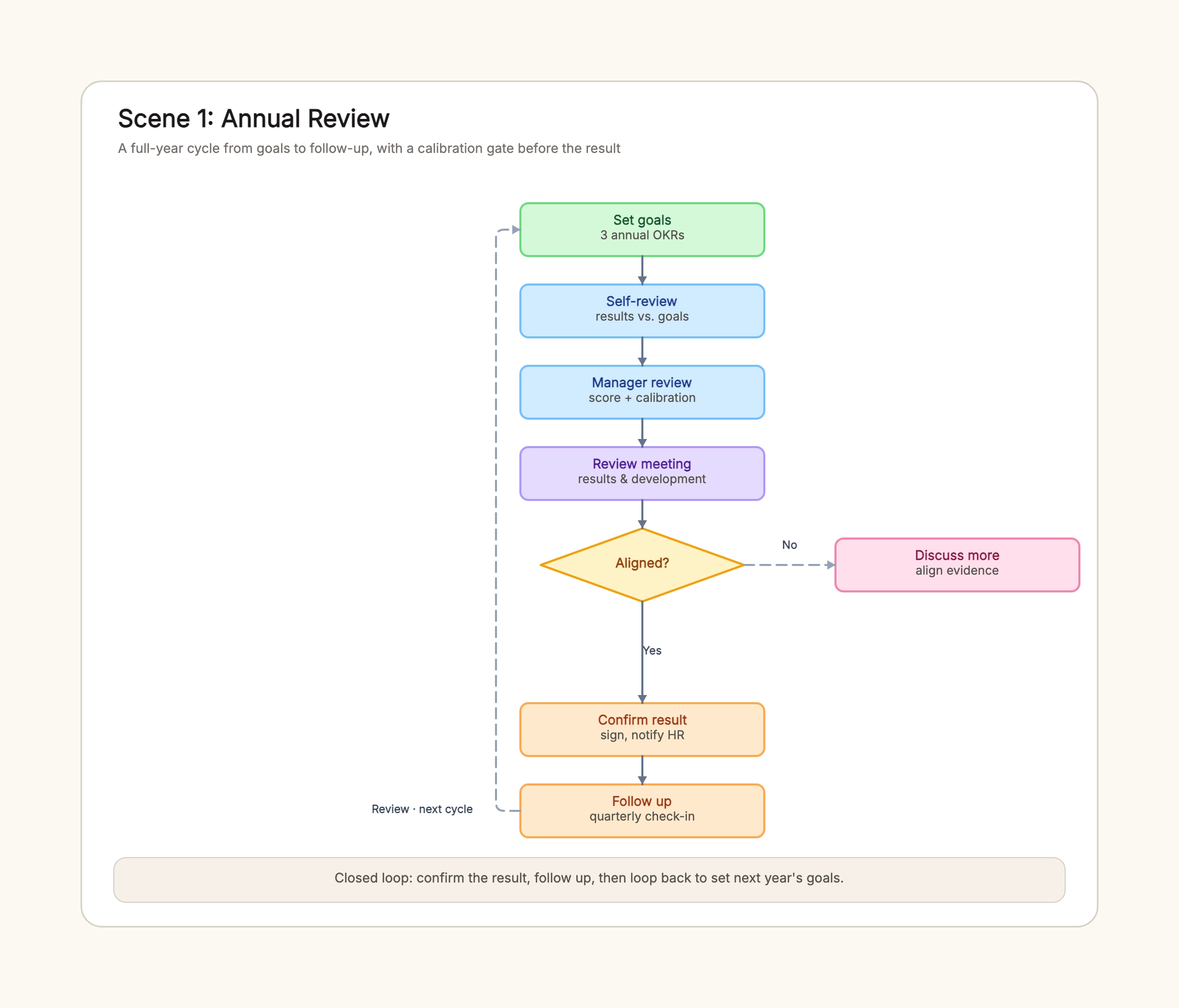
Annual review for a marketing team member
Who uses it: A manager running a year-end review for a direct report
Set goals — 3 annual OKRs (brand, pipeline, retention)
Self-review — results and gaps against each OKR
Manager review — score + calibration meeting
Review meeting — results and development plan
Confirm result — sign and notify HR
Follow up — quarterly check-in on actions
Why this works: The annual loop gives a full-year view and ties the result to development planning. The calibration step keeps the score fair before the meeting.
Quarterly review for a sales rep
Who uses it: A sales manager running light quarterly check-ins
Quarter goals — quota and pipeline milestones
Quick self-review — wins and blockers
Manager notes — light scoring
Quarterly 1:1 — re-prioritize accounts
Confirm updates — refresh next-quarter goals
Next-quarter review — check milestones
Why this works: The quarterly loop trades depth for cadence. Monthly milestones make the light scoring concrete, and the 1:1 re-prioritizes before the next quarter starts.
Probationary review for a new engineer
Who uses it: An engineering manager onboarding a new hire
Probation goals — 30-day milestones
New-hire self-review — vs. onboarding plan
Manager review — meets the bar?
Probation review — pass / extend / end
Confirm decision — file the outcome
Post-hire follow-up — 90-day check-in
Why this works: The probation loop runs the same structure over 90 days and ends in a clear decision. Anchoring goals to the onboarding plan makes the pass bar concrete.
Self-review for a product manager
Who uses it: A product manager preparing their own self-assessment
Goals — shipped features and metrics moved
Self-review — outcomes, not activity
Evidence — launch notes, metrics, feedback
Development — skills to grow next cycle
Why this works: A self-review is strongest when it is written against outcomes rather than activity. Collecting evidence first keeps the meeting about results, not memory.
Calibration meeting for a manager
Who uses it: A people manager aligning scores across the team
Collect manager scores and self-scores
Compare — where do they disagree?
Align evidence before the review meeting
Agree on a fair, consistent rating
Why this works: Calibration sits between the manager's view and the meeting so disagreements are resolved with evidence. It keeps ratings fair and consistent across the team.
OKR-based review for a startup
Who uses it: A founder running lightweight reviews in a small team
Set OKRs — one objective, three key results each
Self-review — progress on each key result
Manager review — calibrate the score
Review meeting — reset or carry OKRs
Follow up — roll results into next OKRs
Why this works: A startup review maps naturally onto OKRs. The loop resets key results each cycle so the outcome directly feeds the next objective instead of ending at a grade.