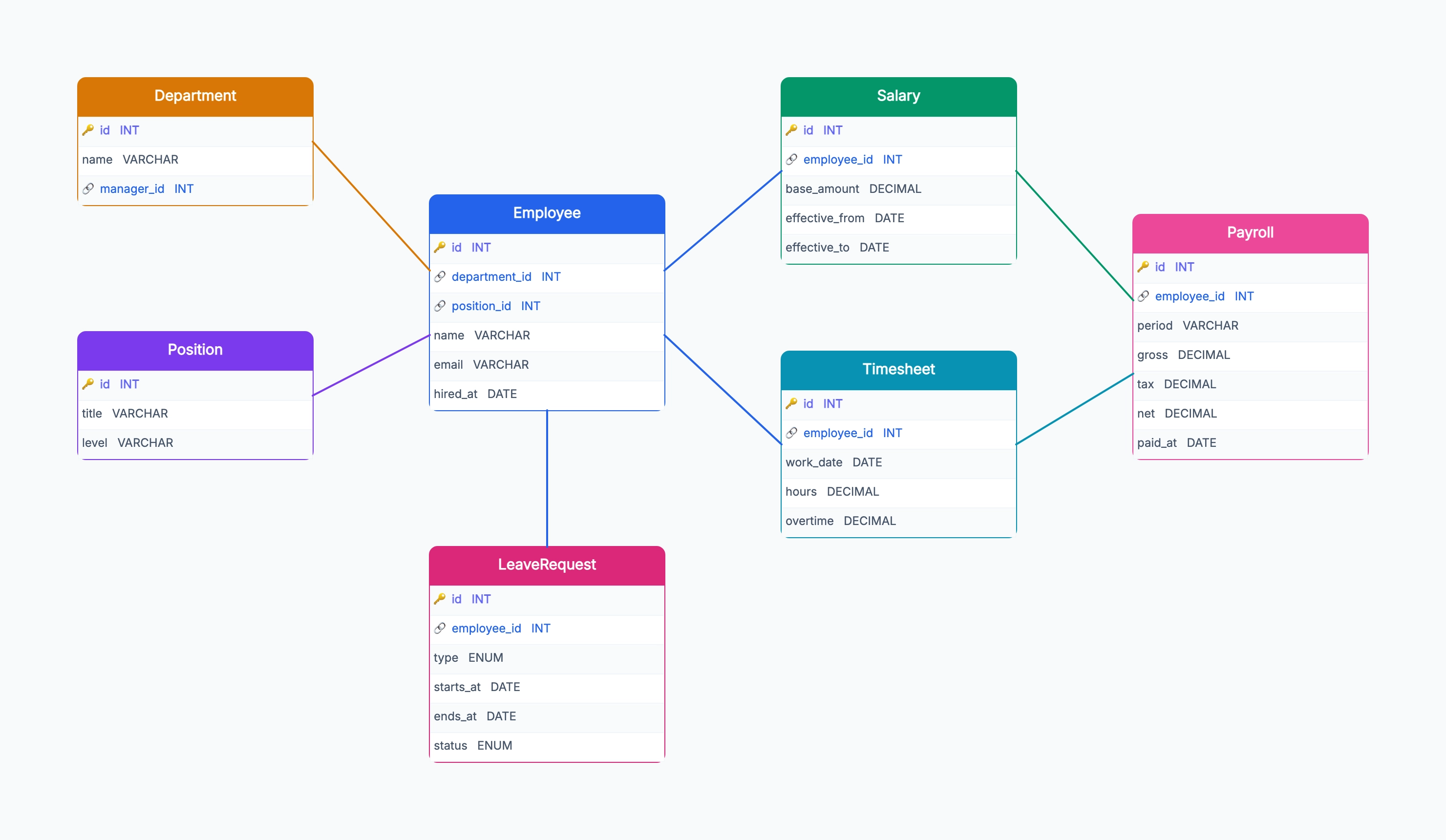
Small business (the baseline)
Who uses it: Founder/HR building a first payroll system
Employee (id, name, email, hired_at, department_id, position_id)
Salary stored as history with effective dates
Monthly Payroll combining salary
LeaveRequest with vacation/sick types
No timesheets — salaried employees only
Why this works: Small business HR can skip timesheets for salaried staff — the diagram is simpler, but salary history is non-negotiable because past payrolls must reproduce exactly what was paid at the time.
Hourly workforce
Who uses it: Team with shift-based or hourly employees
Timesheet is central — gross pay = hours × hourly_rate
Salary table stores hourly_rate with effective dates
Overtime tracked separately with a multiplier
Shift table records scheduled hours vs worked hours
Payroll calculation runs per pay period from the timesheet
Why this works: Hourly workforces make Timesheet the source of truth for payroll — the diagram emphasizes the timesheet→payroll link, because hours worked drive gross pay and overtime rules are encoded into payroll calculation.
Salaried with benefits
Who uses it: Mid-size team with health insurance, 401k, and equity
Benefit (id, employee_id, type, provider, contribution)
Deductions added to Payroll for pre-tax benefits
Equity grants tracked separately with vesting schedule
Bonus and commission as additional Pay components
Tax withholding calculated from gross minus deductions
Why this works: Benefits add a layer of Pay components — the diagram extends Payroll with deductions for insurance, 401k, etc., because net pay isn't just gross minus tax once benefits enter the picture.
Multi-country payroll
Who uses it: Team with employees across jurisdictions
Employee gains a country_code and tax_id
Payroll calculation rule scoped per country
Currency stored on Salary and Payroll
Local statutory deductions per country (social security, etc.)
Compliance documents per employee per country
Why this works: Multi-country payroll demands per-country rules — the diagram adds country to Employee and forks payroll calculation by jurisdiction, because tax and statutory deductions vary fundamentally between countries.