Back to template

Novel Outline Examples

These examples are organized by the problem an outline needs to solve: structure, pacing, chronology, point of view, or internal change.

Novel Outline Examples

Real examples

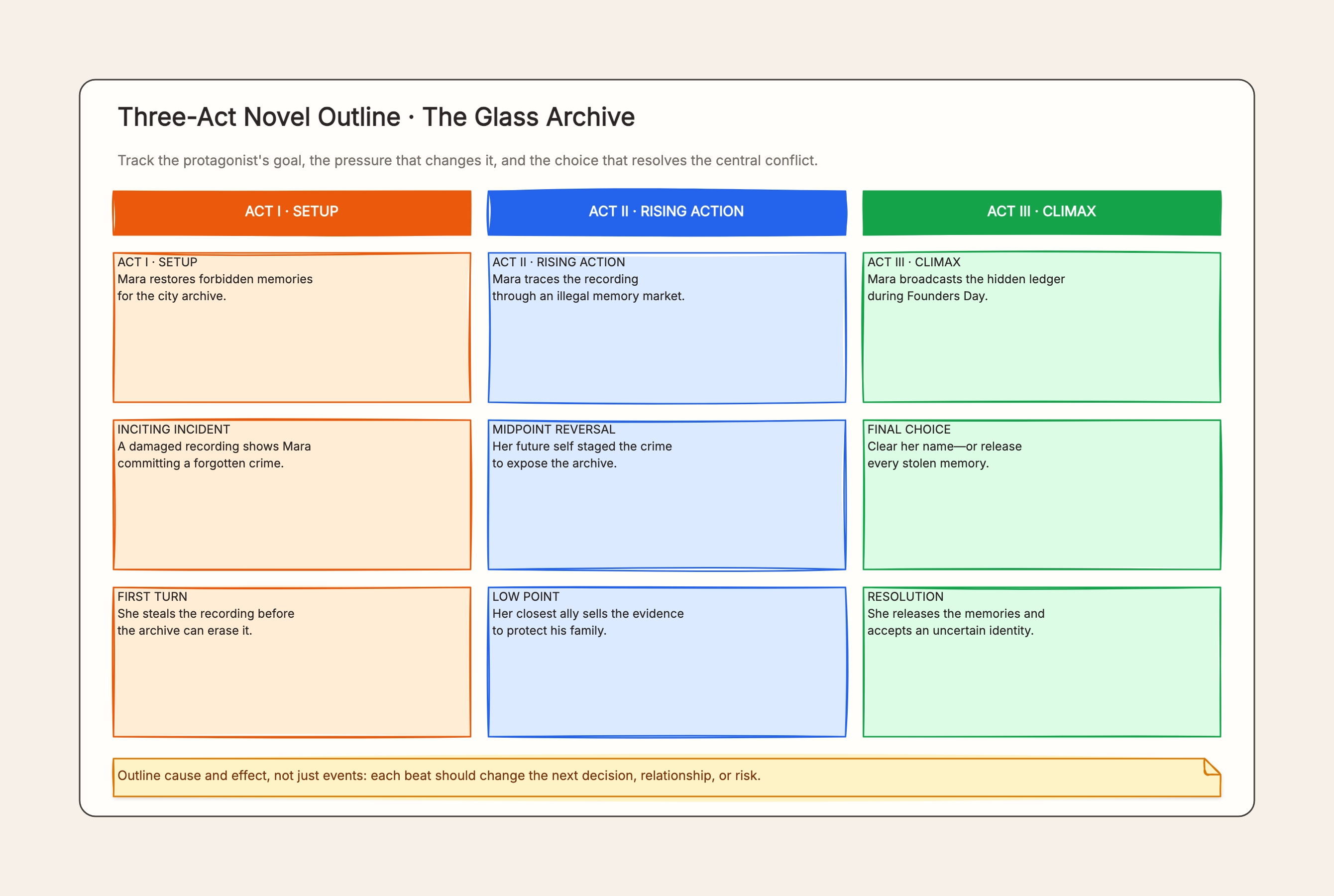
Three-act speculative mystery

Who uses it: A writer testing a high-concept premise

Act I: evidence contradicts memory
Act II: investigation changes the meaning of the crime
Midpoint: protagonist caused the mystery
Act III: public choice with personal cost

Why this works: The central reveal changes both the external plan and the protagonist's idea of identity.

12-chapter drafting outline

Who uses it: A writer preparing a first draft

Viewpoint per chapter
Concrete turn
New cost or clue
Question carried forward

Why this works: Each chapter earns its place by changing the next decision rather than filling a predetermined page count.

Character transformation arc

Who uses it: A character-driven novelist

Starting belief
External want
Tests and losses
Climactic choice
Ending belief

Why this works: The final action proves the internal change instead of explaining it afterward.

Romance dual arc

Who uses it: A romance writer balancing two protagonists

Person A's fear and want
Person B's fear and want
Bonding midpoint
Breakup pressure
Mutual final choice

Why this works: Parallel rows reveal whether both characters make meaningful choices and change.

Dual-timeline mystery

Who uses it: A writer intercutting past and present

Two color-coded timelines
Shared object or question
Reveals ordered by reader knowledge
Convergence near climax

Why this works: The board separates chronology from disclosure order, which prevents accidental spoilers and contradictions.

Fantasy quest with subplot

Who uses it: A writer managing a long middle

Main goal and milestones
Companion conflict
Political subplot
Midpoint convergence
Subplot consequence at climax

Why this works: Separate lanes show whether the subplot creates pressure on the main story rather than becoming an unrelated detour.
Tips for a stronger novel outline

  • Write beats as change: because this happens, the next choice changes.
  • Track reader knowledge separately from character knowledge.
  • Give the midpoint structural consequences.
  • Let the climax resolve external and internal questions together.
  • Treat the outline as a revision tool, not a contract.

How it compares to similar tools

Beat sheet

A compact list of major turns, useful before chapter planning.

Chapter board

A medium-detail view of viewpoint, scene turn, pacing, and handoff.

Scene list

A detailed drafting or revision tool that tracks goal, conflict, outcome, setting, and characters for every scene.

Common mistakes to avoid

  • Confusing surprise with randomness

    A reveal can be unexpected while still growing from earlier clues and choices.

  • No escalation across chapters

    Later obstacles should narrow options, raise cost, or challenge a deeper belief.

  • Subplots never affect the main plot

    Connect subplot decisions to the resources, relationships, or risks involved in the climax.

Frequently asked questions

How many chapters should I outline?+

Outline the number your story currently needs. Chapter count varies by genre, length, and pacing; the 12-card example is a working demonstration, not a target.

Should every chapter end on a cliffhanger?+

No. It should create forward movement through a question, consequence, changed relationship, discovery, or decision; not every ending needs danger.

When should I revise my outline?+

Revise whenever the draft reveals a stronger motivation, consequence, or sequence. Updating the outline can also help diagnose a stalled middle.

Start editing online

Go back to the template, swap in your own content, and keep the same structure if it fits your project.

Use this template: /editor/new?template=novel-outline

Create a novel outline