Back to template

Library Management Database Design Examples

These library schema examples show how the same book-copy-loan core adapts to public libraries, school libraries, multi-branch systems, and digital lending of ebooks.

Library Management Database Design Examples

Real examples

Public library (the baseline)

Who uses it: Developer building a first library management system

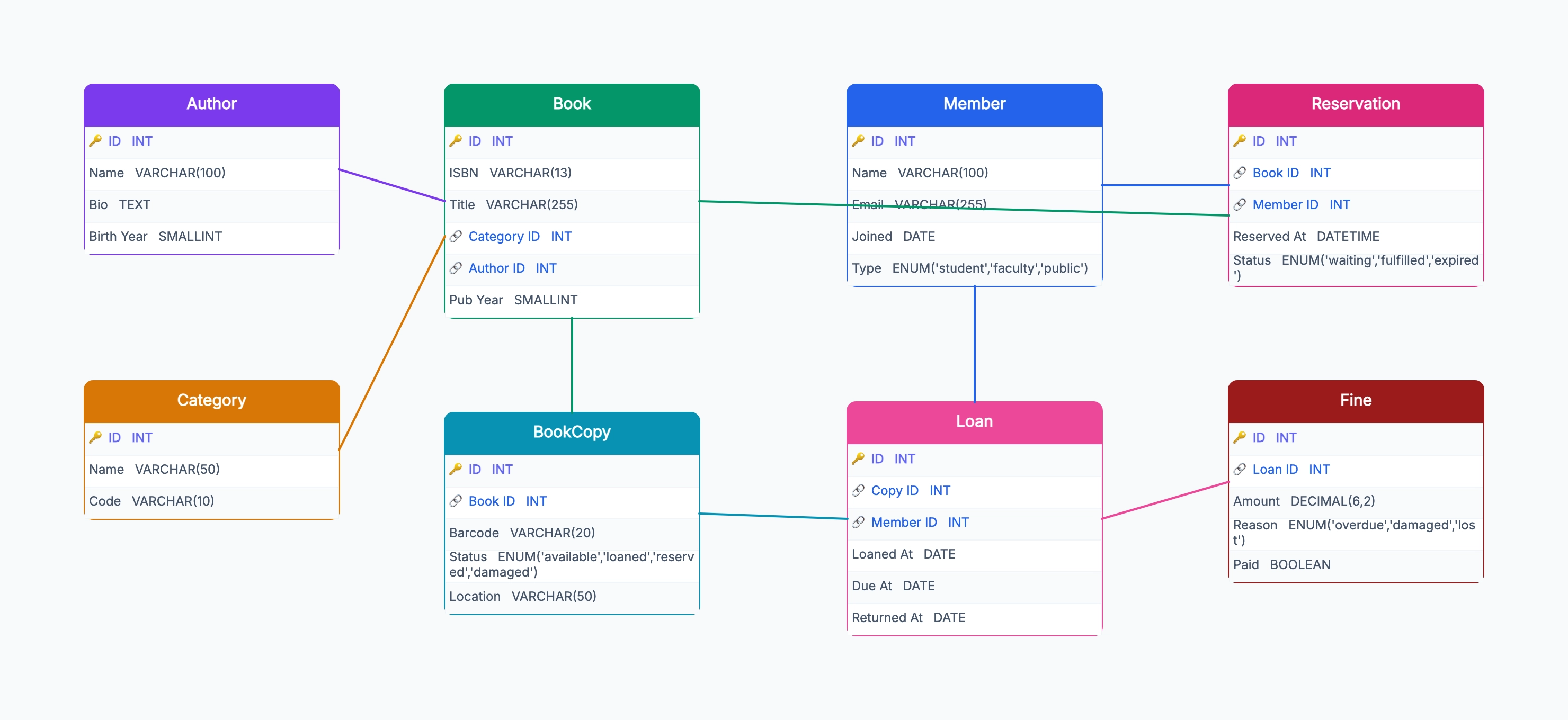
Book (id, isbn, title, author_id, category_id)
BookCopy (id, book_id, barcode, status) — many per Book
Member (id, name, email, joined_at)
Loan (id, copy_id, member_id, loaned_at, due_at, returned_at)
Fine (id, loan_id, amount, paid)

Why this works: The public library baseline gets the Book vs Copy split right — every other library schema is a variation on this core, because separating catalog from physical inventory is what makes loans, fines, and reservations work cleanly.

School library

Who uses it: Team building a system for a school's collection

Members are Students linked to Classes
Loan periods often tied to the school year
Recommended-reading lists per grade/subject
Fines may be replaced by privilege restrictions
Smaller catalog, fewer copies per title

Why this works: A school library narrows Member to Student and ties loan rules to academic calendar — the diagram replaces generic Member with a student-aware entity and adds grade-level reading lists as a first-class concept.

Multi-branch library system

Who uses it: Team running a network of library branches

Branch (id, name, address) — every copy belongs to a branch
BookCopy gains a branch_id and a current_location
Inter-branch transfers tracked as a separate table
Members can borrow from and return to any branch
Holds (reservations) can specify a pickup branch

Why this works: A multi-branch system adds a Branch entity that copies and transfers reference — the diagram shows the copy as the thing that moves between branches, with the book catalog staying global.

Digital lending

Who uses it: Team adding ebook or audiobook lending

DigitalBook (id, title, format, license_count)
License count caps how many simultaneous loans are allowed
Loan has an access_url and an expiry instead of a physical return
No BookCopy — digital items are licensed, not copied
DRM enforcement at loan creation

Why this works: Digital lending replaces physical copies with licenses — the diagram drops BookCopy and adds a license-count cap on the title, because availability is bound by licenses rather than physical inventory.

Tips for better study mind maps

  • Always separate Book from BookCopy — putting copy details on Book breaks the moment the library has two of the same title.
  • Attach loans to BookCopy, not Book, because only a specific physical copy is checked out at a time.
  • Put fines on Loan, not Member, so a member's outstanding fines tie back to specific overdue items.
  • Track BookCopy status as an enum (available, on-loan, lost, withdrawn) so availability queries are simple.

Start editing online

Go back to the template, swap in your own topics, and keep the same structure if it fits your class or project.

Use this template: /editor/new?template=library-management-database-design

Edit this library schema template