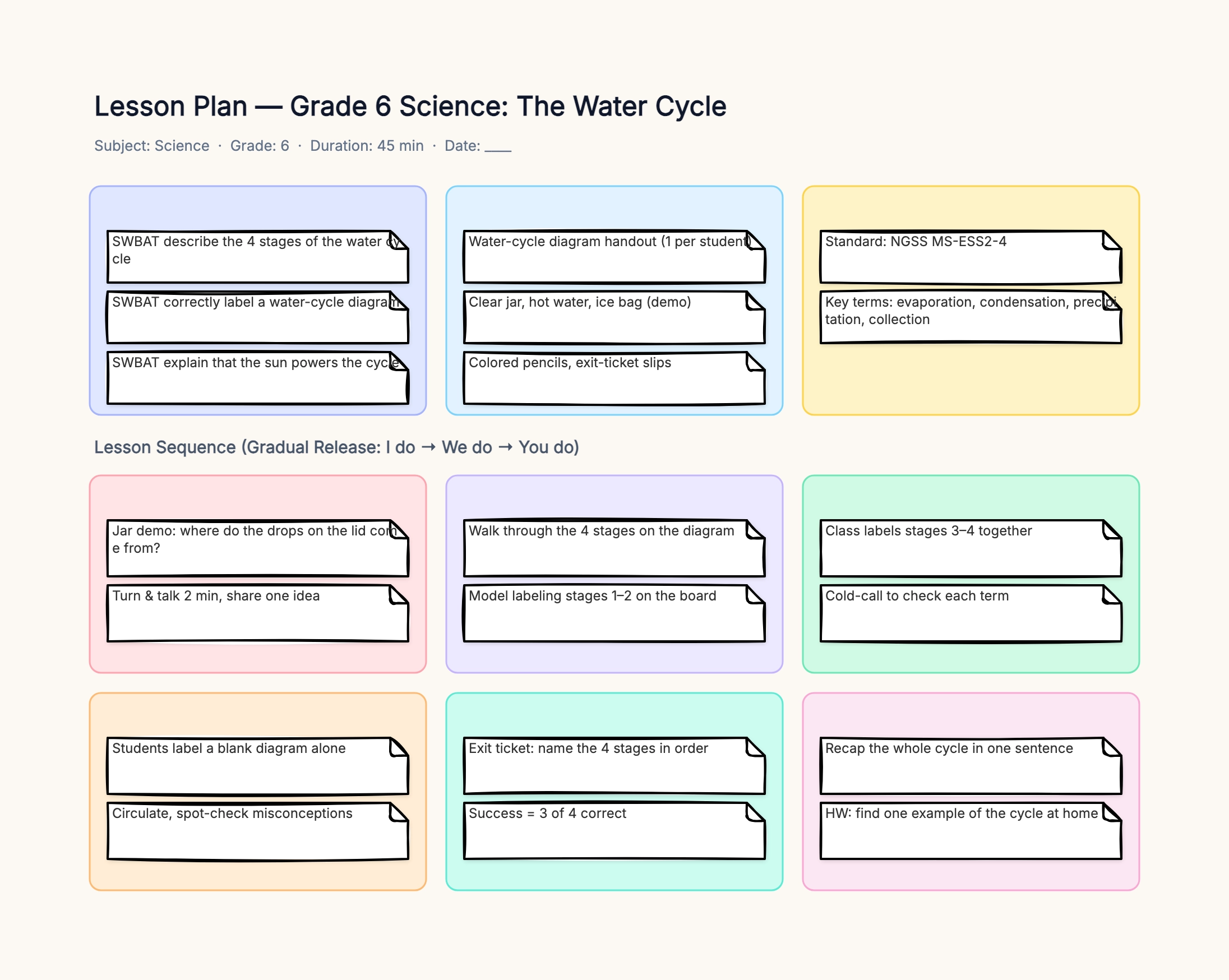
Gradual-release science lesson (Grade 6)
Who uses it: A new middle-school science teacher planning a single 45-minute period
Objective: SWBAT label the 4 stages of the water cycle
Warm-up (5 min): jar-and-ice demo, turn & talk
I do (12 min): model labeling stages 1–2
We do (12 min): class labels 3–4 together
You do (10 min): label a blank diagram alone
Assessment (4 min): exit ticket, 4 stages in order
Why this works: This is the template's default. The value is the time budget and the matching objective/assessment: the exit ticket ('name the 4 stages') tests exactly what the objective promised. Gradual release fits a concrete, labelable skill like this one.
Preschool circle-time plan
Who uses it: An early-childhood teacher or homeschooling parent of a 3–5 year old
Objective: children can name the days of the week in order
Warm-up: hello song + calendar routine
Main activity: days-of-the-week song with hand motions
Practice: each child places a day card on the pocket chart
Assessment: teacher observes who sequences correctly
Closure: goodbye song, preview tomorrow
Why this works: Preschool plans replace worksheets with songs, movement, and routines, and 'assessment' is observation, not a quiz. The sections still help — an objective keeps circle time from drifting, and a closure builds the daily rhythm young children rely on.
Weekly lesson plan (one subject, Mon–Fri)
Who uses it: An elementary teacher planning a week of reading in one view
Week objective: students summarize a fiction text
Mon: model summarizing a short story (I do)
Tue: summarize a passage together (we do)
Wed: students summarize in pairs
Thu: independent summary of a new text (you do)
Fri: assessment + reteach for the small group who missed it
Why this works: Here each activity band is a day, and the objective row is the week's goal. Spreading gradual release across five days — model Monday, independent by Thursday, assess Friday — is a common weekly structure, and the reteach note on Friday plans for the students who need another pass.
5E inquiry lesson (high-school biology)
Who uses it: A science teacher using inquiry-based instruction
Engage: show two plants, one wilted — why?
Explore: students test variables on seedlings
Explain: introduce osmosis after the exploration
Elaborate: apply osmosis to a new scenario
Evaluate: students diagram water movement in a cell
Note: Explore comes before Explain (reverse of I-do)
Why this works: 5E flips the order: students explore a phenomenon before the teacher explains it, so they build intuition first. To model it, the activity sections are renamed to the five Es and Explore sits ahead of direct instruction. Best when the payoff is conceptual understanding, not a quick procedure.
One-on-one tutoring session (math)
Who uses it: A private tutor planning a 60-minute session with one student
Objective: student solves two-step equations independently
Warm-up: review one-step equations (retrieval)
Teach: work one two-step example aloud
Guided: solve two together, student narrates the steps
Independent: student solves three alone, tutor watches
Homework: 5 problems + one word problem
Why this works: Tutoring compresses the whole cycle for a single learner, so the 'we do' step is a conversation, not a class activity. The retrieval warm-up and the student-narrates-the-steps move are what make one-on-one time efficient — the tutor hears the misconception instead of guessing.
College lab / TA session plan
Who uses it: A graduate teaching assistant running a weekly lab or discussion section
Objective: students run a titration and calculate concentration
Pre-lab (10 min): safety + walk the procedure
Demo: TA models the first titration step
Lab work: students titrate in pairs, TA circulates
Check: each pair's result within tolerance before leaving
Wrap-up: common errors + what the next lab builds on
Why this works: A lab session's 'independent practice' is the lab itself, and the assessment is a tolerance check on the result. The plan front-loads safety and a demo, then the TA's job is circulating and catching errors — so the plan emphasizes checks for understanding over lecture.