Back to template

Homeschool Schedule Examples

These homeschool schedule examples show different levels of structure: a repeatable day, a subject-based week, a play-based kindergarten day, and plans that make room for projects, appointments, and shared caregiving. Choose the closest structure and replace the cards with your own priorities.

Homeschool Schedule Examples

Real examples

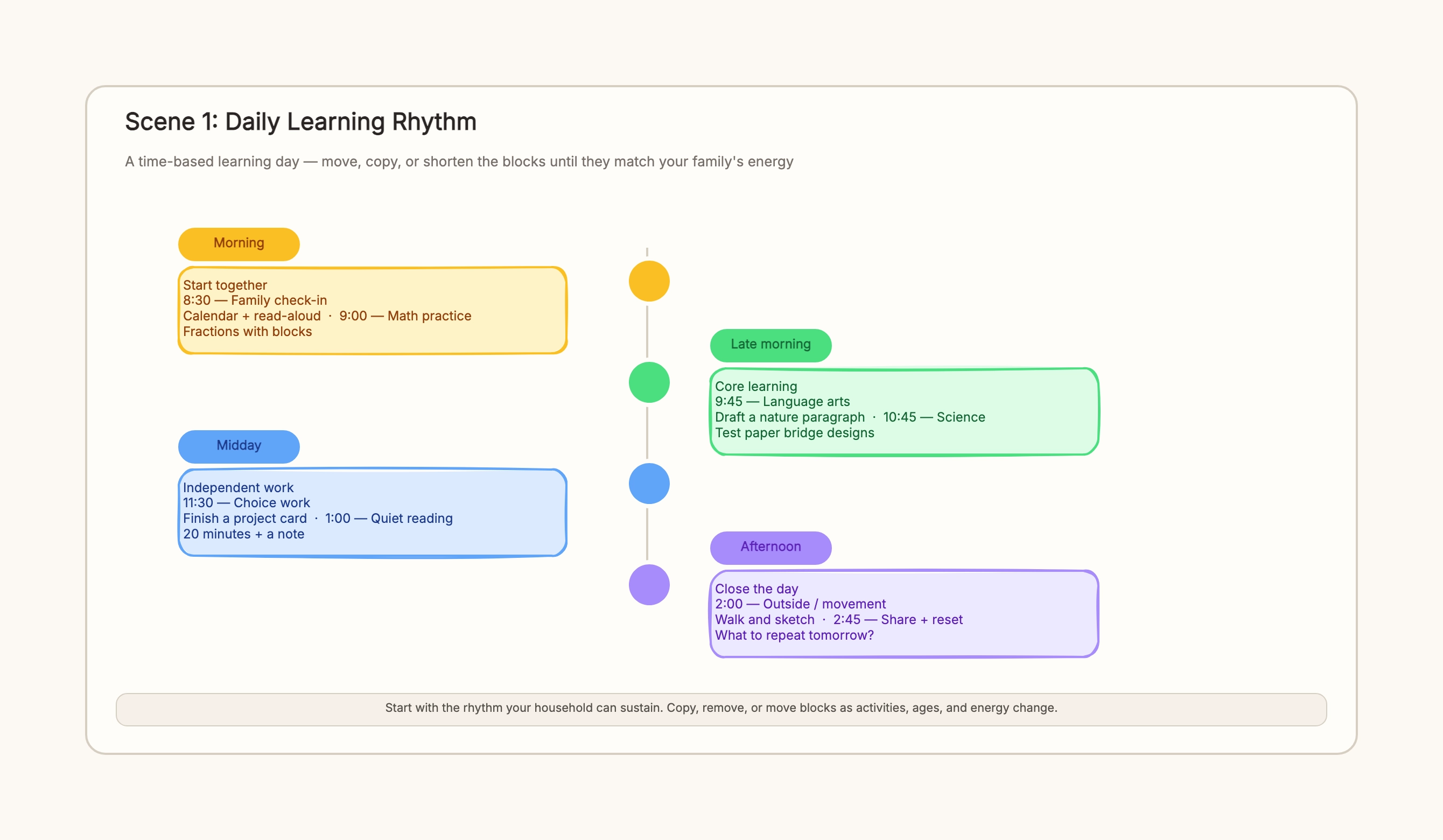
Daily learning rhythm

Who uses it: A family that wants a visible, repeatable school-day shape

8:30 — Check-in + read-aloud
9:00 — Math practice
9:45 — Language arts
10:45 — Science activity
1:00 — Independent reading
2:00 — Outside + reflection

Why this works: This example uses a few anchors instead of assigning every minute. The concrete activity after each subject makes it clear what to start next.

Weekly subject rotation

Who uses it: A family spreading priorities across five days

Mon — math, reading, community map
Tue — writing, seed observation, library
Wed — measurement, history source, map labels
Thu — revision, science notes, art
Fri — review, reading response, next-week choice

Why this works: Rotating work across the week leaves room for longer projects and reduces the pressure to complete every subject every day.

Kindergarten play-based day

Who uses it: A young learner who benefits from short connected activities

Picture book + retell
Build a 10-block tower
Find objects beginning with M
Outdoor leaf-shape hunt
Draw one discovery + spoken caption

Why this works: The sequence moves from a story to hands-on work, movement, observation, and creation, with activities that can be shortened or repeated.

Project week

Who uses it: A learner working deeply on one topic

Mon — choose a question
Tue — collect sources
Wed — test or build
Thu — draft the explanation
Fri — share the result + reflect

Why this works: A project week keeps the question and next action visible while allowing the subject work to connect around one meaningful outcome.

Shared-caregiver plan

Who uses it: A family where more than one adult helps with learning

Morning — caregiver A: read-aloud
Midday — learner: independent task card
Afternoon — caregiver B: outside activity
End of day — family: move unfinished cards

Why this works: The key is not assigning every teaching role permanently; it is making ownership and handoffs visible so the day does not depend on memory.

Appointment-heavy week

Who uses it: A family balancing learning with work, appointments, or travel

Monday — focused morning + appointment
Tuesday — project block
Wednesday — field-trip notes
Thursday — catch-up choices
Friday — review and reset

Why this works: This structure protects a few priorities while treating appointments and travel as real parts of the week rather than failures of the schedule.
Tips for useful homeschool schedule examples

  • Use anchor blocks first; exact times can come later if your household needs them.
  • Put a concrete activity or outcome on each card, not only a subject name.
  • Keep the weekly view lighter than a to-do list so interruptions do not break it.
  • Review and copy the parts that worked before creating the next week.

Related resources

How it compares to similar tools

Routine-first example vs. subject-first example

Choose a routine-first board when transitions and energy are the main challenge. Choose a subject-first weekly plan when the family needs to see how learning priorities distribute across several days.

Independent-work card vs. adult-led block

Independent-work cards make the next action clear when an adult is busy. Adult-led blocks are better for a new concept, shared reading, discussion, or a hands-on activity that needs help.

Common mistakes to avoid

  • Mistaking a sample for a required schedule

    Examples show how a board can work; they are not a prescription for hours, subjects, or pace. Replace the cards with your own constraints and priorities.

  • Adding a new card without removing anything

    A board becomes unusable when every good idea stays on it. Keep a small set of current priorities and archive or move the rest.

  • Treating interruptions as failure

    Appointments, weather, family needs, and a long project are normal. Move cards intentionally and use the weekly view to regain context.

Frequently asked questions

What is the simplest homeschool schedule to start with?+

Start with three to five anchors: a shared start, one focused learning block, an independent or project block, movement, and a short close. Add detail only where it helps your family begin.

How do I make a homeschool schedule flexible?+

Use cards that can move, keep a few priorities per day, and plan at the weekly level instead of filling every hour. Review the board after real days, not ideal days.

What belongs in a kindergarten homeschool day?+

Short, concrete activities such as stories, building, counting, sound games, outdoor observation, drawing, movement, and sharing are easier to adapt than long abstract lesson blocks.

Can two children use the same homeschool schedule?+

Yes. Put shared anchors on the main board, then use separate cards or colors for age-specific activities and independent work. Keep only the handoffs and shared activities together.

How often should I update the schedule?+

A brief end-of-week review is enough for most families. Move unfinished work, repeat useful blocks, and remove activities that are no longer helpful.

Start editing online

Go back to the template, swap in your own content, and keep the same structure if it fits your project.

Use this template: /editor/new?template=homeschool-schedule

Use this homeschool schedule template