Back to template

ETL Pipeline Architecture Diagram Examples

These pipeline examples show how the same source-transform-warehouse shape adapts to classic batch ETL, modern ELT, streaming pipelines, and change-data-capture.

ETL Pipeline Architecture Diagram Examples

Real examples

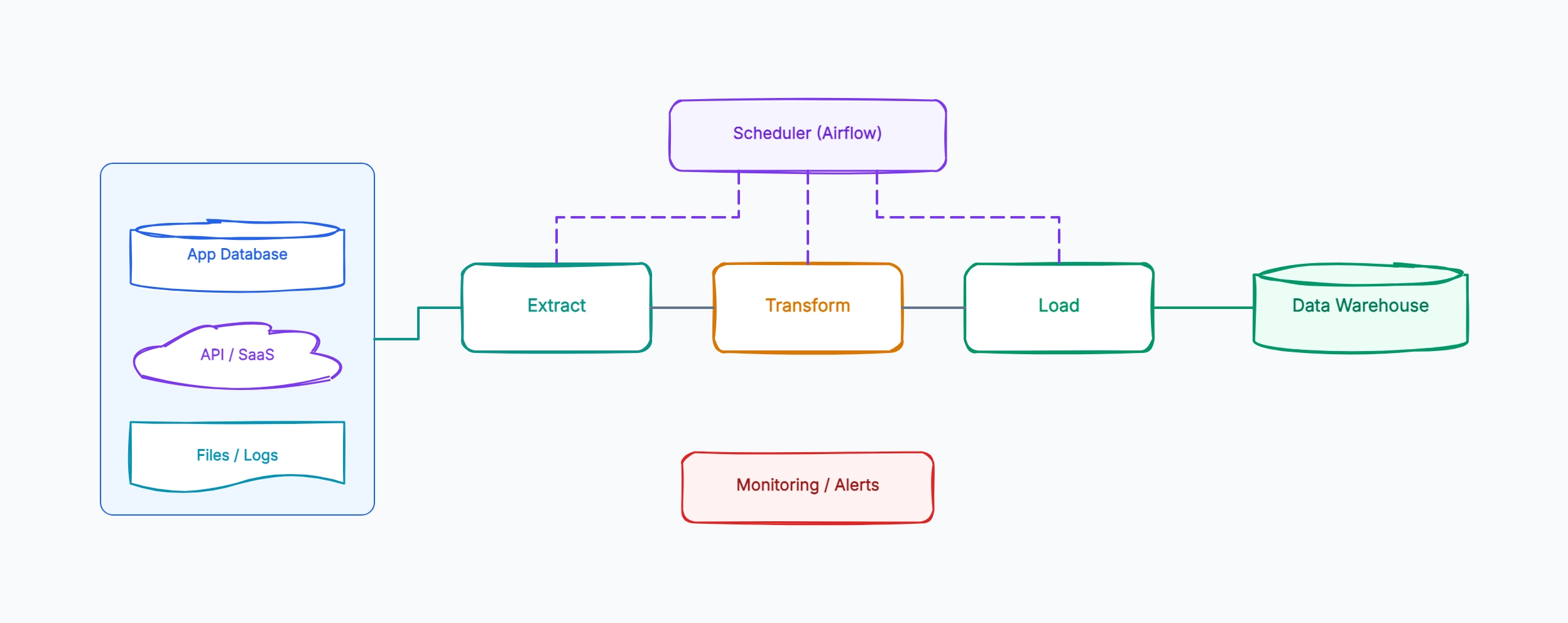
Classic batch ETL (the baseline)

Who uses it: Team building a first analytics pipeline

Scheduled hourly or nightly job
Extract from sources into a staging area
Transform in the pipeline (Spark, Pandas, dbt models pre-load)
Load only clean, modeled data into the warehouse
Warehouse stays small and clean

Why this works: Classic batch ETL transforms before load — the diagram shows transformation as a discrete stage, which keeps the warehouse minimal but pushes complexity into the pipeline tooling.

ELT (modern cloud-warehouse pattern)

Who uses it: Team using Snowflake / BigQuery / Redshift

Extract and Load raw data into the warehouse first
Transform inside the warehouse via SQL (dbt)
Raw layer + staging layer + marts layer in the warehouse
Easier to debug — raw data is queryable
Uses warehouse compute, not external Spark cluster

Why this works: ELT inverts the order — the diagram puts load before transform and the transform stage lives inside the warehouse. This works because modern cloud warehouses make transformation cheap at scale.

Streaming pipeline

Who uses it: Team needing near-real-time data

Sources stream events through Kafka / Kinesis
Transform via Flink / Spark Streaming / ksqlDB
Continuous load into the warehouse or a real-time store
Latency in seconds, not hours
No scheduler — pipeline runs continuously

Why this works: Streaming replaces the batch scheduler with a continuously running pipeline — the diagram drops the scheduler box and adds a stream-processing engine, because freshness requirements push the architecture from periodic batches to always-on flow.

Change Data Capture (CDC)

Who uses it: Team syncing operational DBs into the warehouse

Read the source DB's change log (binlog, WAL)
Stream changes via Debezium → Kafka
Apply changes to warehouse tables incrementally
Low impact on source database (no heavy queries)
Near-real-time without full extracts

Why this works: CDC eliminates the periodic full-extract — the diagram replaces the extract stage with a change-log reader, so the warehouse stays in sync without ever scanning the source tables.

Tips for better study mind maps

  • Always show the scheduler as a separate component above the pipeline — orchestration is a deployable system, not a property of the transform stage.
  • Make monitoring a distinct node; pipeline failures are silent without alerts on stage success / freshness.
  • Label transformation location explicitly (in-pipeline vs in-warehouse) — that single choice is the ETL-vs-ELT distinction.
  • For streaming pipelines, drop the scheduler and add a stream-processing engine; mixing both confuses readers.

Start editing online

Go back to the template, swap in your own topics, and keep the same structure if it fits your class or project.

Use this template: /editor/new?template=etl-pipeline-architecture

Edit this ETL template