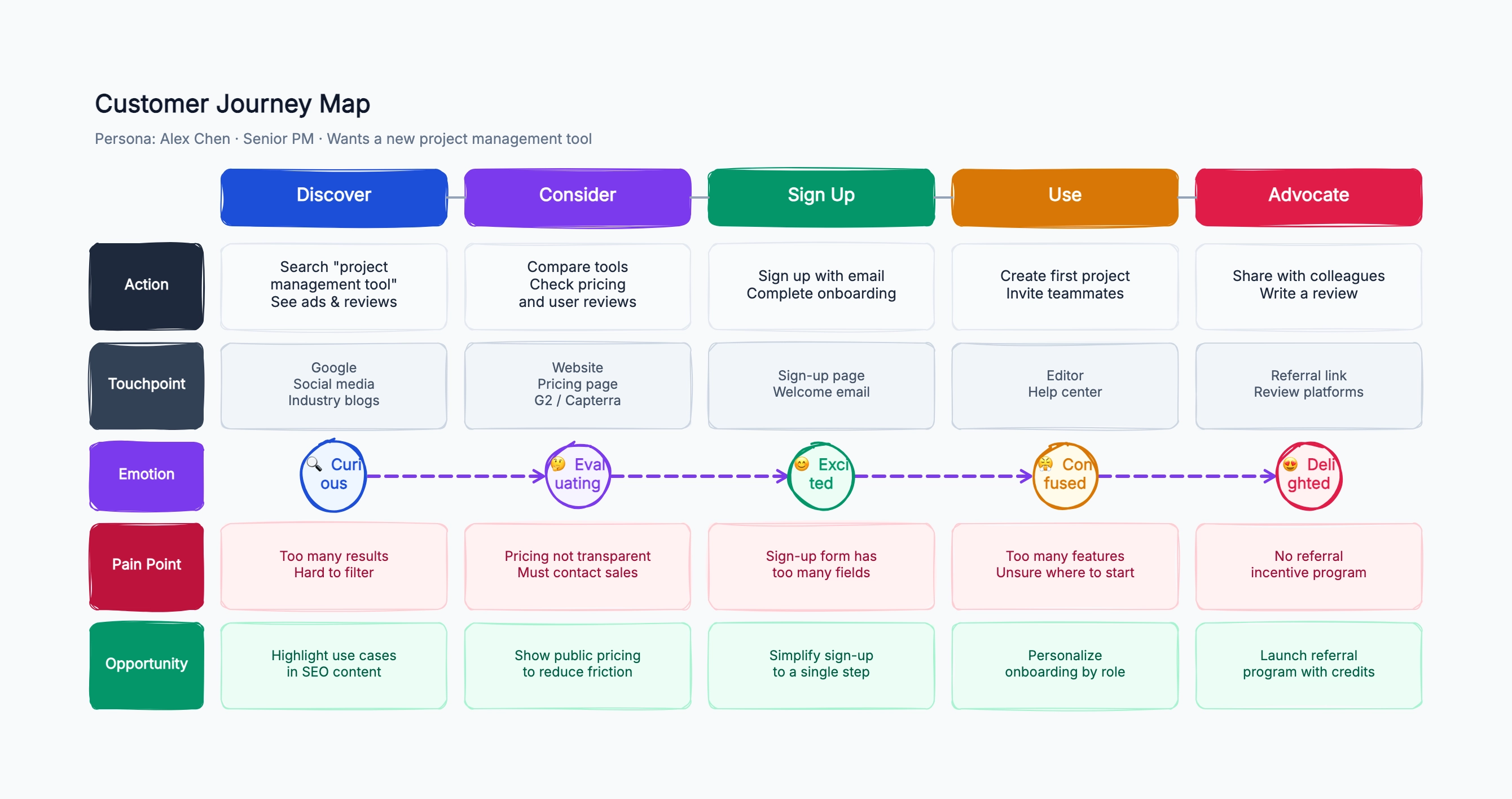
B2B SaaS product-led growth journey
Who uses it: Product and growth team mapping a free-to-paid conversion path
Discover: organic search → tries free tier → emotion: curious, low commitment
Activate: completes setup wizard → emotion: excited → pain: blank-state anxiety
Engage: invites teammates → emotion: confident → opportunity: in-app collaboration prompts
Convert: hits free tier limit → emotion: frustrated then persuaded → opportunity: transparent upgrade CTA
Retain: weekly active user → emotion: reliant → opportunity: power-user coaching emails
Advocate: recommends to peers → emotion: proud → opportunity: referral program
Why this works: The 'blank-state anxiety' at Activate was the most impactful finding — adding template suggestions at first login improved 7-day activation rate by 22%.
E-commerce purchase journey
Who uses it: UX team mapping a first-time buyer experience for a fashion brand
Discover: Instagram ad → lands on product page → emotion: attracted
Consider: reads reviews → checks size guide → emotion: uncertain → pain: inconsistent sizing info
Purchase: adds to cart → checkout → emotion: anxious → pain: too many form fields
Receive: delivery tracking → unboxing → emotion: excited → opportunity: personalized note
Return/Repurchase: return process → emotion: frustrated → opportunity: easy return CTA in confirmation email
Advocate: posts on social → emotion: proud → opportunity: share discount code
Why this works: Mapping the return experience as a separate stage (not just 'post-purchase') revealed that the return friction was the leading predictor of second-purchase intent dropping to zero.
Healthcare patient journey
Who uses it: Patient experience team at a telehealth startup
Discover: searches symptoms → finds service → emotion: anxious → pain: overwhelming medical jargon
Register: creates account → verifies insurance → emotion: uncertain → pain: insurance verification takes days
Consult: video appointment → emotion: relieved → touchpoint: video platform + chat
Follow-up: receives care plan → emotion: confident → pain: unclear next steps
Ongoing: prescription refills → emotion: dependent → opportunity: proactive refill reminders
Advocate: recommends to family → emotion: grateful → opportunity: family plan referral
Why this works: The 'insurance verification takes days' pain at Register was causing 40% of sign-up abandonment. Mapping it explicitly justified a 3-week engineering sprint to build real-time eligibility checks.
Online learning student journey
Who uses it: EdTech product team mapping learner retention
Discover: YouTube ad or friend recommendation → emotion: curious
Enroll: browses catalog → pays → emotion: motivated → pain: unclear course outcomes
Learn: watches first lessons → emotion: engaged → pain: passive video content, no practice
Plateau: misses a week → emotion: guilty → pain: no re-engagement nudge
Complete: finishes course → emotion: proud → opportunity: certificate sharing to LinkedIn
Return: buys next course → emotion: loyal → opportunity: learning path recommendations
Why this works: 'Plateau' emerged as a distinct stage the team had not previously mapped. Adding a re-engagement email at day 7 of inactivity reduced dropout at this stage by 18%.
Enterprise software sales journey
Who uses it: Sales and marketing team mapping a complex B2B deal
Awareness: reads industry report or analyst review → emotion: curious
Evaluation: product demo → proof of concept → emotion: cautious → pain: needs security review
Procurement: legal/security review → emotion: frustrated → pain: long approval cycles
Onboarding: IT setup → admin training → emotion: overwhelmed → pain: complex configuration
Adoption: team rollout → emotion: mixed → opportunity: role-based training paths
Renewal: renewal conversation → emotion: satisfied → opportunity: expand to new teams
Why this works: Mapping the Procurement stage revealed that security reviews were taking 6–8 weeks — longer than the demo-to-decision timeline. The team responded with a security documentation kit that cut review time to 2 weeks.
Mobile banking app journey
Who uses it: Product team at a digital bank designing for first-time users
Discover: app store search → reads reviews → emotion: cautious
Onboard: ID verification → account setup → emotion: anxious → pain: ID verification rejections
First use: checks balance → sets up direct deposit → emotion: relieved → pain: direct deposit form confusing
Daily banking: pays bills → transfers → emotion: confident → opportunity: spending insights
Feature discovery: finds savings tools → emotion: surprised → opportunity: in-app contextual tips
Trust milestone: holds primary account → emotion: committed → opportunity: premium tier offer
Why this works: The 'ID verification rejection' pain at Onboard had a 15% failure rate that the team assumed was acceptable. The journey map made the emotional impact visible — users who failed verification never returned.