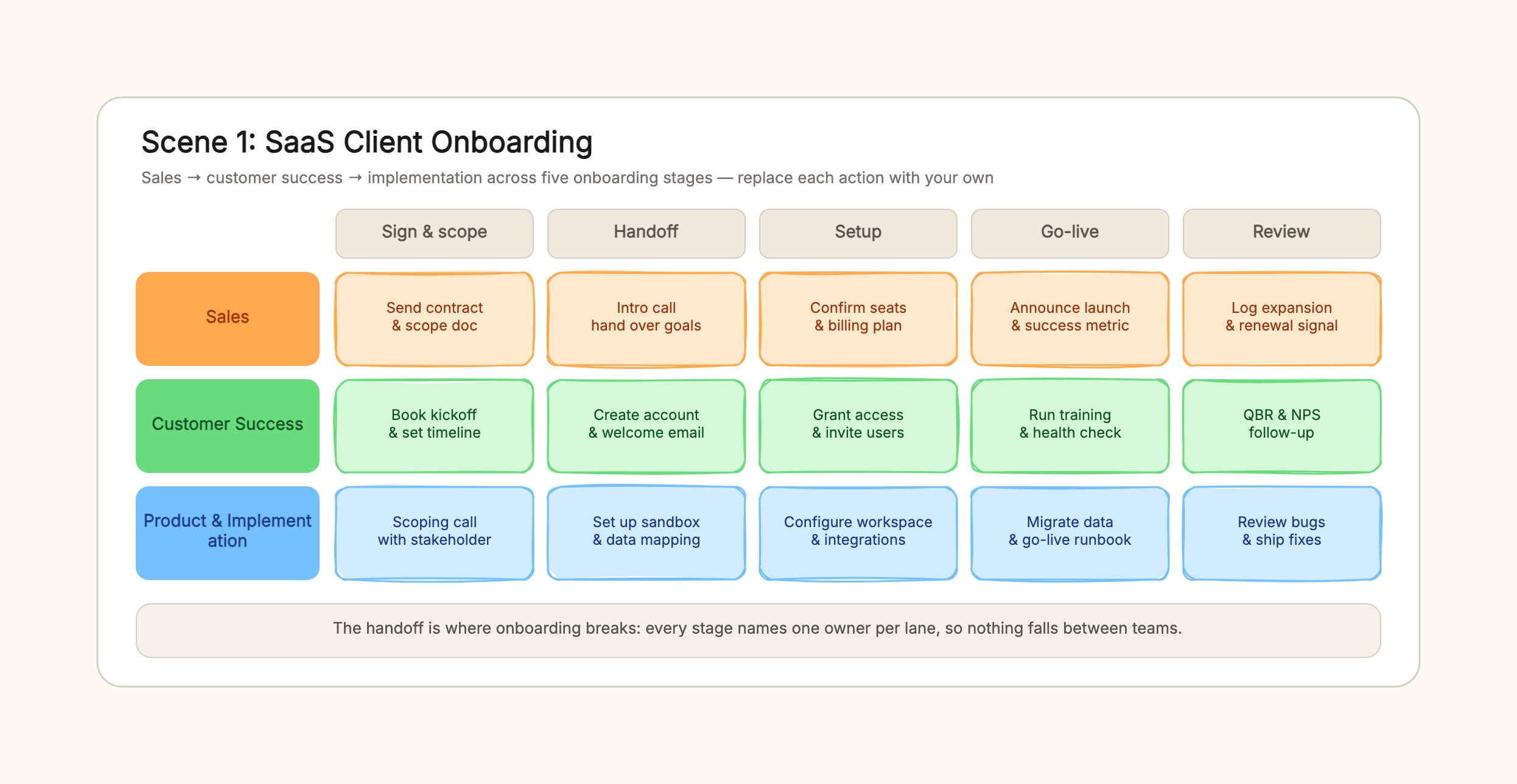
SaaS startup onboarding
Who uses it: A founder or product manager onboarding a new software customer
Sales — send contract, intro call, confirm seats
Customer success — book kickoff, create account, run training
Product — scoping call, sandbox, data migration
Go-live — launch announcement and success metric
Review — QBR, NPS, and renewal signal
Why this works: Three lanes keep the commercial, relationship, and technical work separate so a new customer never waits on a founder who is doing all three at once.
Accounting firm client intake
Who uses it: An account manager at an accounting firm taking on a new bookkeeping client
Partner — engagement letter, fee agreement, handoff
Account manager — kickoff, collect docs, welcome email
Bookkeeping team — scope work, import ledger, reconcile
First close — confirm data in, draft statements
Review — check-in call and billing review
Why this works: The stages follow the work a client actually waits on: paperwork first, then access to books and bank feeds, then a first close. Each lane owns its slice.
MSP client cutover
Who uses it: A service desk lead onboarding a new managed-services client
Sales — service agreement, SLA terms, handoff call
Service desk — open portal, create accounts, welcome pack
Engineers — discovery, network map, deploy agents
Go-live — cutover, monitoring, first-response runbook
Review — ticket review and satisfaction survey
Why this works: An MSP onboarding is a handoff of access and runbooks. Splitting sales, desk, and engineers makes sure credentials, agents, and SLAs each have an owner.
Freelancer client kickoff
Who uses it: A freelance designer or writer onboarding a new client
Scope — proposal, deposit, kickoff call
Access — brand files, logins, content folder
Setup — tools, templates, review cadence
First deliverable — draft and feedback loop
Review — wrap-up and referral ask
Why this works: A solo freelancer collapses the lanes into phases, but the logic is the same: scope, access, setup, first deliverable, and review, each with one owner.
Student club member onboarding
Who uses it: A student team lead onboarding new club members
Recruit — intro chat and role match
Access — group chat, shared drive, calendar
Setup — tools, first task, mentor pairing
First contribution — one small task done
Review — check-in and next project
Why this works: Even a volunteer team needs a handoff so new members reach a first contribution fast instead of waiting for someone to assign them work.
Agency account onboarding
Who uses it: An agency producer onboarding a new retainer account
Account — contract, kickoff, stakeholder map
Operations — access, shared folder, billing
Delivery team — brief, tools, first sprint
First review — draft, feedback, approval loop
Quarterly — retrospective and scope check
Why this works: An agency adds a delivery lane between account and operations so a new retainer starts producing work instead of stalling in kickoff meetings.