Back to template

CI/CD Pipeline Examples

These CI/CD examples show how different teams structure build, test, approval, deployment, and monitoring stages. Use them as references when designing or documenting your own delivery workflow.

CI/CD Pipeline Examples

Real examples

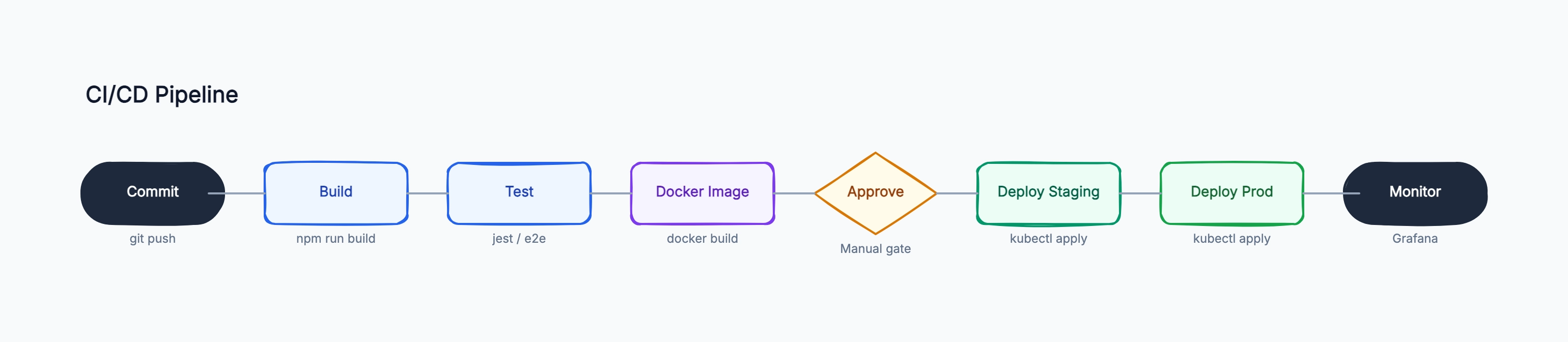
Kubernetes microservice deployment

Who uses it: Platform engineer standardizing service delivery

Trigger: merge to main
Build: compile service and run static checks
Test: unit tests, contract tests, e2e smoke tests
Package: Docker build → image registry
Deploy: Helm/Kustomize to staging, then production
Monitor: Grafana alerts, error budget burn, rollback decision

Why this works: Separating image creation from deployment clarifies which stage produces the artifact and which stage promotes it. That separation is essential for reproducible releases.

Frontend web app pipeline

Who uses it: Frontend team deploying a Next.js or React application

Pull request: lint, type-check, unit tests
Preview deployment for every PR
Merge to main: production build + bundle size check
Deploy to CDN/edge platform
Post-deploy: Lighthouse smoke test and error monitoring

Why this works: Frontend pipelines often need preview environments earlier than backend pipelines. Showing preview deployment as a first-class stage helps product and design teams review changes before merge.

Mobile app release pipeline

Who uses it: Mobile team coordinating store releases

Commit → Build iOS/Android artifacts
Automated tests: unit, UI, screenshot regression
Internal distribution: TestFlight / Play Internal Testing
Manual QA approval gate
Store submission and phased rollout
Crash monitoring and rollback/hotfix branch

Why this works: Mobile releases have external store review and phased rollout constraints. A diagram makes those constraints visible so stakeholders do not treat mobile deployment like a web deploy.

Monorepo CI pipeline

Who uses it: Engineering manager reducing CI time in a large repository

Change detection: identify affected packages
Parallel build and test jobs by package
Shared cache for dependencies and artifacts
Integration tests only for affected service graph
Deploy changed services independently

Why this works: The key decision in a monorepo pipeline is affected-project detection. Visualizing it prevents every change from triggering every job, which keeps CI fast as the repository grows.

Tips for better study mind maps

  • Show the artifact handoff clearly: source code becomes a build artifact, then an image, then a deployment.
  • Mark manual gates explicitly so teams can decide which ones are still necessary.
  • Include monitoring after deployment; a pipeline that ends at deploy misses the operational feedback loop.
  • Use labels on arrows for commands or tools such as npm, Docker, Helm, kubectl, or Terraform.

Start editing online

Go back to the template, swap in your own topics, and keep the same structure if it fits your class or project.

Use this template: /editor/new?template=cicd

Use this CI/CD pipeline template