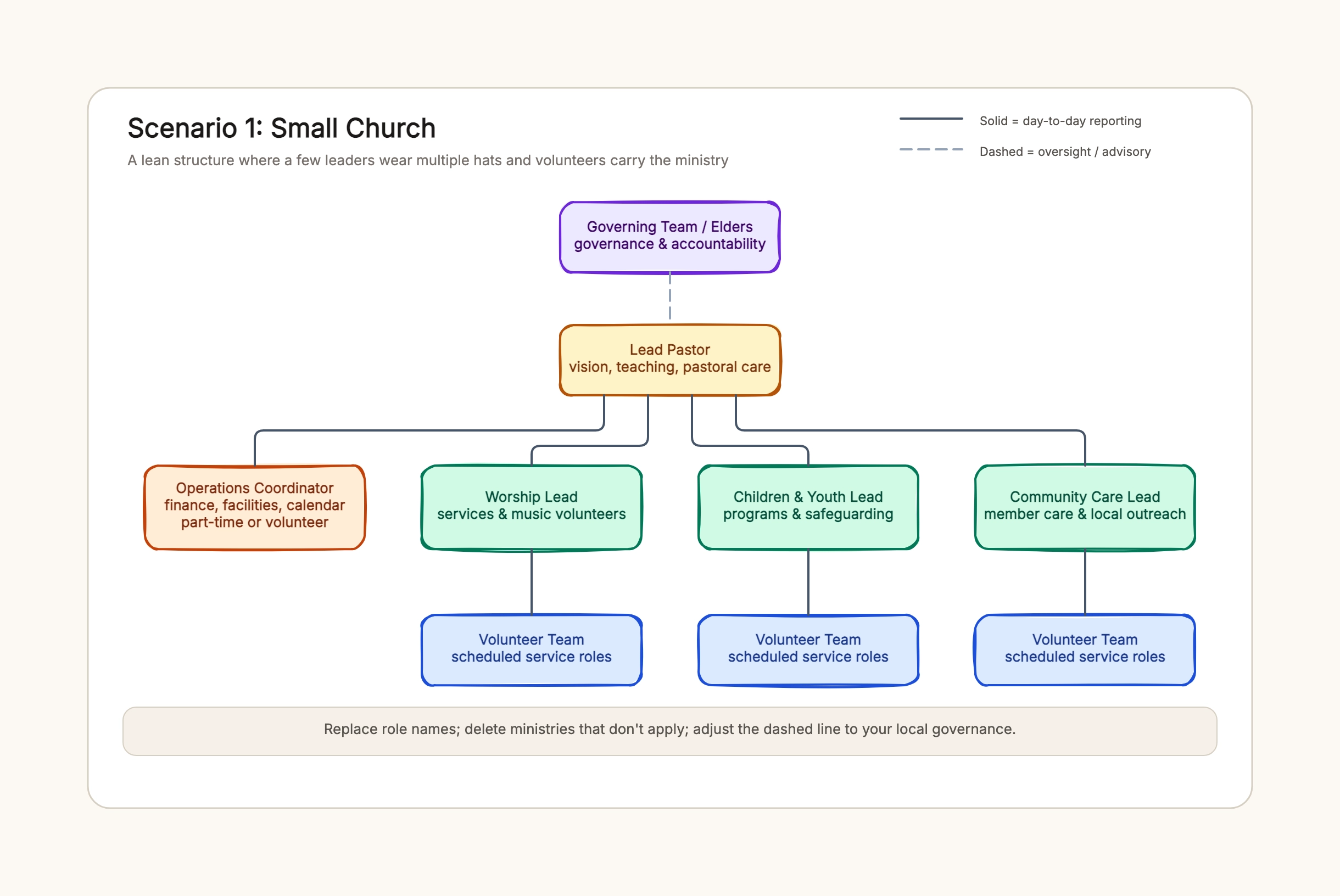
Newly planted small church
Who uses it: A church planter documenting the founding leadership team
Governing Team / Elders
|- - - oversight - - -> Lead Pastor
|- Operations Coordinator (part-time or volunteer)
|- Worship Lead
|- Children & Youth Lead
|- Community Care Lead
Why this works: A shallow structure with shared roles shows founding teams that most leaders cover more than one area, so nobody waits for a dedicated hire before ministry starts.
Volunteer-led church
Who uses it: A lay leadership team with no full-time staff
Elders / Leadership Team
|- Lead Pastor (bi-vocational)
|- Worship Team
| |- Music, AV, scheduling
|- Kids & Families Team
|- Outreach & Hospitality Team
|- Operations Team (finance, facilities)
Why this works: When no one is full-time, the chart shows teams rather than titles, so the structure stays honest about who actually does the work each week.
Growing church with ministry and operations tracks
Who uses it: A staff team formalizing two director-level tracks
Governing Board / Elders
|- - - oversight - - -> Senior Pastor
|- Ministry Director
| |- Worship
| |- Children
| |- Youth
| |- Groups & Care
|- Operations Director
| |- Finance & Administration
| |- Communications
| |- Facilities & Safety
Why this works: Splitting pastoral ministry from administration is the clearest signal a church has moved past its founding stage — each director owns a track, and the senior pastor leads the staff instead of running both.
Multi-ministry church with volunteer coordinators
Who uses it: An executive pastor coordinating several ministry branches
Governance Council
|- - - oversight - - -> Lead Pastor
|- Pastoral Team
| |- Teaching & Formation
| |- Care & Counseling
|- Ministry Team
| |- Worship & Production
| |- Children & Youth
| |- Community Outreach
|- Operations Team
| |- Finance & HR
| |- Communications
| |- Facilities & Safety
|- Volunteer Coordinators (dashed to each ministry branch)
Why this works: At this scale the chart keeps the main hierarchy to three levels and attaches volunteer coordinators with dashed lines, so volunteers are visible without bloating the reporting tree.
Leadership transition
Who uses it: An elder board handing the church to a new pastor
Elders / Board
|- - - oversight - - -> (incoming) Lead Pastor
|- Pastoral Staff (unchanged)
|- Ministry Leads (unchanged)
|- Operations / Admin (unchanged)
|- note: interim responsibilities during handover
Why this works: Documenting the structure before a handover gives both the outgoing and incoming pastor the same picture, so the transition changes a name rather than a whole organizational design.
Community outreach project team
Who uses it: An outreach leader coordinating a temporary initiative
Lead Pastor (sponsor)
|- Outreach Lead
| |- Food & Care Team
| |- Local Partners (dashed)
| |- Event Volunteers
|- Church Administration (dashed support)
Why this works: Project teams flatten the hierarchy for a season: the outreach lead reports to the pastor while the supporting teams and partners connect with dashed lines, so the initiative stays separate from the standing org chart.