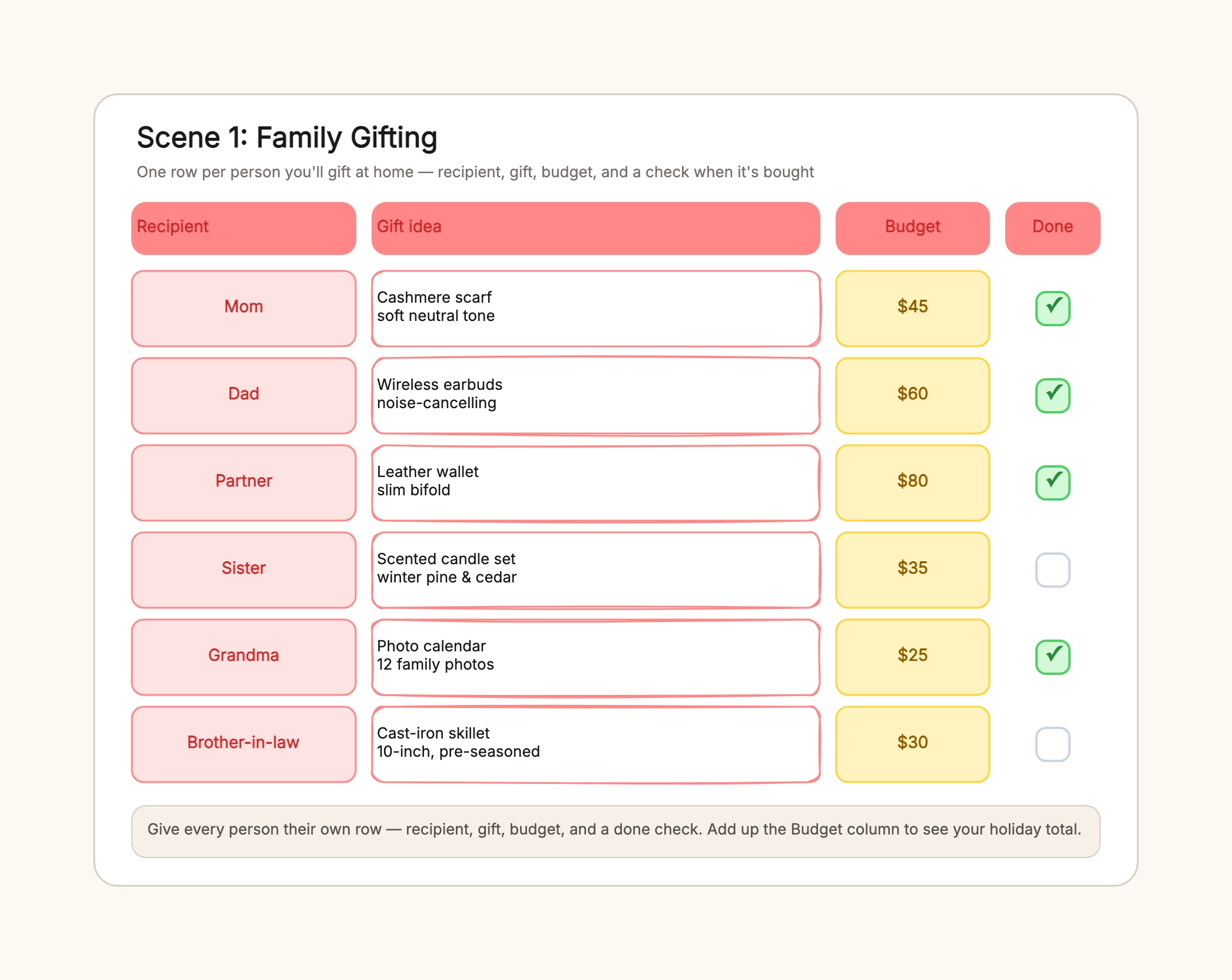
First family Christmas list
Who uses it: A new parent or partner organizing the household gifts
Mom — cashmere scarf — $45 — done
Dad — wireless earbuds — $60 — done
Partner — leather wallet — $80 — done
Sister — scented candle set — $35 — to buy
Grandma — photo calendar — $25 — done
Why this works: One row per person keeps the household gifts separated, and the budget column adds up to the family's holiday total.
Office secret santa exchange
Who uses it: A team lead or office manager running the swap
Secret santa pick — desk plant — $20 — done
White elephant — funny mug set — $15 — done
Team lead — gourmet coffee — $25 — done
New intern — notebook set — $18 — to buy
Admin staff — coffee gift card — $20 — to buy
Why this works: Every row stays under the price cap, so the exchange is fair. The done box shows who has already been bought for.
Gifts for kids by age
Who uses it: A parent or grandparent buying for several children
Emma (6) — LEGO set — $40 — done
Liam (9) — board game — $30 — done
Sophie (3) — plush teddy bear — $20 — done
Noah (12) — wireless headphones — $50 — to buy
Mia (5) — art supply kit — $25 — done
Why this works: Adding age to each row makes the list match the child — a six-year-old and a twelve-year-old get different gifts.
Large extended-family list
Who uses it: Someone buying for aunts, uncles, and cousins
Aunt — gourmet coffee — $25 — done
Uncle — cast-iron skillet — $30 — to buy
Cousin (adult) — scented candle — $20 — done
Cousin (kid) — board game — $25 — done
Grandma — photo calendar — $25 — done
Why this works: A bigger list still stays readable because each row is one person. The budget column stops the total from drifting.
Couple's shared gift list
Who uses it: A couple splitting the buying and wrapping
His parents — photo calendar — $25 — done
Her parents — gourmet coffee — $30 — done
Best friend — candle set — $20 — to buy
Neighbor — cookie tin — $12 — done
Dog walker — gift card — $20 — to buy
Why this works: A shared list lets two people buy without doubling up. The done box shows who has already been covered.
Budget-first Christmas list
Who uses it: Someone with a fixed total and many people to cover
Total budget — $300
Partner — leather wallet — $80
Two kids — $45 and $50
Four extended family — $20 each
Buffer for wrapping and cards — $25
Why this works: Start from the total, split it across recipients, and keep a buffer. The budget column turns the wishlist into a plan.