Back to template

Camping Checklist Examples

These camping checklist examples cover the trips people actually take — a first car trip, a weekend tent trip, a family trip with kids, a backpacking overnighter, an RV road trip, and a team offsite. Pick the one closest to your trip and adjust the zones and gear.

Camping Checklist Examples

Real examples

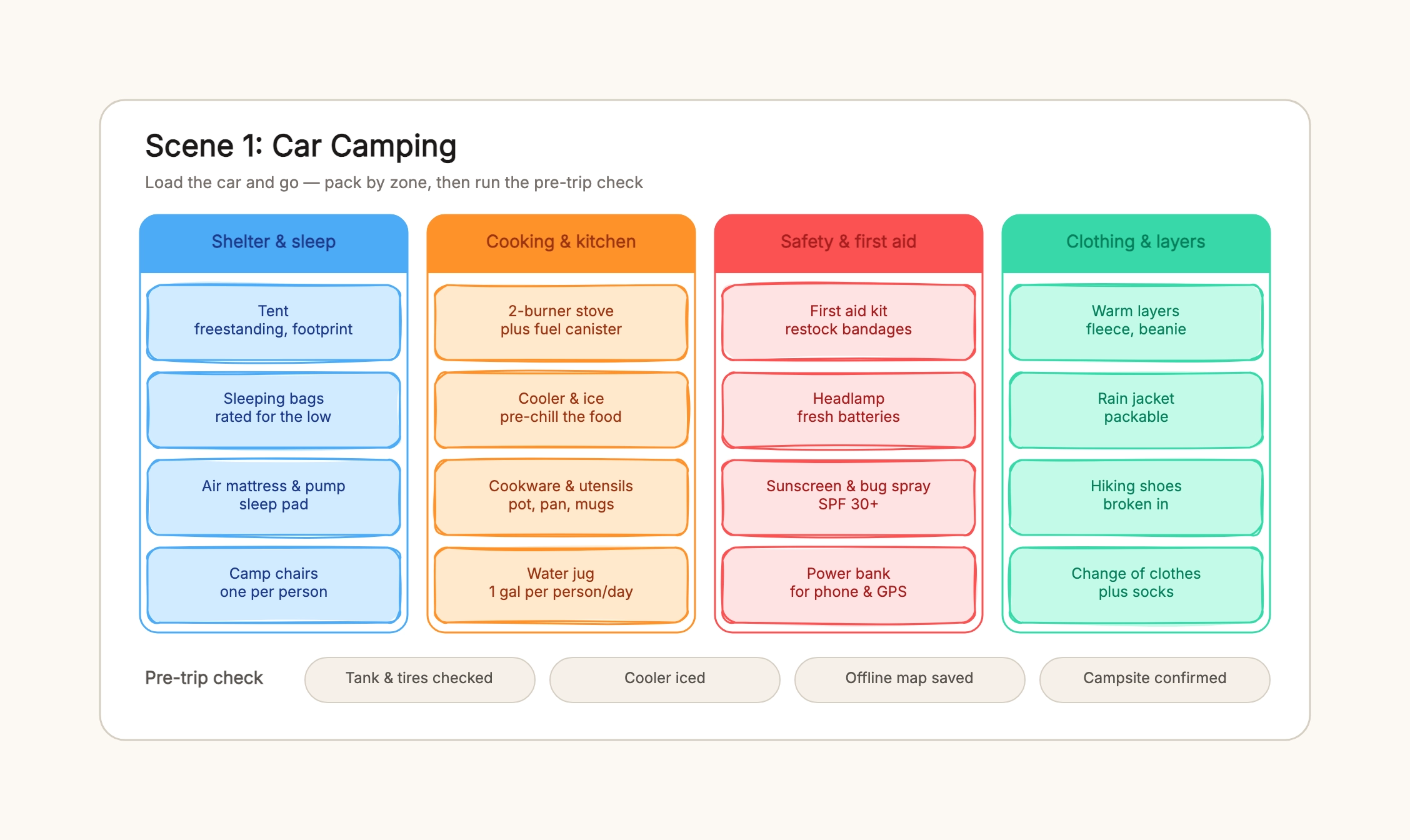
First car camping trip

Who uses it: A student or young professional camping for the first time

Shelter — tent, sleeping bag, air mattress, camp chairs
Cooking — 2-burner stove, cooler, cookware, water jug
Safety — first aid kit, headlamp, sunscreen, power bank
Clothing — warm layers, rain jacket, hiking shoes, spare socks

Why this works: A first car trip keeps the four zones complete but roomy. The car carries the comfort gear, so the list focuses on not leaving a zone empty.

Weekend tent camping

Who uses it: A working adult slipping away for a two-night weekend

Shelter — lightweight tent, sleeping bag, foam pad
Cooking — single-burner stove, nested pot, water filter
Safety — trail first aid kit, headlamp, map & compass
Clothing — quick-dry base, insulation, waterproof shell, extra socks

Why this works: A weekend tent trip trims each zone to what fits in a pack, so the list is lighter without losing any of the four zones.

Family camping with kids

Who uses it: A parent or family camping with children

Shelter — tent, sleeping bags per person, camp chairs, extra blankets
Cooking — stove, cooler, cookware, water, kids' snacks
Safety — first aid kit, headlamps, sunscreen & bug spray
Clothing — layers per person, rain gear, change of clothes, spare socks

Why this works: Kids add a per-person factor to every zone. The list keeps the four zones but scales quantities, and adds snacks and spare clothes so a wet afternoon does not end the trip.

Backpacking overnighter

Who uses it: A student or outdoor enthusiast hiking in to camp

Shelter — ultralight tent, sleeping bag, foam pad, tarp
Cooking — single-burner stove, fuel, nested pot, water filter
Safety — trail first aid kit, headlamp, map & compass, whistle
Clothing — quick-dry base, insulation, waterproof shell, wool socks

Why this works: A backpacking trip is the lightest version of the four zones. Every item earns its weight, but the zone structure stays the same so nothing critical is dropped.

RV road trip

Who uses it: A product manager or team lead planning a multi-stop trip

Vehicle — fresh water, waste tanks, tires, hookups
Shelter — RV bedding, awning, table & chairs, blankets
Cooking — RV stove, fridge, cookware, water hose
Safety — first aid kit, fire extinguisher, toolkit, flashlight

Why this works: An RV trip checks the vehicle as a system first, then the four zones. The vehicle checks are the part a gear list usually misses.

Team camping offsite

Who uses it: A creator or organizer coordinating a group trip

Per person — sleeping bag, pad, headlamp, layers
Shared cooking — stove, fuel, cookware, coolers, water
Shared safety — first aid kit, sunscreen, bug spray
Pre-trip — confirm campsite, headcount, food plan

Why this works: A group trip splits gear into per-person and shared piles so the organizer is not the only one who knows what is coming. The pre-trip check adds a headcount and food plan.

Tips for a zone-by-zone camping checklist

  • Pack by zone, not by store — each bag or bin should be complete on its own.
  • Run the pre-trip check before you load, not after the car is full.
  • Restock the first aid kit after every trip, not just before the next one.
  • Keep the list after the trip and note what stayed unused to trim next time.
  • For group trips, split gear into per-person and shared piles so nothing is double-packed.

Related resources

Start editing online

Go back to the template, swap in your own content, and keep the same structure if it fits your project.

Use this template: /editor/new?template=camping-checklist

Use this template