Back to template

Business Model Canvas Examples

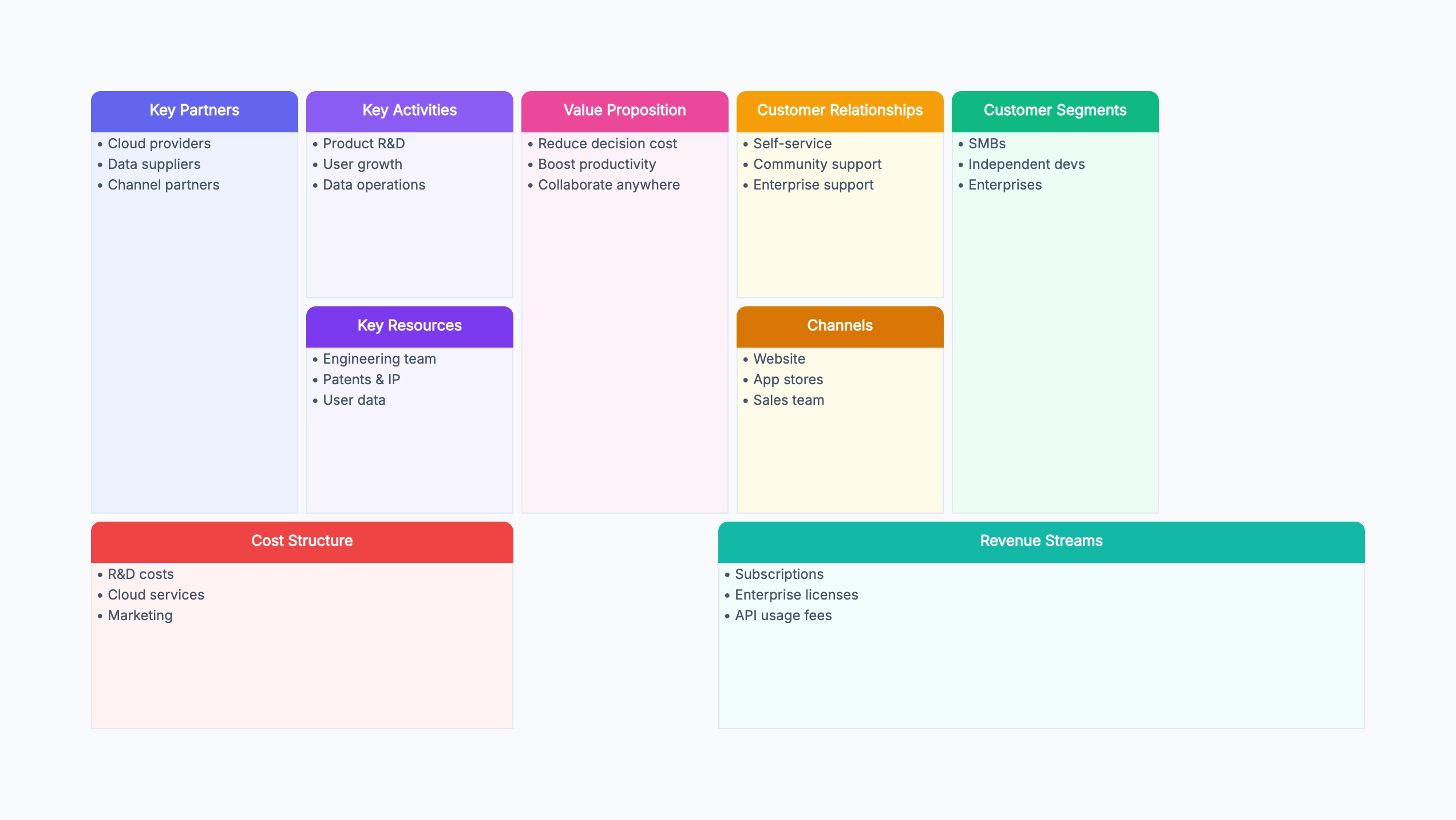
These business model canvas examples show how different organizations map their value creation, delivery, and capture across nine building blocks. Use them as reference when filling in your own canvas — the goal is clarity, not perfection.

Business Model Canvas Examples

Real examples

B2B SaaS subscription tool

Who uses it: Founding team preparing for a seed round pitch

Segments: project managers, ops teams at 10–200 person companies
Value Prop: real-time dashboards that replace weekly status meetings
Channels: PLG via free tier, LinkedIn ads, integration marketplace
Revenue: freemium → $15/user/mo pro → $40/user/mo enterprise
Cost: engineering (60%), cloud infra (15%), sales (25%)

Why this works: Mapping the freemium funnel explicitly in Revenue Streams helped the team see that the free-to-paid conversion rate was the single most important metric to optimize.

Two-sided marketplace

Who uses it: Product team designing a freelance platform

Segments: freelancers (supply) + small businesses (demand)
Value Prop: vetted talent on day 1; milestone-based escrow for trust
Channels: SEO, referral program, LinkedIn outreach
Revenue: 15% take rate on completed projects
Cost: trust & safety, payment processing, customer support

Why this works: Two-sided businesses often need to map both sides of the canvas separately in the Customer Segments and Value Proposition blocks. The take rate model made unit economics easy to model for investors.

Direct-to-consumer e-commerce brand

Who uses it: Founder launching a sustainable products brand

Segments: eco-conscious consumers aged 25–40
Value Prop: carbon-neutral products with transparent supply chain
Channels: Instagram/TikTok ads, influencer partnerships, own website
Revenue: product sales + subscription refill box
Cost: COGS (45%), paid social (30%), fulfillment (15%), overhead (10%)

Why this works: The canvas made the high COGS-to-revenue ratio immediately visible. The subscription refill box was added after seeing that one-time purchase margins alone were unsustainable.

Nonprofit education organization

Who uses it: Executive director preparing an annual strategy review

Segments: underserved students (beneficiaries) + donors/grants (funders)
Value Prop: free coding bootcamp with job placement support
Channels: community partners, social media, school referrals
Revenue: government grants, corporate sponsors, alumni donations
Cost: instructors, curriculum, facilities, outreach

Why this works: Nonprofits benefit from the canvas as much as startups. Mapping funders separately from beneficiaries in Customer Segments revealed a misalignment — funders wanted job placement metrics that the team hadn't been tracking.

Mobile consumer app

Who uses it: Indie developer planning a monetization strategy

Segments: daily commuters + students looking for focus tools
Value Prop: ambient focus music with session tracking and streaks
Channels: App Store optimization, Reddit communities, productivity blogs
Revenue: freemium ($0) → premium ($4.99/mo) → lifetime ($49)
Cost: development, server costs (minimal), app store fee (30%)

Why this works: The lifetime deal option was added after the canvas revealed that a $4.99/mo subscription had poor perceived value for a single-purpose app. Lifetime pricing converted 3× better.

Consulting and professional services firm

Who uses it: Agency founder formalizing the business model after 3 years of operation

Segments: Series A–B startups needing fractional CMO support
Value Prop: senior marketing strategy without full-time hire cost
Channels: founder network referrals, LinkedIn thought leadership
Revenue: monthly retainer + success fee on funded campaigns
Cost: consultant salaries (70%), tools and software (10%), overhead (20%)

Why this works: Filling in the canvas for the first time revealed that 80% of revenue came from three clients. The Key Partners block was empty — which explained the lack of referral pipeline.

Tips for better study mind maps

  • Fill in Customer Segments and Value Proposition first — every other block should connect back to these two.
  • An empty block is diagnostic: if Key Partnerships is blank, ask whether you are missing critical suppliers, distributors, or co-marketing relationships.
  • Revenue Streams and Cost Structure should be reviewed together — if costs exceed realistic revenue projections, the model needs revision before you build.
  • A business model canvas is a hypothesis, not a plan. Revisit it after every major pivot, fundraise, or significant market shift.

Start editing online

Go back to the template, swap in your own topics, and keep the same structure if it fits your class or project.

Use this template: /editor/new?template=business-model-canvas

Use this business model canvas template