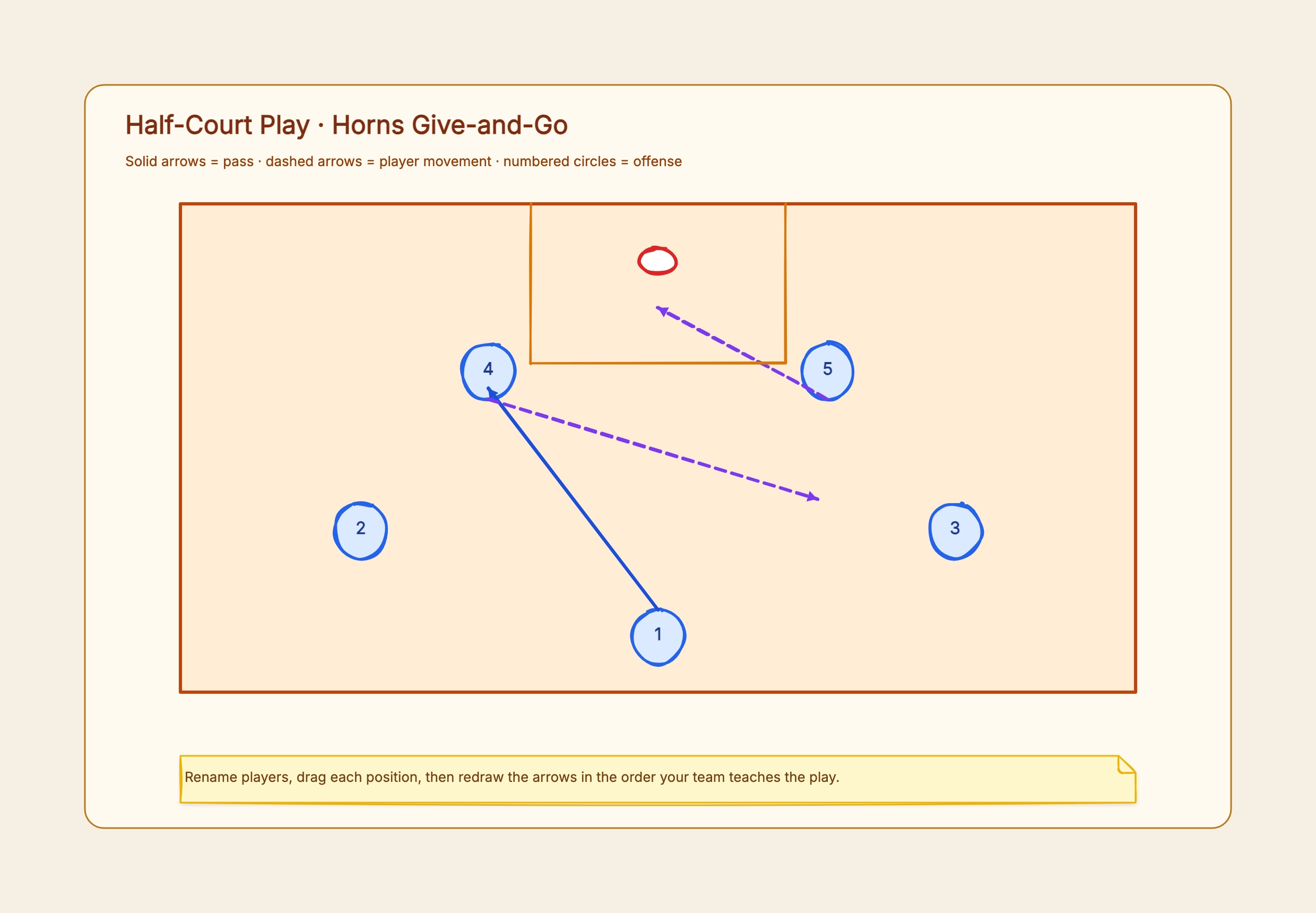
Horns entry
Who uses it: A coach installing a half-court set
Two players at the elbows
Two players spaced in the corners
Ball handler enters to an elbow
Passer cuts or screens away
Why this works: The spacing is visible before the arrows, making the first decision easy to teach.
Sideline inbound
Who uses it: A team preparing an after-timeout play
Inbounder outside the boundary
Four players in a high alignment
Screen angle marked
First read and safety outlet
Why this works: Only two routes are emphasized so the scoring option does not disappear in a web of counters.
1-2-1-1 press break
Who uses it: A youth team learning outlet spacing
Inbounder below the baseline
Two wide outlets
Middle flash
Deep receiver
Pass windows shown in order
Why this works: The diagram prioritizes available passing triangles rather than pretending to prescribe exact running distance.
Zone overload
Who uses it: A team attacking a 2-3 zone
Ball on the wing
Short-corner runner
High-post flash
Weak-side skip option
Why this works: One colored area can mark the overload side while numbered players preserve positional clarity.
Transition lanes
Who uses it: A coach teaching fast-break spacing
Rim runner
Two wide lanes
Ball in middle lane
Trailer behind the play
Why this works: A full-court layout makes width and depth easier to see than a list of running assignments.
Defensive rotation
Who uses it: A team reviewing help responsibilities
Ball-side pressure
Low help
Nail help
Weak-side split
Closeout path
Why this works: Using one defender color and one rotation at a time keeps the diagram readable.