Back to template

AI Application Architecture Diagram Examples

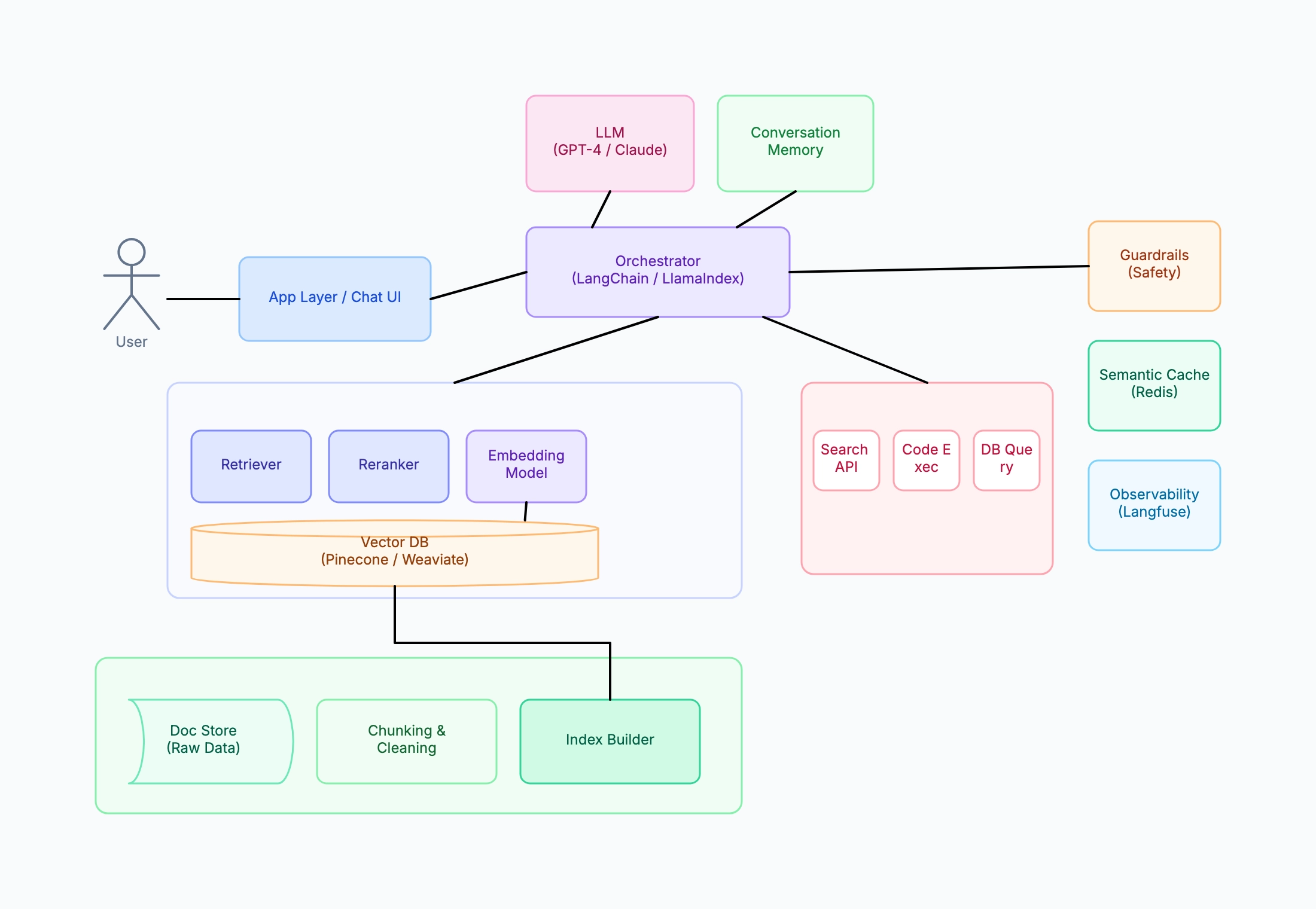
These AI architecture examples show how teams design different types of LLM-powered systems using the same core building blocks — orchestrator, LLM, vector store, and tools — assembled in different configurations for different use cases.

AI Application Architecture Diagram Examples

Real examples

Enterprise document Q&A system (RAG)

Who uses it: ML engineer building an internal knowledge base chatbot

Ingest: SharePoint / Confluence → chunker (512 tokens, 50 overlap) → embedding → Weaviate
Query path: user query → embedding → vector search (top-20) → reranker (top-5) → GPT-4
Orchestrator: LangChain with conversation history in PostgreSQL
Guardrails: PII detection on input, citation check on output
Cache: exact-match Redis + semantic similarity cache for repeated questions
Observability: Langfuse for LLM call tracing, cost tracking per department

Why this works: Enterprise RAG systems need the full stack — guardrails catch sensitive data before it reaches the LLM, the reranker improves precision when the document corpus is large and noisy, and per-department cost tracking justifies the infrastructure spend.

Coding assistant with tool use

Who uses it: Developer tools startup building a code review and generation assistant

Orchestrator: LlamaIndex ReAct agent with multi-step reasoning
LLM: Claude 3.5 Sonnet for code generation, smaller model for intent classification
Tools: GitHub API (PR diff, file tree), code execution sandbox, web search
Memory: short-term (current PR context) + long-term (user preferences, past reviews)
Vector DB: code embeddings for codebase context retrieval
No reranker — code context retrieval is handled by AST-aware chunking

Why this works: Coding assistants benefit from a ReAct agent loop because a single code generation task often requires multiple tool calls — fetch the file, understand the diff, look up relevant tests — before the LLM can produce a useful response.

Multi-agent research pipeline

Who uses it: AI researcher automating literature review and synthesis

Supervisor agent: breaks research question into sub-tasks
Search agent: queries arXiv API and semantic scholar
Read agent: extracts key claims from PDFs via RAG
Write agent: synthesizes findings into structured report
Shared vector store: all retrieved papers indexed for cross-agent retrieval
Human-in-the-loop: approval gate before write agent runs

Why this works: Multi-agent diagrams help reviewers understand which agent is responsible for which failure mode — if the output is factually wrong, was it the search agent retrieving bad sources or the write agent hallucinating a synthesis?

Student learning assistant

Who uses it: EdTech startup or computer science student building a study companion

Simple RAG: course syllabus + lecture notes → embedding → ChromaDB
Orchestrator: LangChain ConversationChain (no agent tools needed)
LLM: GPT-3.5-turbo (lower cost for student budget)
Memory: sliding window of last 10 messages
No reranker, no guardrails (single-user, trusted corpus)
Logging: simple text file for debugging, no paid observability

Why this works: A student project doesn't need the full enterprise stack — showing a stripped-down version makes it clear which components are essential (LLM, vector store, orchestrator) and which are production concerns that can be added later.

Tips for better study mind maps

  • Draw the user request path first (left to right or top to bottom), then add cross-cutting concerns at the edges.
  • Separate the RAG pipeline from the agent tool layer — they serve different purposes even if both are coordinated by the orchestrator.
  • Show the data ingestion pipeline as a separate offline flow to distinguish it from the real-time query path.
  • Add the semantic cache between the user and the orchestrator to show that it short-circuits the LLM call when a match is found.

Start editing online

Go back to the template, swap in your own topics, and keep the same structure if it fits your class or project.

Use this template: /editor/new?template=ai-pipeline

Edit this AI architecture template